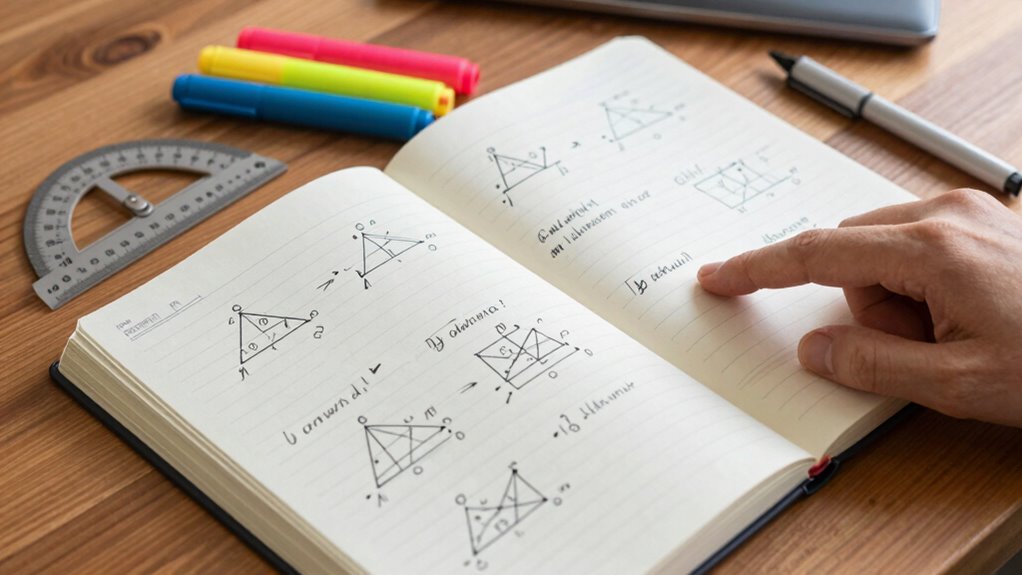

To avoid getting lost, focus on the visual clues in the diagram, like labels, markings, and highlighted areas, which reveal key relationships. Break the proof into manageable steps, verifying each one before moving on. Redraw confusing diagrams for clarity and follow the logical flow indicated by keywords like “because” or “therefore.” Developing your ability to see how each step connects will make the process smoother. Keep exploring, and you’ll discover even more ways to master the proof.

Prime made for students and young adults
- Fast, free delivery for dorm and study essentials
- Prime Video and Amazon Music included
- Member-only deals
Key Takeaways
- Break down the proof into small, manageable steps to follow the logical flow easily.
- Use diagrams to visualize relationships and clarify confusing parts.
- Focus on reasoning keywords like “because” and “therefore” to understand connections.
- Redraw or highlight diagrams to emphasize key components and relationships.
- Verify each step’s support before progressing to maintain coherence and avoid confusion.
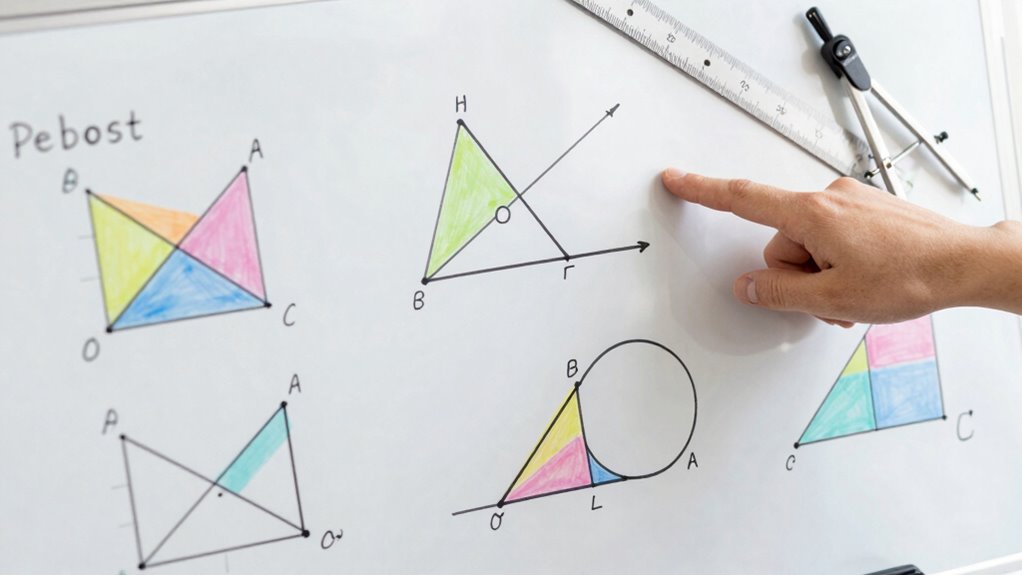
Have you ever struggled to understand a geometry proof? If so, you’re not alone. Many students find proofs confusing because they jump from one idea to another without clear connections. To make sense of a proof, you need to focus on two key aspects: visual organization and logical flow. These elements act as your guide, helping you follow the reasoning step by step without feeling overwhelmed.
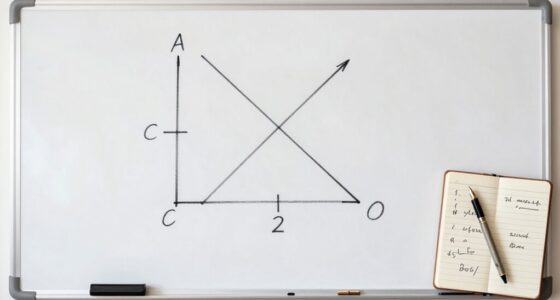
Start by examining the visual organization of the proof. Most geometry proofs are written with diagrams that illustrate the relationships between figures, angles, and segments. Pay close attention to these diagrams—they often highlight the key points and make abstract concepts more concrete. Look for labels, markings, and any highlighted areas that show congruent parts or parallel lines. Visual cues help you see how different components of the proof connect, which is especially useful when you’re trying to understand why a certain statement is true. If the diagram isn’t clear, take a moment to redraw it. A neat, accurate sketch can clarify confusing parts and reinforce your understanding. Recognizing geometric relationships within the diagram can further enhance your comprehension.
Next, focus on the logical flow of the proof. Each step should follow naturally from the previous one, building toward the conclusion. As you read, ask yourself: Is this statement supported by a reason or a previous step? If not, pause and identify what justifies this move. Recognizing the logical flow is like following a trail of breadcrumbs—each step leads you closer to the final goal. Use the structure of the proof to your advantage: look for keywords like “because,” “therefore,” or “since,” which indicate reasoning links. When you see these, pause to confirm that the connection makes sense. If a step seems confusing, go back and verify the prior statements or the diagram to see how they support it. Developing critical reasoning skills can greatly improve your ability to analyze and understand proofs more effectively.
geometry proof diagram redraw tools
As an affiliate, we earn on qualifying purchases.
As an affiliate, we earn on qualifying purchases.
Frequently Asked Questions
How Can I Identify Main Theorems in a Proof?
You can identify main theorems in a proof by looking for visual cues like highlighted or boxed statements, which often emphasize key points. Pay attention to the logical flow—main theorems usually serve as pivotal steps connecting different parts of the proof. They often appear after definitions or lemmas, acting as foundational results that support the subsequent reasoning. Recognizing these cues helps you grasp the proof’s core ideas more easily.
What Symbols Are Most Important to Understand?
You should focus on symbols like equal signs (=), congruence (≅), and arrows (→) to understand the flow and relationships. Recognize notation clarity in symbols such as ∠ (angle), ⊥ (perpendicular), and ∼ (similarity). Symbol recognition helps you follow logical steps more easily, making it clearer how each statement connects. Mastering these symbols allows you to read proofs more confidently and avoid getting lost.
How Do I Approach Complex, Multi-Step Proofs?
Practice patience, pinpoint patterns, and parse proofs step-by-step. When tackling complex, multi-step proofs, you should visualize the vision and follow the logical flow. Use visualization techniques to see the structure clearly, breaking down each step into manageable parts. Focus on understanding how each conclusion connects to the next, and don’t rush—approach with curiosity and confidence, allowing the logical flow to guide you smoothly through the proof.
What Should I Do if I Don’t Understand a Step?
If you don’t understand a step, look for visual cues and contextual clues around it. Pause and re-examine the diagram, paying attention to labels and markings that highlight what’s being used. Reread the previous steps to see how they connect, and don’t hesitate to write out explanations in your own words. These strategies help clarify the logic, making it easier to follow and understand complex proofs.
How Can I Improve My Overall Proof-Reading Skills?
To improve your proof-reading skills, focus on visualization techniques and proof organization. Visualize each step to better understand the logic, and break the proof into clear, organized sections. Practice regularly by reviewing and summarizing proofs in your own words. This helps you identify errors and follow the flow more easily. Over time, these habits strengthen your ability to spot mistakes and grasp complex geometric arguments confidently.
As an affiliate, we earn on qualifying purchases.
Conclusion
So, now that you’ve mastered reading geometry proofs without losing your mind, go forth and impress your friends with your newfound math prowess. Just remember, if you ever feel overwhelmed, blame it on the “complexity of geometry” — it’s a classic escape plan. Keep practicing, stay patient, and soon you’ll be the one confidently deciphering proofs while others are still stuck on their homework. Geometry? More like geome-try not to get lost!
geometry proof step-by-step guide book
As an affiliate, we earn on qualifying purchases.
As an affiliate, we earn on qualifying purchases.
As an affiliate, we earn on qualifying purchases.
Halloween Picks
halloween
As an affiliate, we earn on qualifying purchases.