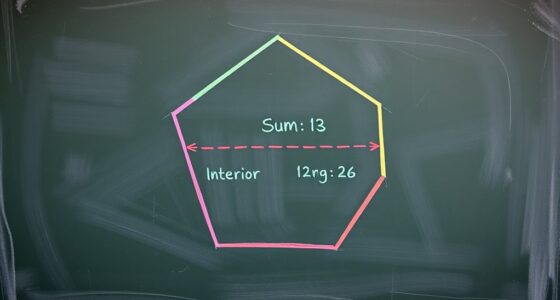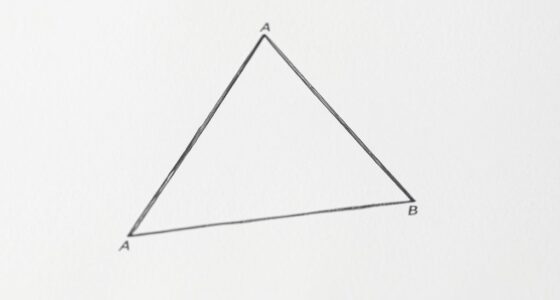

In geometric reasoning, contradictions happen when your assumptions or logical steps clash with foundational axioms, like the parallel postulate. If you reach a situation that’s impossible—such as a line both intersecting and being parallel—you’ve identified a conflict. This signals that something’s off in your reasoning or assumptions. Recognizing how contradictions reveal these conflicts can help you understand the importance of axioms and improve your geometric arguments. Keep exploring to uncover more insights.

Prime made for students and young adults
- Fast, free delivery for dorm and study essentials
- Prime Video and Amazon Music included
- Member-only deals
Key Takeaways
- Contradictions occur when logical steps in a geometric proof lead to mutually exclusive statements.
- They indicate that assumptions or axioms conflict with each other or with established principles.
- Detecting contradictions helps identify errors or invalid reasoning in geometric arguments.
- In geometric reasoning, contradictions reveal inconsistencies in the application of axioms like the Parallel Postulate.
- Resolving contradictions often involves re-evaluating initial assumptions to maintain logical consistency.
Have you ever encountered a situation in geometric reasoning where your logical steps lead to a contradiction? It can be frustrating, especially when you believe your assumptions are solid. In geometry, contradictions often reveal that something in your reasoning or assumptions is flawed. To understand how this works, you need to consider the foundational principles that guide your logical deductions—specifically, Euclidean axioms and the Parallel postulate.
Euclidean axioms serve as the basic building blocks of classical geometry. They are self-evident truths that you accept without proof, such as “a straight line can be drawn between any two points” or “all right angles are equal.” These axioms set the stage for your entire reasoning process. When you follow them strictly, your deductions tend to be consistent, but only if your assumptions are correct. If you introduce an assumption that conflicts with these axioms, you risk creating a contradiction. For example, assuming that two lines that are cut by a transversal are both parallel and intersecting at some point would contradict the Euclidean axioms.
The Parallel postulate is especially significant because it distinguishes Euclidean geometry from non-Euclidean geometries. In Euclidean geometry, the Parallel postulate states that given a line and a point not on that line, there is exactly one line through that point parallel to the original line. If you attempt to challenge or modify this postulate, you venture into non-Euclidean territory, where the nature of parallel lines changes. When your reasoning relies on the Euclidean Parallel postulate, a contradiction emerges if you assume something incompatible, such as the existence of multiple parallels through a point outside a given line. Such a contradiction reveals that your assumptions violate the fundamental structure of Euclidean geometry.
Contradictions in geometric reasoning often pop up when your logical chain leads to an impossible situation—like a line being both parallel and intersecting at the same point. When this happens, it signals that your initial assumptions, or the axioms you are using, are incompatible with each other. This is a vital insight because it guides you to re-examine your starting points. If you’re working within Euclidean axioms and the Parallel postulate, contradictions help you verify whether your deductions are valid or if your assumptions need adjustment. Recognizing the role of axioms in geometric proofs can help prevent such errors and clarify your reasoning process. Recognizing these contradictions also deepens your understanding of the axiomatic system underlying geometry, which is essential for rigorous proof construction.
Understanding axiomatic systems and their role in geometry is crucial because it clarifies why certain assumptions lead to contradictions and others do not. In essence, contradiction acts as a safeguard in geometric reasoning. It shows you where your logic breaks down and prompts you to revisit your axioms, assumptions, or theorems. Understanding how contradictions work in this context is key to mastering geometric proofs and appreciating the delicate balance of axioms like the Parallel postulate. When used properly, contradictions sharpen your reasoning, helping you distinguish between valid and flawed arguments.
As an affiliate, we earn on qualifying purchases.
Frequently Asked Questions
How Do Contradictions Differ From Errors in Geometric Proofs?
Contradictions differ from errors in geometric proofs because contradictions reveal a logical inconsistency, meaning your assumptions or steps violate fundamental principles, invalidating the proof. Errors, on the other hand, are mistakes like miscalculations or misapplied rules that don’t necessarily break the entire logical flow. Recognizing contradictions helps you identify flaws in your reasoning, ensuring proper proof validation, while errors require correction without necessarily questioning the overall logical structure.
Can Contradictions Be Intentionally Used to Find Geometric Solutions?
Yes, you can intentionally use contradictions for paradoxical reasoning in geometric problem solving. By assuming a statement and arriving at a contradiction, you prove that the original assumption is false, leading you to the correct solution. This method encourages creative problem solving, helping you explore different angles and uncover hidden properties. It’s a powerful tool that leverages contradictions to deepen understanding and find innovative solutions in geometry.
Are Contradictions Always Indicative of False Assumptions in Geometry?
Contradictions often point to false assumptions or paradoxical statements in geometry, but they don’t always mean your reasoning is wrong. Sometimes, they highlight assumption conflicts that need clarification or correction. When you encounter a contradiction, double-check your assumptions and logic. It’s a useful tool to refine your understanding; it helps you identify where your reasoning might be flawed, guiding you toward accurate solutions and deeper insight.
How Do Contradictions Relate to the Concept of Logical Consistency?
Contradictions signal a break in logical consistency, meaning your reasoning isn’t holding up. When you perform contradiction analysis, you test assumptions to see if they lead to such conflicts. If a contradiction arises, it indicates a flaw or false assumption, highlighting where your logical consistency fails. By identifying contradictions, you guarantee your geometric reasoning stays valid, helping you refine your proofs and avoid errors that undermine the entire argument.
What Historical Examples Highlight the Role of Contradictions in Geometry?
Did you know that historical paradoxes like Zeno’s Achilles and the tortoise challenge our understanding of geometry? These examples highlight how contradictions reveal geometric inconsistencies, pushing mathematicians to refine their theories. For instance, ancient Greek mathematicians faced contradictions in Euclidean geometry, leading to the development of non-Euclidean geometries. Such contradictions spurred progress by exposing limitations and inspiring new frameworks for understanding space and shape.
As an affiliate, we earn on qualifying purchases.
Conclusion
In the domain of geometric reasoning, contradiction acts like a compass guiding you through a maze of ideas. When you spot a contradiction, it’s like shining a light on a hidden trap, clearing the path toward truth. Embrace these contradictions—they’re your clues, your sparks for insight. Remember, in geometry as in life, contradictions aren’t dead ends but open doors to deeper understanding, turning your curiosity into the keys that reveal the mysteries of shapes and space.
As an affiliate, we earn on qualifying purchases.
As an affiliate, we earn on qualifying purchases.
Halloween Picks
halloween
As an affiliate, we earn on qualifying purchases.