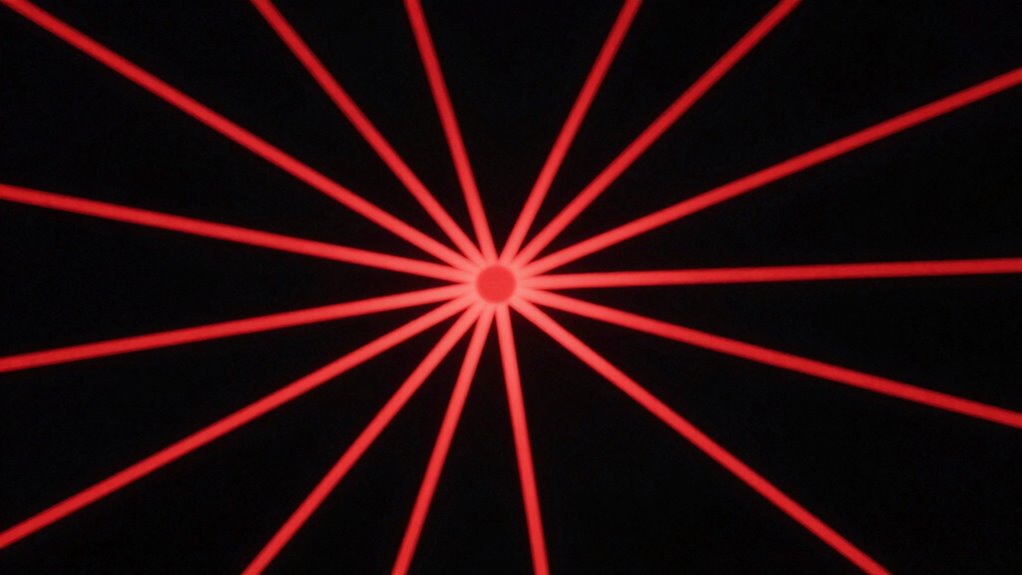
Points, lines, rays, and segments are often confused because they all relate to geometry, but each has a different meaning. A point marks a precise location with no size. A line extends infinitely in both directions, while a ray starts at a point and extends in one direction forever. A segment has two endpoints and a measurable length. Understanding these differences helps you interpret diagrams better—keep going to learn more about these essential terms.

Prime made for students and young adults
- Fast, free delivery for dorm and study essentials
- Prime Video and Amazon Music included
- Member-only deals
Key Takeaways
- Points indicate exact locations, with no size or dimension, unlike lines, rays, or segments.
- Lines extend infinitely in both directions, while rays start at a point and extend infinitely in one direction.
- Segments have two endpoints and a measurable length, unlike points, lines, or rays.
- Rays start at an endpoint and extend endlessly in one direction, differing from lines that extend infinitely both ways.
- Proper understanding of these elements clarifies their different roles in geometry and real-world applications.
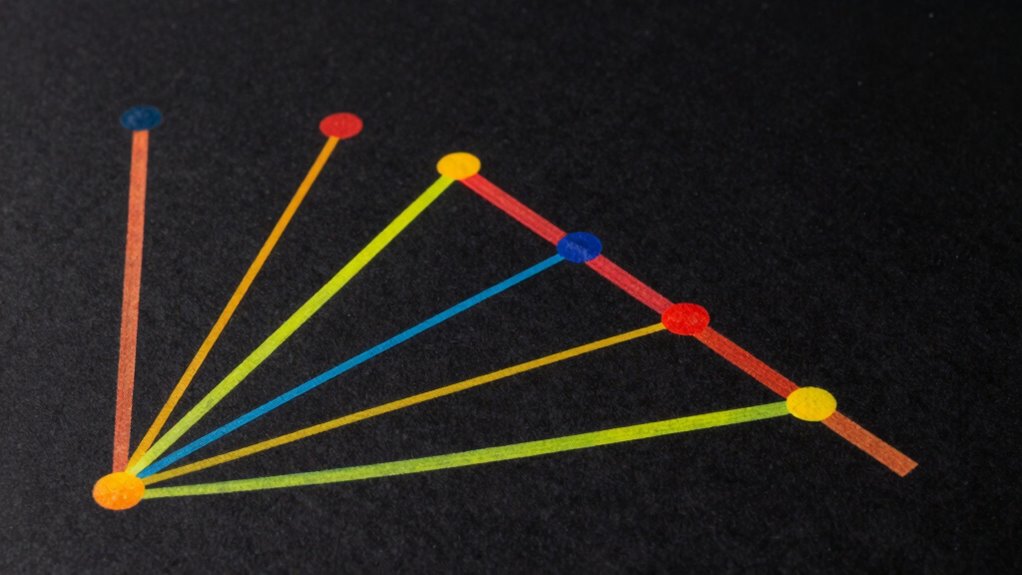
Understanding the fundamental elements of geometry begins with points, lines, rays, and segments. These basic building blocks form the foundation for more complex geometric concepts, and mastering them helps you interpret the world around you accurately. When you look at a map, a blueprint, or even a piece of art, you’re seeing geometric representations of real objects and ideas. Recognizing the differences among these elements is essential because they each serve unique purposes in both theoretical and practical contexts.
Points are the simplest of these elements. Think of a point as a location, a dot that marks a specific spot in space. It has no size, no length, and no width — just a position. When you see a point on a graph or a map, it indicates a precise location. Lines, on the other hand, extend infinitely in both directions. They connect multiple points and are useful for representing boundaries, roads, or any continuous stretch. You can think of a line as a pathway that has no beginning or end, making it ideal for illustrating concepts like straightness or direction in geometric representations.
Rays are a bit more specific. They start at a point, called the endpoint, and extend infinitely in one direction. Imagine shining a flashlight: the beam starts at your flashlight and spreads outward infinitely. Rays are particularly useful in real-world applications like navigation or physics, where you need to represent a direction that starts at a particular point and extends outward. Understanding the properties of rays helps in visualizing and solving many geometric problems. Recognizing these properties also aids in understanding angle measurements**, which are fundamental in many geometric applications. Segments are finite; they have two endpoints and a measurable length between them. If you think about a ruler or a piece of string, you’re dealing with segments. They are essential for measurements, construction**, and defining boundaries in various fields.
geometry points and lines educational kit
As an affiliate, we earn on qualifying purchases.
As an affiliate, we earn on qualifying purchases.
Frequently Asked Questions
How Are Points Represented Visually in Diagrams?
In diagrams, you represent points as small, labeled dots on a coordinate plane. You often use geometric notation to label these points with uppercase letters, like A or B. The points are precise locations, and their position is defined by coordinates. You should clearly mark and label each point to distinguish them, ensuring they’re not mistaken for lines, rays, or segments. This clarity helps in understanding their role in the diagram.
Can a Line Be Curved or Only Straight?
About 90% of people think lines are only straight, but in reality, lines can be curved or straight, based on line curvature definitions. A line, in geometry, is usually straight and extends infinitely in both directions. However, when you talk about curved lines, you’re describing a different concept called a curve, which bends instead of remaining straight. So, yes, a line can be curved, but it’s not the same as a straight line.
What’s the Difference Between a Line and a Line Segment?
A line extends infinitely in both directions, shown by line notation with arrows, while a line segment has two endpoints and includes only the points between them. You can measure the segment’s length, but a line’s length is indefinite. So, when you see line notation with arrows, it’s a line; a segment, with endpoints, is limited. Understanding this difference helps clarify geometric concepts.
Do Rays Have a Fixed Length Like Segments?
Rays don’t have a fixed length like segments do; they stretch infinitely in one direction like an endless highway. The ray length is only defined from its starting point to any point along its path, but it keeps going forever beyond that. Unlike a segment, which is like a bridge with a set span, a ray’s length isn’t fixed—it’s a journey that never truly ends, always extending outward.
How Do You Name Points and Lines Correctly?
You name points with capital letters, like A or B, and use these to identify specific locations. For lines, use two points on the line, such as AB, and draw a line symbol above them. Remember, naming conventions are important: points get single letters, while lines are named with two points. The symbols clarify whether you’re referring to a point or a line, ensuring clear communication in geometry.
geometry ruler and protractor set
As an affiliate, we earn on qualifying purchases.
As an affiliate, we earn on qualifying purchases.
Conclusion
Understanding points, lines, rays, and segments is like mastering the building blocks of a grand puzzle. When you grasp their differences, you open the door to clearer geometry. Think of these terms as the characters in a story — each with its own role to play. Once you see how they fit together, your geometric journey becomes a smooth sail on a calm sea. Keep practicing, and soon you’ll navigate these concepts with confidence and ease.
As an affiliate, we earn on qualifying purchases.
geometric construction compass and ruler
As an affiliate, we earn on qualifying purchases.
As an affiliate, we earn on qualifying purchases.
Fall Picks
fall essentials
As an affiliate, we earn on qualifying purchases.