To prove Ceva’s theorem, you analyze the ratios of divided segments on each side of the triangle created by the cevians. If these cevians are concurrent, the ratios of the segments they create satisfy a specific relationship: their product equals one. By expressing these ratios in terms of segment lengths and using properties of similar triangles or area ratios, you can see why the condition holds. Continuing will help you understand the detailed reasoning behind this important geometric result.
Key Takeaways
- Establish that the cevians are concurrent at point ( O ) within the triangle.
- Use similar triangles formed by the cevians to relate segment ratios on the sides.
- Apply the properties of ratios from the similar triangles to set up the product condition.
- Show that the product of the ratios on the sides equals one if and only if the cevians are concurrent.
- Conclude that the algebraic ratio condition in Ceva’s theorem is both necessary and sufficient for concurrency.
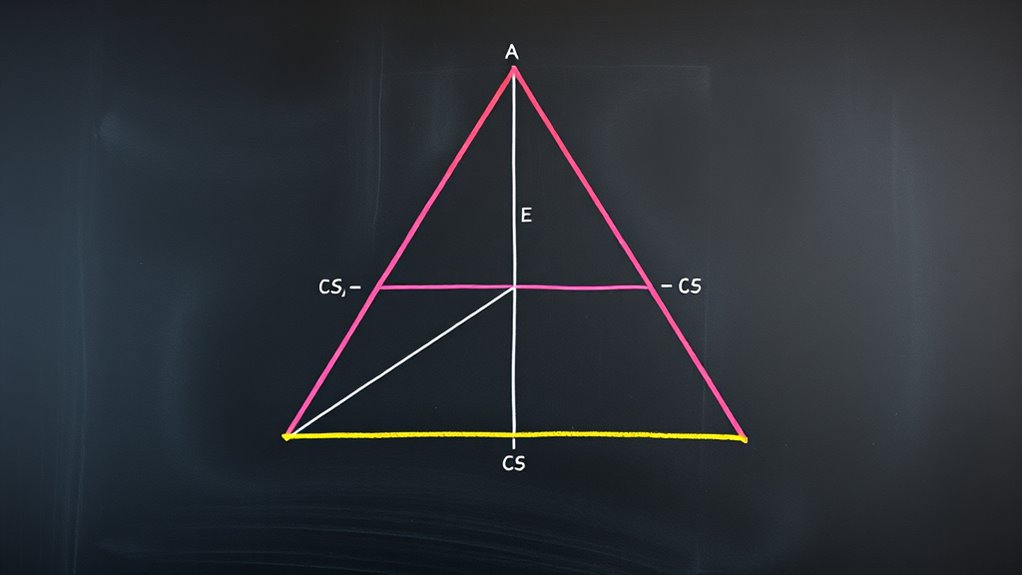
Ceva’s Theorem provides a powerful criterion for determining when three cevians—lines drawn from each vertex of a triangle to the opposite side—are concurrent. This theorem has numerous applications in geometry, especially in solving problems involving ratios, similar triangles, and the construction of points with special properties. By understanding Ceva’s theorem applications, you can quickly assess whether three cevians intersect at a single point without needing to perform complex angle or length calculations. This makes it a fundamental tool in geometric proofs and problem-solving, especially in competition math and advanced Euclidean geometry.
Ceva’s Theorem is essential for verifying cevian concurrency in triangle geometry.
The historical development of Ceva traces back to the 17th century, when the Italian mathematician Giovanni Ceva published his work. Ceva’s contributions *considerably* advanced the understanding of concurrent lines within a triangle. Before Ceva’s theorem, mathematicians like Menelaus had identified related principles, but Ceva’s approach provided a clear algebraic condition for concurrency, which made the theorem easier to apply and prove. Ceva’s work built upon earlier ideas, formalizing the relationships between segments created by cevians and ratios of division. His theorem became a cornerstone in geometry, influencing subsequent mathematicians and leading to the development of more complex geometric concepts.
When you apply Ceva’s theorem, you *fundamentally* check the ratios of divided segments on the sides of the triangle. If the product of these ratios equals one, the three cevians are concurrent. This simple yet powerful condition allows you to verify the concurrency of lines without needing to measure angles or construct auxiliary lines. The theorem’s versatility extends to various geometric constructions, such as finding the centroid, incenter, or other special points where cevians meet. It also assists in proving the collinearity of points or establishing ratios in similar triangles. Additionally, understanding the historical context of Ceva’s theorem can deepen your appreciation for its significance and enduring utility.
In practical terms, understanding the historical development of Ceva enriches your appreciation for its elegance and utility. Knowing that Ceva’s theorem was a breakthrough in the 17th century helps you see its enduring relevance today. Its applications span from solving classic geometry problems to modern computational geometry algorithms. As you explore the theorem, keep in mind that its roots lie in centuries of mathematical inquiry, and it continues to serve as a fundamental principle for analyzing the complex relationships within triangles. Whether you’re working on geometry proofs or exploring geometric constructions, Ceva’s theorem remains an *integral* tool rooted in a rich mathematical heritage.
Frequently Asked Questions
Can Ceva’s Theorem Be Applied to Non-Acute Triangles?
Yes, Ceva’s Theorem can be applied to non-acute triangles, including obtuse and right triangles. Its applicability limits are not restricted by the triangle’s type, as long as the cevians intersect inside the triangle. You just need to guarantee the cevians meet within the triangle’s interior; otherwise, the theorem’s conditions don’t hold. So, you can confidently use Ceva’s theorem in any triangle, regardless of whether it’s acute, right, or obtuse.
What Are Real-World Applications of Ceva’s Theorem?
Imagine you’re designing a futuristic building or calibrating a robotic arm, and Ceva’s Theorem becomes your secret weapon. It helps you guarantee structural stability in architectural design and precise movement in robotic arm calibration. By understanding how cevians intersect within a triangle, you can optimize load distribution, improve mechanical accuracy, and create safer, more efficient systems. This theorem’s real-world uses make complex engineering tasks more reliable and innovative.
How Does Ceva’s Theorem Relate to Menelaus’ Theorem?
You’ll find that Ceva’s and Menelaus’ theorems relate through their use of similarity ratios and concurrent lines. Ceva’s theorem deals with lines from vertices intersecting at a common point, while Menelaus’ theorem involves a transversal intersecting the sides of a triangle. Both establish conditions for concurrency and collinearity, highlighting how ratios of segments relate when lines are concurrent or transversal, enriching your understanding of triangle geometry.
Are There Any Generalizations of Ceva’s Theorem?
Imagine a web of lines stretching across a triangle, each intersection revealing new geometric truths. Yes, there are generalizations of Ceva’s theorem, extending into advanced geometric proofs and triangle similarity. These generalizations explore concurrency in more complex figures, involving ratios and ratios of ratios. By studying these, you deepen your understanding of how lines interact within triangles, revealing a richer, interconnected geometric landscape beyond the classic theorem.
Can Ceva’s Theorem Be Used for Coordinate Geometry Proofs?
Yes, you can use Ceva’s Theorem for coordinate geometry proofs. By assigning coordinates to the triangle’s vertices and calculating the ratios of divided segments, you can verify triangle concurrency conditions. This approach simplifies proving that cevians are concurrent in a coordinate plane, making the theorem very useful in coordinate geometry. You just need to carefully set up your coordinate system and apply the ratios to confirm concurrency.
Conclusion
Now that you’ve mastered Ceva’s Theorem, you’re practically a triangle wizard! With this proof, you hold the secret weapon to conquer any triangle problems thrown your way. Imagine effortlessly solving complex puzzles that leave others scratching their heads—your newfound knowledge makes you unstoppable! So go ahead, take on any triangle challenge, because with Ceva’s Theorem in your toolkit, you’re not just a learner—you’re a geometry superhero!