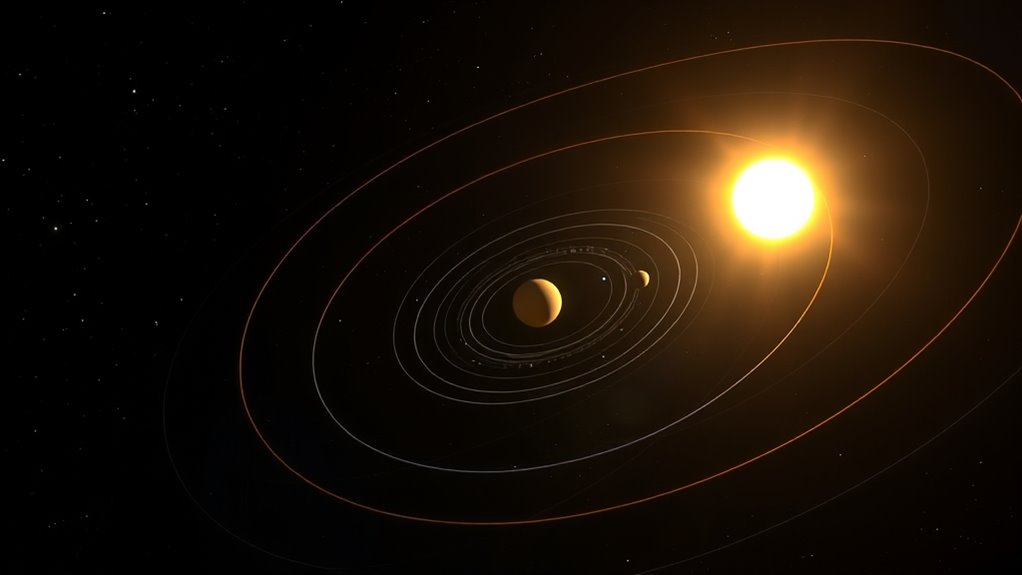

In the solar system, planets move along elliptical orbits with varying degrees of eccentricity, which shapes their paths and distance from the Sun. This eccentricity influences how close or far they get, affecting their speed and orbital timing. Kepler’s laws explain that planets move faster at perihelion and slower at aphelion, driven by the orbit’s shape. To understand how these factors influence planetary motion, keep exploring how elliptical orbits work in detail.
Key Takeaways
- Planets move in elliptical orbits around the Sun, with varying eccentricities shaping their orbital paths.
- Kepler’s first law states the Sun occupies one focus of each elliptical orbit.
- Orbital eccentricity affects the distance between a planet and the Sun at perihelion and aphelion.
- Kepler’s second law explains how orbital speed varies, with planets moving faster near perihelion.
- The shape and size of elliptical orbits influence orbital periods and planetary motion predictions.
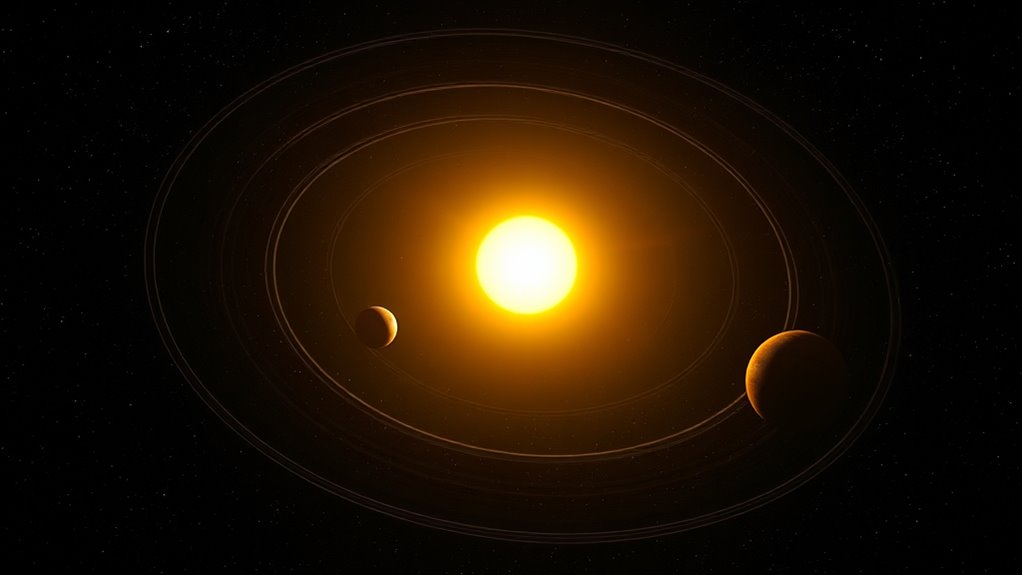
Have you ever wondered how satellites orbit Earth or how spacecraft travel between planets? The key lies in understanding the shape of their orbits, which are primarily elliptical rather than perfect circles. This is where planetary eccentricity comes into play. Planetary eccentricity measures how much an orbit deviates from a perfect circle; an eccentricity of zero indicates a circle, while values closer to one describe elongated ellipses. In our solar system, planets follow these elliptical paths around the Sun, a fact explained by Kepler’s laws of planetary motion. Kepler’s first law states that each planet orbits the Sun in an ellipse, with the Sun at one focus. This law helps us grasp why planetary orbits are not perfect circles but ellipses with varying degrees of eccentricity.
Understanding planetary eccentricity is fundamental in orbital mechanics because it affects the distance between a planet and the Sun during its orbit. When a planet is at perihelion, it’s closest to the Sun, and at aphelion, it’s farthest away. The degree of eccentricity determines how stretched out this orbit is, influencing planetary seasons, climate, and even the planning of spacecraft missions. For instance, missions to Mars or comets must account for these elliptical orbits to optimize travel time and fuel efficiency. Recognizing how eccentricity influences orbital size and shape allows scientists and engineers to predict planetary positions accurately and design spacecraft trajectories accordingly.
Kepler’s laws further clarify how these elliptical orbits function. Kepler’s second law, the law of equal areas, states that a line connecting a planet to the Sun sweeps out equal areas during equal intervals of time. This implies that planets move faster when they are closer to the Sun (at perihelion) and slower when they are farther away (at aphelion). This variation in orbital speed is essential for mission planning and understanding natural celestial phenomena. Kepler’s third law provides a relationship between a planet’s orbital period and its average distance from the Sun, reinforcing the idea that orbit size and shape, influenced by eccentricity, directly impact orbital timing.
Frequently Asked Questions
How Do Gravitational Influences From Other Planets Affect Orbital Shapes?
Gravitational influences from other planets cause planetary perturbations, which can alter your orbit’s shape over time. These perturbations may make your orbit more elongated or shift its position. Additionally, orbital resonances, where your orbit’s period aligns with another planet’s, can amplify these effects, leading to more significant changes. You should expect these gravitational interactions to constantly shape and modify your orbital path, especially over long periods.
Can an Orbit Change From Elliptical to Circular Naturally?
Imagine your orbit as a dance, where energy and gravity lead. Naturally, an orbit can become more circular if your orbital energy adjusts—like when a planet loses or gains energy through interactions or tidal forces. Over time, these shape dynamics can smooth out an elliptical path into a circle, but it’s a slow, delicate change driven by gravitational influences, not something that happens instantly.
What Role Does Orbital Eccentricity Play in Climate Variations?
You might notice that orbital eccentricity influences climate variations by altering how solar radiation hits Earth. Higher eccentricity means more seasonal effects due to varying distances from the Sun, causing greater temperature swings. Conversely, lower eccentricity results in more stable climate patterns. So, as eccentricity changes, it impacts the amount of solar radiation received during different seasons, leading to noticeable shifts in climate over long periods.
How Are Spacecraft Trajectory Adjustments Managed Within Elliptical Orbits?
Managing spacecraft trajectory adjustments within elliptical orbits is like juggling fire—precision is vital. You’ll use thruster calibration to guarantee accurate burns, and propellant management keeps your fuel steady for maneuvering. Small, well-timed thruster firings alter your orbit’s shape or position, helping you stay on course or reach new targets. Regular adjustments prevent deviations from spiraling into chaos, making certain your mission stays on track amidst the complex dance of celestial mechanics.
Are All Planets’ Orbits Perfectly Elliptical or Are Deviations Common?
You’ll find that not all planets have perfectly elliptical orbits; deviations are quite common. These deviations impact orbital stability and are often measured through eccentricity. Small changes in eccentricity can influence a planet’s orbit over time, so astronomers continuously monitor these variations. While most planetary orbits are nearly elliptical, gravitational influences from other bodies and past events cause slight deviations, making orbital stability and eccentricity measurement essential for precise understanding.
Conclusion
Now that you understand how ellipses shape planetary orbits, it’s fascinating to realize that over 99.9% of our solar system’s planets follow these elliptical paths. This means almost every planet you see in the night sky is moving along an elongated orbit, not a perfect circle. So, next time you gaze upward, remember: the planets are dancing around the Sun in these beautiful, elongated ellipses, creating the cosmic rhythm that keeps our solar system in motion.