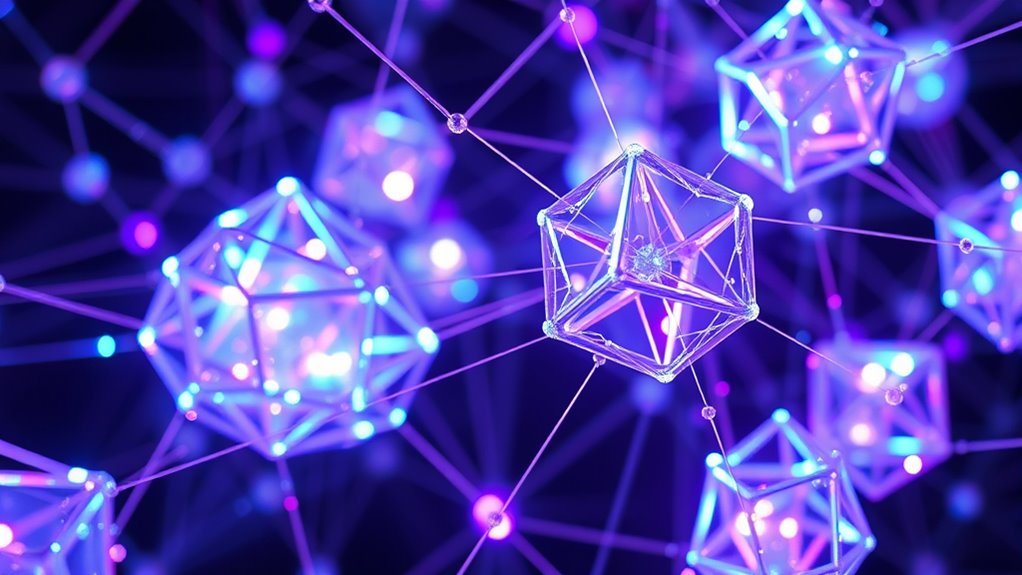

Quantum geometry shows that space isn’t smooth but made up of tiny, indivisible units called quantum bits. Instead of a continuous fabric, these fundamental building blocks form a discrete, granular structure at incredibly small scales, like the Planck length. This idea helps unify quantum physics and gravity, revealing that the universe’s fabric is woven from interconnected quantum states. Exploring these concepts further will uncover how this shape-shifting, granular space influences the very nature of reality.

Prime made for students and young adults
- Fast, free delivery for dorm and study essentials
- Prime Video and Amazon Music included
- Member-only deals
Key Takeaways
- Quantum geometry models space as a discrete network of indivisible quantum units, replacing smooth classical shapes.
- Spin networks represent the fundamental quantum states of space, encoding geometry through interconnected nodes and links.
- At tiny scales, space’s shape emerges from probabilistic quantum structures rather than continuous surfaces.
- This approach helps unify gravity and quantum physics by describing the granular fabric of spacetime.
- Quantum geometry reveals how space’s shape is built from fundamental quantum elements, shaping our understanding of the universe’s smallest scales.
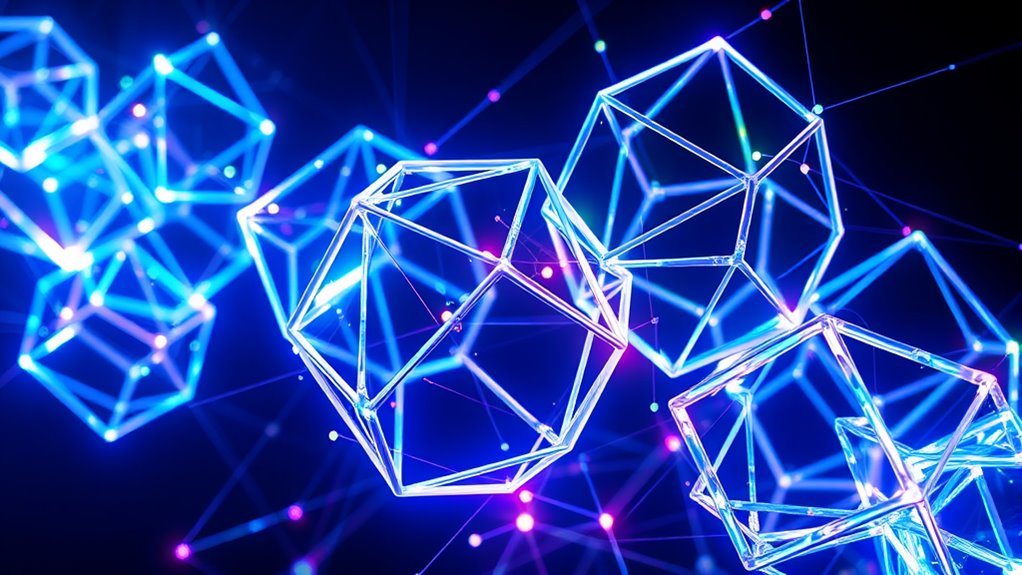
Have you ever wondered how the fabric of space itself behaves at the smallest scales? At the frontier of physics, scientists explore quantum spacetime—a realm where the smooth continuum we experience daily gives way to a fundamentally different structure. Unlike the familiar picture of space as a continuous expanse, quantum geometry suggests that space is composed of discrete structures. Think of it as a cosmic digital grid, where space isn’t infinitely divisible but made up of tiny, indivisible units. These units could be incredibly small, perhaps on the order of the Planck length, about 10^-35 meters, a scale so minuscule that conventional physics breaks down. In this framework, the fabric of the universe isn’t a smooth fabric but a patchwork of elementary building blocks, much like pixels forming an image. This idea challenges our intuition and opens up new ways to understand the universe at its most fundamental level.
Space at the smallest scales is a digital grid of indivisible quantum units.
In quantum spacetime, the concept of geometry shifts from being a smooth, continuous entity to one governed by discrete structures. Instead of smooth curves and surfaces, the geometry is built from fundamental quantum elements, which could be tiny loops, spin networks, or other quantum states. These structures encode information about distances, areas, and volumes in a way that’s inherently probabilistic. For example, the area of a surface isn’t just a fixed value but a sum of discrete quantum contributions, each representing a tiny quantum of area. This approach aligns with the principles of quantum mechanics, where certainty is replaced with probability, and physical quantities are described by wavefunctions or quantum states. Additionally, the mathematical frameworks used to describe these discrete geometries often involve spin networks, which serve as the fundamental building blocks of quantum space.
This shift to discrete structures isn’t just a mathematical curiosity; it aims to reconcile general relativity with quantum mechanics. Traditional gravity models treat spacetime as a smooth manifold, but at quantum scales, this smoothness may dissolve into a granular architecture. This idea is central to theories like Loop Quantum Gravity, which describe the fabric of spacetime as woven from spin networks—interconnected nodes and links representing quantum states of geometry. These networks evolve over time, giving rise to a quantum version of spacetime dynamics. By understanding quantum spacetime as a collection of discrete structures, physicists hope to uncover the true nature of gravity at the smallest scales and perhaps discover new insights into black holes, the Big Bang, or the fabric of the cosmos itself.
In essence, exploring quantum spacetime reveals a universe where space isn’t a passive backdrop but an active, quantized entity. Instead of a smooth, continuous fabric, you’re looking at a universe woven from discrete structures—fundamental building blocks that challenge your classical intuition and push the boundaries of modern physics. This perspective might be key to unifying the laws of the very large with those of the very small, leading to a more complete understanding of the universe’s shape and origin.
As an affiliate, we earn on qualifying purchases.
Frequently Asked Questions
How Does Quantum Geometry Relate to Classical Geometry?
Quantum geometry relates to classical geometry by extending classical analogies into the quantum domain. You can visualize quantum geometry through geometric visualization, where traditional shapes and surfaces are replaced with probabilistic and discrete structures. This helps you understand how space and time might behave at tiny scales, revealing a more complex, textured reality beyond smooth classical analogies. It bridges familiar concepts with the strange, quantum world.
What Are Practical Applications of Quantum Geometry Today?
Imagine quantum geometry as a blueprint for tomorrow’s tech. You can harness it today through quantum computing, which accelerates complex problem-solving, and quantum sensors that detect minute changes beyond classical limits. These practical applications transform industries, from secure communications to medical imaging. By understanding quantum shapes, you reveal innovative tools that push the boundaries of what’s possible, making your future smarter, more precise, and incredibly exciting.
Can Quantum Geometry Unify All Fundamental Forces?
Yes, quantum geometry could unify all fundamental forces by leveraging spacetime discreteness and quantum entanglement. You might see a future where these concepts connect gravity with quantum mechanics, creating a single framework. This unification could explain phenomena like black holes and the early universe. By understanding how spacetime is quantized and entangled, you could discover new insights into the universe’s fundamental nature and unify the forces that govern it.
How Does Quantum Geometry Influence Black Hole Physics?
Ever wonder how quantum geometry shapes black hole physics? It influences by revealing how entanglement entropy relates to the black hole’s event horizon, supporting holographic principles. You see, this connection helps explain information paradoxes and the nature of spacetime at extreme densities. Quantum geometry offers a framework where the fabric of space itself becomes dynamic, providing insights into black hole behavior that classical physics can’t grasp. Isn’t that fascinating?
What Are the Main Challenges in Developing Quantum Geometric Theories?
You face main challenges like overcoming mathematical complexity, which makes developing quantum geometric theories tough, and achieving experimental verification, since testing these theories often requires technologies beyond current capabilities. You need to simplify complex math to build testable models and find innovative ways to verify predictions experimentally. These hurdles slow progress but are essential for advancing your understanding of how quantum geometry influences fundamental physics.
As an affiliate, we earn on qualifying purchases.
Conclusion
You’ve uncovered the mesmerizing core of quantum geometry, where quantum quirks and geometric grandeur collide. By bridging the bizarre and the beautiful, you see how shapes and structures shape our understanding of the subatomic world. This bold blend beckons you to believe in a universe where physics and form fuse, forging a future of fascinating discoveries. Embrace this exciting evolution, where quantum questions quickly lead to captivating clues, creating a cosmos of curiosity and comprehension.
As an affiliate, we earn on qualifying purchases.
quantum mechanics visualization tools
As an affiliate, we earn on qualifying purchases.
As an affiliate, we earn on qualifying purchases.
Halloween Picks
halloween
As an affiliate, we earn on qualifying purchases.