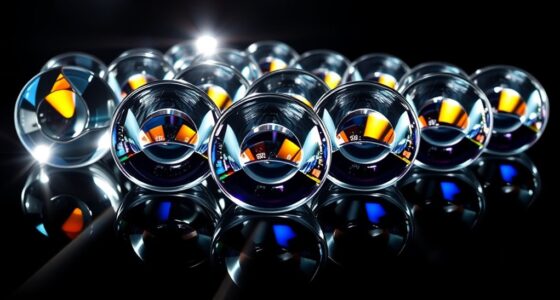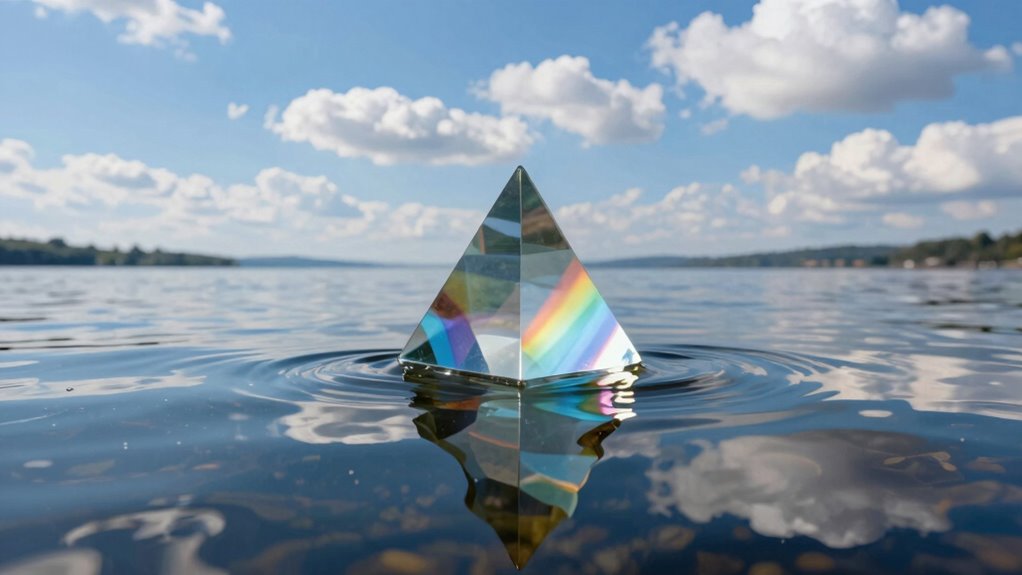

Reflection and refraction turn geometry into optics by showing you how light behaves at surfaces and through different materials. When light hits a smooth surface, it bounces off at predictable angles, following the laws of reflection. When passing through objects like water or glass, it bends, following geometric rules outlined by Snell’s Law. These concepts transform simple shapes into complex optical effects, and if you look closer, you’ll discover more about how physics shapes what we see every day.

Prime made for students and young adults
- Fast, free delivery for dorm and study essentials
- Prime Video and Amazon Music included
- Member-only deals
Key Takeaways
- Reflection follows the law of angles, translating geometric principles into predictable mirror images.
- Refraction involves bending light at interfaces, applying geometry to predict light paths through different mediums.
- Snell’s Law quantifies the relationship between angles and medium properties, linking geometry with optical behavior.
- Optical phenomena like dispersion and rainbow formation result from geometric light bending and spreading.
- Geometric shapes and angles underpin the design of lenses and optical devices, converting geometric principles into practical optics.
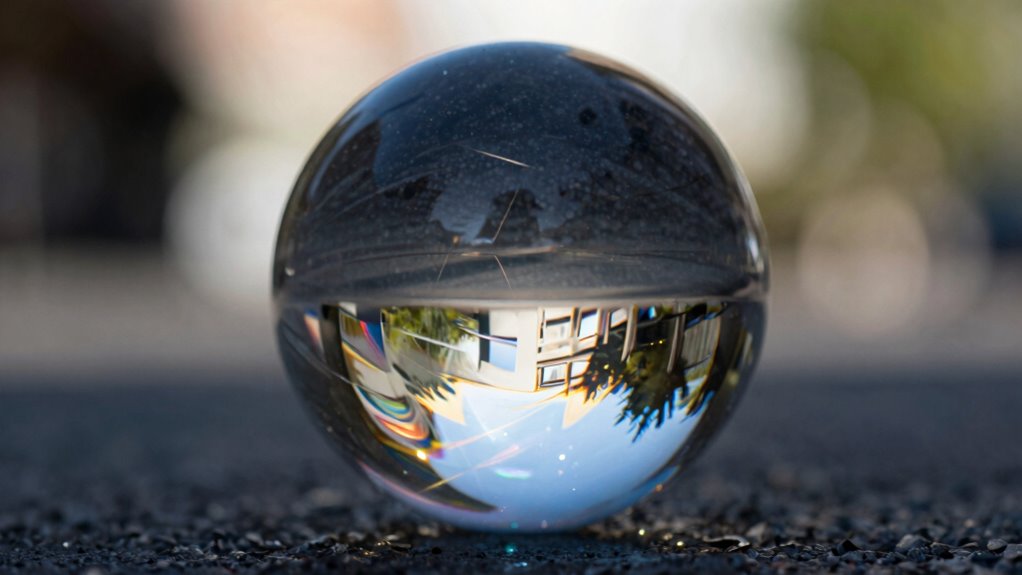
Have you ever wondered how a mirror creates a perfect image or why a straw looks bent in a glass of water? These everyday phenomena are rooted in the principles of reflection and refraction, two fundamental concepts in optics that transform simple geometry into a fascinating science. When light waves bounce off a smooth surface, reflection occurs, sending the light back in a predictable way. This is how mirrors produce clear, detailed images—your face appears just as you see it, thanks to the angle at which light hits the mirror and then reflects toward your eyes. Similarly, refraction happens when light passes through different mediums, bending as it moves from air into water or glass. This bending causes the straw to appear distorted or bent in the glass, revealing how light’s speed varies with the medium. The way light interacts with objects is deeply connected to the behavior of light waves, which explains many other optical phenomena. Light dispersion plays an essential role in understanding how refraction creates colorful effects, especially when light passes through prisms or drops of water. As light enters a new medium, different wavelengths bend at slightly different angles. This separation of colors, known as dispersion, explains why a rainbow appears after a rainstorm or why you see colorful patterns in a soap bubble. These effects are a type of optical illusion—visual tricks that deceive your eyes into perceiving something different from reality. When you see a rainbow, your brain interprets the spread-out spectrum of light as a continuous arc, even though it’s just a dispersion of colors caused by refraction. Interestingly, the principles of optical physics help scientists develop advanced lenses and optical devices used in everyday gadgets. A comprehensive understanding of these phenomena also involves the concept of Snell’s Law, which quantifies how light bends when crossing media boundaries. Additionally, the study of wave interference provides insight into the formation of patterns such as diffraction and holography, further enriching our understanding of light behavior. Moreover, the influence of medium properties on light’s behavior demonstrates how different materials can alter optical effects, shaping the way we design optical systems. In many ways, optics turns the abstract shapes of geometry into vivid, tangible phenomena. When you observe an optical illusion, like the famous Müller-Lyer or Ponzo illusions, you’re witnessing the way your brain interprets light and shadow, often influenced by how light dispersion and refraction affect perception. These illusions reveal how light’s behavior can manipulate your sense of spatial relationships and depth.
Understanding how reflection and refraction work helps you see the world differently. They enable you to grasp why objects appear distorted or why images are reversed in mirrors. They also explain complex phenomena like rainbows or the bending of light around objects, which seem almost magical until you understand the geometric principles behind them. Essentially, these processes turn simple shapes and angles into a visual language that describes how light interacts with the world, transforming geometry into the intriguing realm of optics.
As an affiliate, we earn on qualifying purchases.
Frequently Asked Questions
How Do Reflection and Refraction Differ in Their Effects on Light?
Reflection sends light waves bouncing off surfaces, creating images like mirrors, while refraction bends light as it passes through different mediums, causing effects like light dispersion in a prism. Reflection often results in a clear image, whereas refraction can split or distort light. When light hits at a certain angle, total internal reflection occurs, trapping light inside a medium. Both phenomena shape how we see and understand light’s behavior.
What Materials Cause the Most Significant Refraction?
Materials with high refractive indices cause the most significant refraction because their optical density is greater. For example, diamond has a very high refractive index, making light bend sharply when passing through it. When you look at different materials, the greater the refractive index, the more optical density the material has, leading to a more noticeable change in the light’s direction as it moves from one medium to another.
How Does the Angle of Incidence Influence Reflection?
About 90% of light reflects when it hits a surface at a very shallow angle, illustrating how the angle of incidence greatly influences reflection. You’ll find that reflection is highly angle dependent; as the incident variation increases, more light reflects off the surface. When the angle of incidence is steep, less light reflects, and more transmits or refracts. This shows how, by adjusting the incident angle, you can control the reflection intensity effectively.
Can Reflection or Refraction Occur Simultaneously?
Yes, reflection and refraction can occur simultaneously when a wave hits a boundary at an angle. You’ll notice wave interference patterns as some light reflects while others refract into the new medium. During this process, light polarization can also change, affecting the wave’s orientation. This combined behavior illustrates how geometric principles govern optics, revealing complex interactions that depend on factors like incident angle and medium properties.
How Are Reflection and Refraction Used in Everyday Devices?
You use reflection and refraction daily in devices like sunglasses and cameras. Polarized light filters out glare through reflection, improving vision, while refraction helps lenses focus light for clear images. In optical illusions, reflection and refraction manipulate light paths to create surprising effects. These principles also operate in microscopes and telescopes, turning simple glass into powerful tools. Understanding these processes enhances your ability to appreciate how everyday devices shape your visual experience.
As an affiliate, we earn on qualifying purchases.
Conclusion
By understanding reflection and refraction, you see how geometry transforms into optics, revealing the fascinating behavior of light. Some might think these concepts are purely theoretical, but they’re essential to everyday life, from lenses to cameras. Don’t dismiss their complexity—embracing these principles deepens your appreciation for how light interacts with surfaces, shaping the way we perceive the world. Ultimately, mastering these ideas unleashes a new perspective, bridging abstract math and real-world phenomena.
lens kit for optical experiments
As an affiliate, we earn on qualifying purchases.
As an affiliate, we earn on qualifying purchases.
As an affiliate, we earn on qualifying purchases.
Halloween Picks
halloween
As an affiliate, we earn on qualifying purchases.