
TL;DR

Prime made for students and young adults
- Fast, free delivery for dorm and study essentials
- Prime Video and Amazon Music included
- Member-only deals
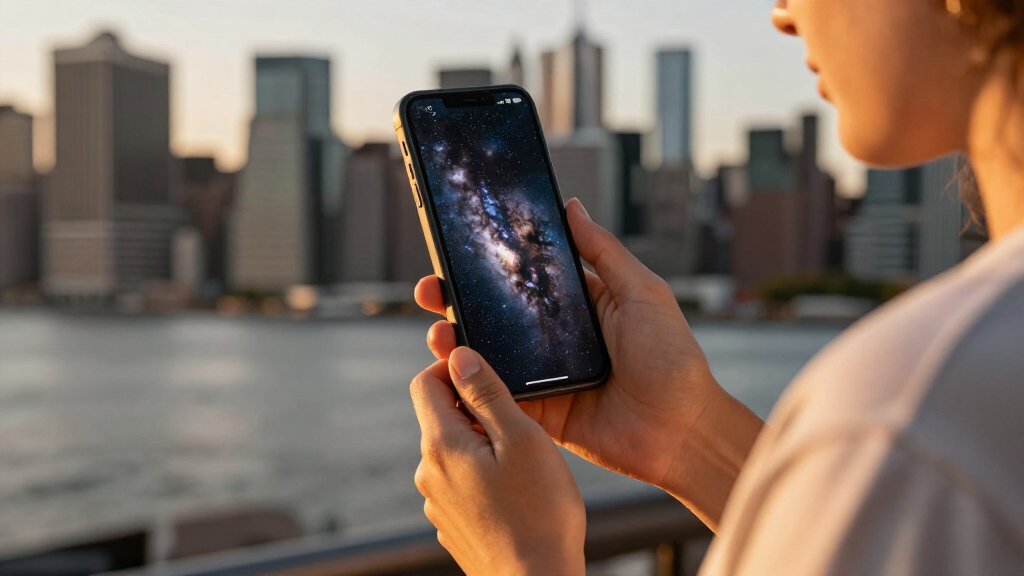
NASA’s Astronomy Picture of the Day for October 15, 2026, features a photograph of the Milky Way above Manhattan. The image uses a near-infrared filter that blocks much of the visible city light, though some incandescent and neon lights remain bright in that range.
NASA’s Astronomy Picture of the Day on October 15, 2026, features the Milky Way above Manhattan, photographed using a filter that blocks most visible light and records near-infrared light instead. The image, credited to Jason Kurth and Ty Buckley, shows how a change in the wavelengths captured can make a faint night-sky feature visible despite the city’s bright lights.
NASA’s accompanying explanation says the photograph was taken with a filter that blocks most visible light, capturing light in the near-infrared region of the electromagnetic spectrum. Near-infrared light has lower energy than visible light. The technique reduces much of the glare from the city, allowing the Milky Way to appear in the image.
The filter does not remove every source of urban light. NASA says incandescent bulbs and some neon lights remain bright in near-infrared, while fluorescent and LED bulbs do not. Stars also emit near-infrared light, so the technique can record celestial objects while suppressing much of the visible-light pollution that otherwise overwhelms them.
The image is credited to Jason Kurth and Ty Buckley. NASA lists Cecilia Chirenti, Robert Nemiroff, Jerry Bonnell and Keighley Rockcliffe as authors and editors of the APOD entry. The page is presented as part of the Astronomy Picture of the Day service, which pairs a daily image or photograph with an explanation written by a professional astronomer.
How Infrared Reveals Urban Skies
The image offers a practical example of how astronomers and astrophotographers can work around light pollution. Rather than implying Manhattan’s ordinary night sky is dark enough for an unobstructed view of the Milky Way, NASA’s explanation identifies the key difference: the camera records a band of light that excludes most visible wavelengths, reducing the impact of many city lights.
That distinction matters for readers interpreting the photograph. It is an image made with a specific filter, not evidence that the Milky Way is readily visible to the unaided eye from the same location under normal viewing conditions. The method also has limits, since some artificial lights still contribute near-infrared light. NASA’s caption uses the picture to emphasize that people share the same sky, while the photograph shows how imaging choices can reveal features otherwise lost against an urban background.
near-infrared astrophotography filter
As an affiliate, we earn on qualifying purchases.
As an affiliate, we earn on qualifying purchases.
A Daily Astronomy Picture
NASA’s Astronomy Picture of the Day, commonly called APOD, publishes a different space-related image or photograph each day with an explanatory caption. The October 15 entry places the Manhattan image within that ongoing service and gives readers a short account of the filtering technique used to make it.
The caption contrasts the city’s visible-light sources with the near-infrared signal captured in the photograph. Fluorescent and LED lighting is described as not bright in the relevant near-infrared range, while incandescent bulbs and some neon sources remain bright. The entry does not provide camera settings, exposure details, a precise observing location or a technical breakdown of the filter. It also lists the following day’s APOD subject as “Chasing the ISS.”
light pollution reduction camera filter
As an affiliate, we earn on qualifying purchases.
As an affiliate, we earn on qualifying purchases.
Limits of the Published Details
NASA’s entry explains the broad filtering approach but does not identify the exact filter specifications, camera equipment, exposure time or precise location in Manhattan. The page also does not state whether the image is a single exposure or a composite, so those details cannot be established from the supplied report.
The caption describes which kinds of lighting are bright in the near-infrared range, but it gives no measurements of how much city light was blocked or how much remained in the final image. It also does not claim that viewers could see the Milky Way with the naked eye from the photographed location. The confirmed point is that the published photograph uses near-infrared capture to reduce most visible-light pollution.
night sky astrophotography equipment
As an affiliate, we earn on qualifying purchases.
As an affiliate, we earn on qualifying purchases.
The Next APOD Entry
NASA lists “Chasing the ISS” as the subject of the October 16, 2026, Astronomy Picture of the Day. The October 15 page does not announce a follow-up investigation or further technical information about the Manhattan photograph. Readers seeking those specifics would need additional information from the photographers or a fuller technical description of the image.
urban light pollution filter for cameras
As an affiliate, we earn on qualifying purchases.
As an affiliate, we earn on qualifying purchases.
Key Questions
What does NASA’s October 15 APOD show?
It features a photograph of the Milky Way above Manhattan, credited to Jason Kurth and Ty Buckley.
How was the Milky Way captured over a brightly lit city?
NASA says the image was made using a filter that blocks most visible light and captures near-infrared light, reducing much of the city’s visible-light glare.
Does the image show that the Milky Way is visible to the naked eye in Manhattan?
No such claim is made in the APOD explanation. It describes a filtered photograph; it does not say the Milky Way can ordinarily be seen unaided from the location.
Do all city lights disappear in near-infrared images?
No. NASA says incandescent bulbs and some neon lights remain bright in near-infrared, while fluorescent and LED bulbs do not.
Who made the photograph, and what is the next APOD?
The image is credited to Jason Kurth and Ty Buckley. NASA lists “Chasing the ISS” for October 16, 2026.
Source: primary
Halloween Picks
halloween
As an affiliate, we earn on qualifying purchases.