
In geometric optics, understanding how light travels along specific paths helps you design effective lenses and optical systems. You learn how rays reflect off surfaces following the law of reflection, bend through refraction based on Snell’s Law, and form images that can be real or virtual. By mastering lens types and how they manipulate light, you’ll see how optical designs reduce distortions and improve clarity. Continuing to explore these concepts reveals how optical systems achieve precision in technology.
Key Takeaways
- Geometric optics studies light as rays to analyze paths through reflection and refraction in lenses.
- Lens design relies on controlling light paths via curvature, focal length, and material properties.
- Reflection and refraction principles determine how lenses focus or diverge light for image formation.
- Correcting aberrations like spherical and chromatic distortion improves lens precision and image quality.
- Understanding light paths aids in designing optical systems such as microscopes, cameras, and fiber optics.
The Fundamentals of Light Propagation
Have you ever wondered how light travels through space and different mediums? Light propagation involves more than just moving straight; it includes phenomena like light polarization, where the light waves vibrate in specific directions. In optical fibers, this is vital because the light’s polarization affects how efficiently signals are transmitted over long distances. As light enters the fiber, it undergoes total internal reflection, guiding it smoothly through the core. The way light behaves inside these fibers relies on understanding its fundamental properties, including how it can be polarized or unpolarized. Recognizing these basics helps you grasp how modern communication systems transmit vast amounts of data quickly and reliably. Additionally, the use of Natural Language Processing (NLP) in analyzing data improves the design of optical networks by optimizing signal processing. This foundation is essential for understanding how light interacts with various materials and devices in optics.
Rays and the Principles of Geometric Optics
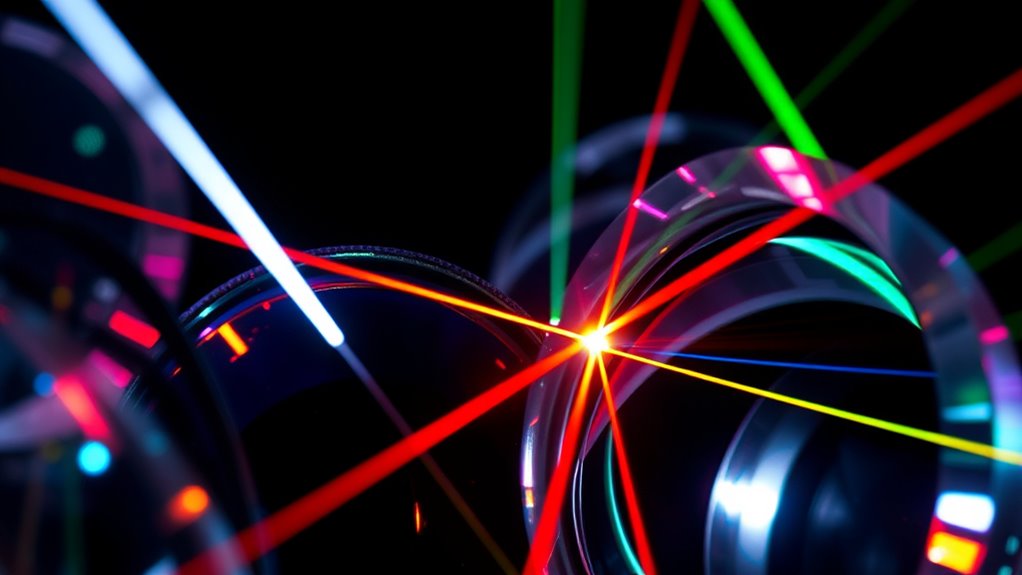
In geometric optics, you’ll learn how rays move and interact with surfaces. These rays follow predictable paths, obeying specific rules like the law of reflection. Understanding these principles helps explain how images form and how light behaves in different situations. Additionally, the properties of materials used in lens design influence how light is refracted and focused.
Ray Propagation Behavior
Understanding how rays propagate is fundamental to grasping the principles of geometric optics. When light travels through different media, it can undergo light scattering, which slightly changes the direction of rays but generally maintains their straight-line paths. This behavior is essential in optical fibers, where light is guided through total internal reflection, allowing efficient signal transmission over long distances. As rays move, they follow predictable paths that depend on the media’s shape and refractive index, making them useful for designing lenses and optical systems. Light scattering can cause some loss or distortion, but in controlled environments like optical fibers, rays remain confined and directed. By understanding these propagation behaviors, you can better predict and manipulate how light interacts within various optical devices. Additionally, the refractive index of media plays a crucial role in determining the bending and reflection of rays, which is vital for lens design.
Law of Reflection
The law of reflection states that when a ray of light strikes a smooth surface, the angle at which it hits the surface equals the angle at which it bounces off. This principle creates mirror symmetry in reflection patterns, meaning the incident and reflected rays are symmetrical relative to the surface normal. Understanding this helps you predict how light behaves on reflective surfaces like mirrors. The following table illustrates key concepts:
| Incident Ray | Normal Line | Reflected Ray |
|---|---|---|
| Approaches surface at angle θ | Perpendicular to surface | Leaves at the same angle θ |
| Reflection pattern | Mirror symmetry | Consistent angle equality |
This symmetry underpins many optical devices, ensuring predictable light paths. Additionally, awareness of proper surface maintenance can enhance the accuracy of reflected light and overall optical performance.
Reflection and the Law of Reflection
When a light ray hits a surface, it makes an angle called the incidence angle. According to the law of reflection, the angle of reflection is always equal to the incidence angle. Surface properties can influence how clearly or brightly the light reflects, affecting the reflection’s quality.
Incidence Angle Definition
Have you ever wondered how light bounces off a mirror? The key is understanding the incidence angle, which is the angle measurement between the incident ray and the normal line at the point of contact. The incident ray is the incoming light path approaching the surface. To find this angle, you draw a normal line perpendicular to the mirror’s surface at the point where the light hits. The angle between the incident ray and this normal line is your incidence angle. This measurement helps determine how light behaves when it encounters reflective surfaces. For example, the law of reflection states that the angle of incidence equals the angle of reflection. By understanding the incidence angle, you’re better equipped to analyze reflection behavior, laying the groundwork for more advanced topics like the law of reflection.
Angle of Reflection Equal
In the law of reflection, the angle of reflection always equals the angle of incidence. This means that when light hits a mirror, the angle at which it reflects off—the angle of reflection—is equal to the angle at which it arrived—the incidence angle. Your mirror coating plays a vital role here; a well-designed coating guarantees minimal absorption and maintains this precise relationship, preserving the integrity of the reflected light. The consistency of the angle of reflection is fundamental for accurate image formation and lens design. When designing optical systems, understanding this rule helps you predict how light will behave upon striking reflective surfaces. By controlling the mirror coating, you can optimize reflection quality and guarantee the light paths follow the law accurately. Additionally, using fabric decorating markers can be useful for labeling or customizing optical components and setups.
Surface Reflection Factors
Surface reflection factors considerably influence how accurately the law of reflection applies in real-world situations. Variations in surface reflectance affect how much light is reflected versus absorbed or transmitted. Reflection coefficients quantify this, indicating the fraction of incident light reflected by a surface. Higher reflection coefficients mean more light reflects, maintaining the law’s predictability. Conversely, rough or matte surfaces scatter light, reducing the clarity of the reflection. To illustrate, consider the following:
| Surface Type | Reflection Coefficient | Surface Reflectance |
|---|---|---|
| Smooth glass | 0.90 | High |
| Matte paint | 0.20 | Low |
| Polished metal | 0.95 | Very high |
Understanding these factors helps in designing lenses and optical devices with predictable reflection behavior.
Refraction and Snell’s Law

Refraction occurs when light passes from one medium to another, causing it to change direction due to differences in optical density. The amount of bending depends on the refractive index of each medium; a higher refractive index means light slows down more. Snell’s Law describes this relationship mathematically, using the angles of incidence and refraction. When light hits the boundary at a specific angle called the critical angle, it refracts along the surface instead of passing through. Beyond this angle, total internal reflection occurs. Understanding the refractive index and the critical angle helps you predict how light behaves at interfaces, which is essential for designing lenses and optical devices. The refractive index varies between different materials, including those used in headphones and other optical components. This principle underpins many applications, from fiber optics to corrective glasses.
The Formation of Images by Lenses
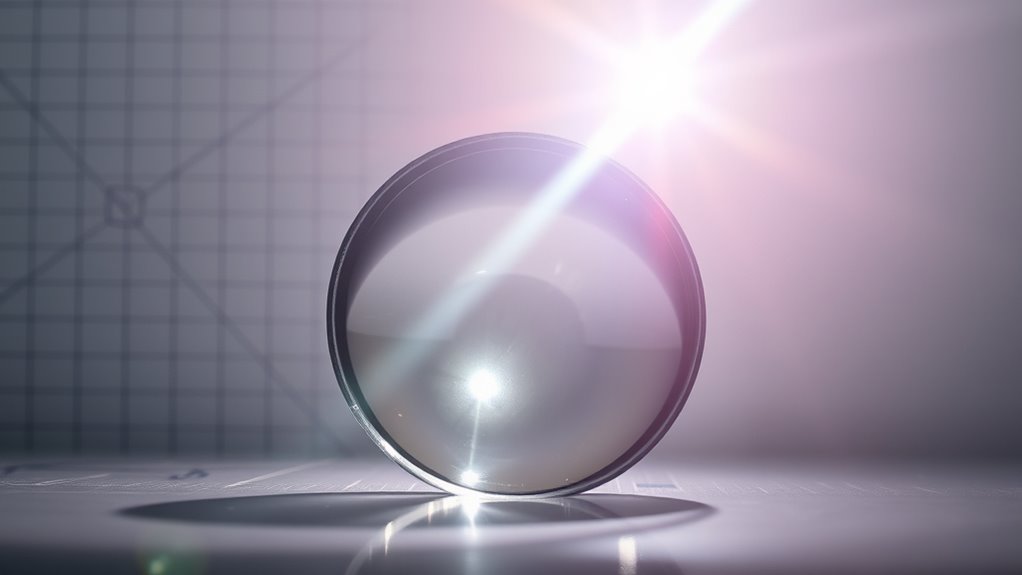
Lenses manipulate light to form images, relying on the principles of refraction you’ve already learned. When light passes through a lens, it bends, creating a focused image on a screen or your retina. The image can be real or virtual, depending on the lens type and object position. Lens magnification determines whether the image appears larger or smaller than the object. You’ll also notice that images formed by convex lenses are inverted, meaning upside down, due to the way light rays cross. To understand this better, consider these points:
- The position of the object affects the size and type of image formed
- Real images are inverted and can be projected onto a screen
- Virtual images are upright and seen through the lens without projection
- The contrast ratio of a lens system influences the clarity and depth of the formed image
This process is essential in designing optical devices like cameras and microscopes.
Types of Lenses and Their Properties
Have you ever wondered how different optical devices achieve various focusing effects? The answer lies in the types of lenses and their properties. Convex lenses, which are thicker in the middle, converge light rays to a focal point, making them ideal for magnification and focusing. Concave lenses, thinner in the middle, diverge light rays, spreading them apart, and are used in glasses for nearsightedness. Lens properties like focal length, curvature, and material determine how they bend light and influence image size and clarity. Some lenses are designed to correct aberrations, while others emphasize specific effects. Understanding these types of lenses and their properties helps you appreciate how optical devices manipulate light to produce sharp images, whether in cameras, glasses, or microscopes.
Lens Aberrations and Optimization

Although lenses are essential for focusing and manipulating light, they often introduce imperfections called aberrations that can distort images. Two common types are chromatic aberration, where different colors focus at different points, and spherical aberration, where light rays near the lens edge focus improperly. To minimize these issues, you can:
- Use achromatic doublets to correct chromatic aberration
- Shape lens surfaces as aspheric to reduce spherical aberration
- Apply coatings or choose materials that improve image quality
- Understanding the different types of aberrations enables better lens design and correction strategies
These optimization techniques help produce sharper, clearer images. By understanding and addressing these aberrations, you enhance lens performance, ensuring your optical systems work more accurately and with fewer distortions. Proper correction leads to better image fidelity and overall system efficiency.
Designing Optical Systems for Precision

Designing optical systems for precision requires careful consideration of component alignment, material selection, and system layout to guarantee minimal errors and ideal performance. You must account for polarization effects, which can alter light behavior and introduce distortions if unmanaged. Using specialized optical coatings helps reduce reflections and improve transmission, ensuring consistent light paths. Precise alignment minimizes aberrations and maintains image quality. Selecting high-quality materials with stable optical properties prevents performance degradation over time. Thoughtful system layout ensures that each element contributes effectively to the overall function. Additionally, implementing proper maintenance protocols can prolong system lifespan and sustain optimal performance. By controlling polarization effects and applying effective coatings, you enhance system reliability and accuracy. This meticulous approach guarantees that your optical system delivers precise, high-fidelity results essential for demanding applications.
Applications of Geometric Optics in Technology
Geometric optics plays an essential role in modern technology, enabling the development of devices that manipulate light with high precision. You’ll find it indispensable in fields like holographic imaging, where it helps create detailed 3D visuals by controlling light paths. In telecommunications, geometric optics guides the design of lenses and mirrors that direct signals efficiently. Additionally, it contributes to advancements in quantum entanglement experiments, where precise light control is critical for secure communication. Recognizing the impact of fatherhood helps us appreciate the importance of guidance and support in nurturing growth and development.
- Designing high-resolution holographic displays
- Improving optical fiber systems for faster data transfer
- Enhancing quantum communication technology through precise light manipulation
Frequently Asked Questions
How Do Lens Coatings Affect Light Transmission and Image Quality?
Lens coatings, like anti-reflective coatings, considerably improve light transmission by reducing glare and reflections, which enhances image quality. They also protect the lens surface, increasing durability against scratches and environmental damage. When you choose lenses with these coatings, you’ll notice clearer, sharper images and longer-lasting performance. Surface durability ensures your lenses stay in good condition over time, maintaining ideal visual clarity and reducing the need for frequent replacements.
What Are the Limitations of Geometric Optics in Complex Systems?
Think of geometric optics as a map with clear roads, but in complex systems, it’s like steering through a maze. You might face limitations like chromatic aberrations, which blur colors, or multiple reflections causing glare. These effects happen because geometric optics simplifies light as straight lines, missing wave behaviors. So, in intricate setups, you need more advanced models to truly understand and correct the imperfections.
How Does Wavelength Influence Lens Design and Performance?
Wavelength effects play a significant role in lens design and performance because different wavelengths of light bend differently, leading to chromatic aberration. You need to take into account this variation to create lenses that minimize color fringing and improve image clarity. By using achromatic or apochromatic lenses, you can correct for these wavelength effects, ensuring sharper images across a broader spectrum, and enhancing overall optical performance.
Can Geometric Optics Be Applied to Non-Visible Wavelengths?
You can apply geometric optics to non-visible wavelengths like infrared and ultraviolet. This approach helps design lenses for infrared imaging and ultraviolet applications, where light behaves similarly to visible wavelengths. Although the wavelengths differ, the principles of light paths and refraction still hold, enabling precise lens design. So, yes, geometric optics remains useful across the electromagnetic spectrum, supporting a variety of specialized imaging and sensing technologies.
How Do Environmental Factors Impact Optical System Accuracy?
Imagine your optical system as a delicate dance floor, where atmospheric turbulence and thermal expansion are gusts of wind and shifting tiles. These environmental factors can throw off your system’s accuracy, causing light paths to distort or drift. As temperature changes, thermal expansion can warp lenses, while atmospheric turbulence adds unpredictable bends. To maintain precision, you need to account for these variables, ensuring your setup stays steady amidst nature’s unpredictable choreography.
Conclusion
As you explore the fascinating world of geometric optics, you’ll find that understanding light paths and lens design opens doors to countless innovations. With a gentle touch on the principles of reflection, refraction, and lens optimization, you can craft optical systems that subtly enhance everyday experiences. Embrace these concepts, and you’ll discover how light’s graceful journey shapes technology’s silent yet profound influence on your world.