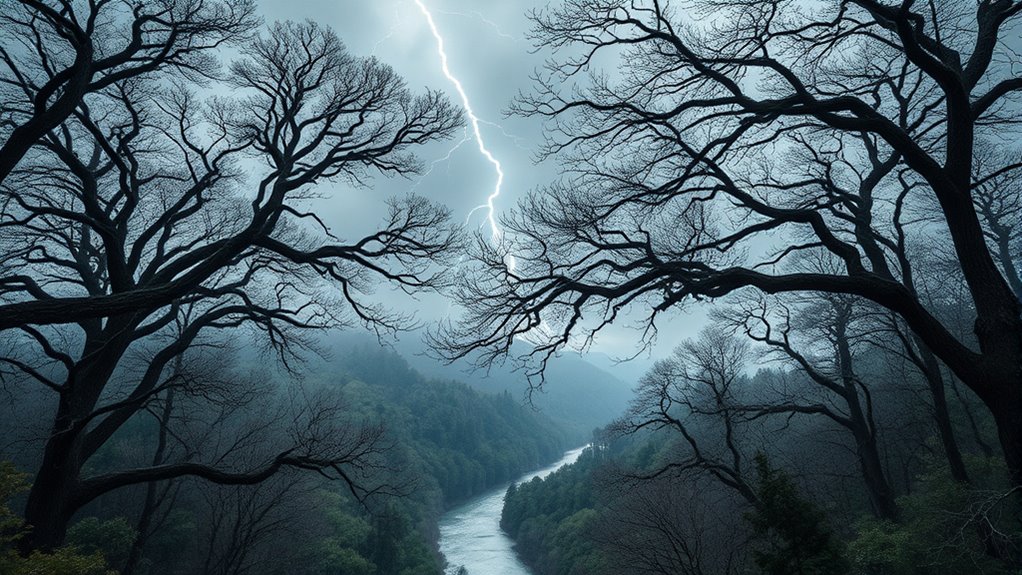

Nature’s fractals are fascinating patterns you see in trees, rivers, and lightning, all following self-similar designs. Trees branch out to maximize space and resources, while river systems split into smaller streams based on fractal rules for efficiency. Lightning paths jag into smaller forks that mirror the main bolt, creating beautiful, complex shapes. If you want to explore how these patterns reveal nature’s underlying mathematics, keep exploring—you’ll discover more hidden connections.
Key Takeaways
- Natural fractals exhibit self-similar patterns across scales, seen in trees, rivers, and lightning.
- Fractal geometry explains how simple rules produce complex, efficient structures in nature.
- Tree branches, river networks, and lightning paths all follow fractal patterns to optimize flow and resource distribution.
- Self-similarity enhances stability, adaptability, and efficiency in biological and environmental systems.
- Fractals reveal the mathematical principles underlying the organization and growth of natural phenomena.
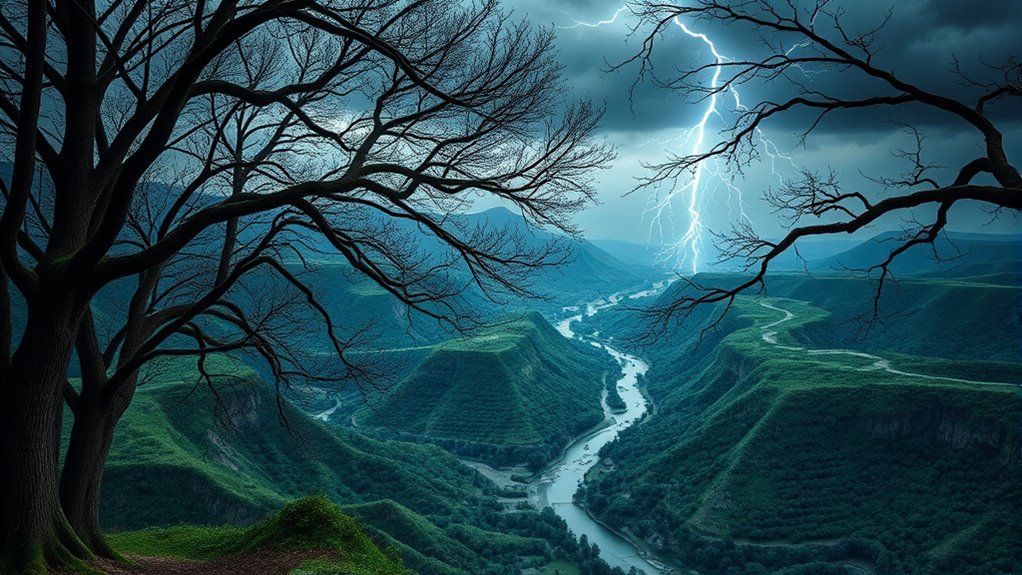
Have you ever noticed the repeating patterns in nature that seem to mirror each other at different scales? These patterns aren’t just coincidental; they’re rooted in the fascinating world of mathematical patterns and self-similarity in biology. When you observe a fern’s fronds, a river delta’s branching, or lightning’s jagged paths, you’re witnessing fractals—structures that repeat their shapes regardless of the level of magnification. Fractals are the visual expression of nature’s inherent order, revealing how simple rules can generate complex and beautiful designs. This self-similarity means that each small part of a pattern resembles the whole, creating a sense of harmony that’s both mesmerizing and efficient. The concept of self-similarity is fundamental to understanding how these natural fractals develop and function.
In biology, self-similarity isn’t just an aesthetic choice; it’s a functional one. Take the branching of blood vessels or bronchial tubes—these structures optimize surface area and flow, all while maintaining a consistent pattern at each scale. Similarly, trees exemplify this concept perfectly. The way a tree’s trunk divides into branches, then smaller branches and twigs, mirrors the larger structure, following fractal geometry. This pattern isn’t random; it’s driven by genetic instructions that produce consistent, scalable forms. As you look at a tree, you’re seeing an elegant demonstration of how mathematical patterns govern growth, ensuring stability and resource distribution across the organism. The same principle applies to river systems, where the main channel splits into smaller streams, which then branch into even finer tributaries. These river networks follow fractal patterns, allowing water to efficiently navigate landscapes, adapt to changes, and optimize drainage.
Lightning, with its jagged, branching strikes, exemplifies nature’s fractal design in a dynamic way. When lightning forks through the sky, each branch resembles the larger bolt, a clear display of self similarity. These patterns aren’t just visually striking—they’re the result of electrical discharge seeking the path of least resistance, creating fractal-like branches that maximize the area for charge transfer. This efficient, recursive pattern is a natural solution to complex problems, showing how mathematical principles underpin even the most transient phenomena.
Frequently Asked Questions
How Do Fractals Influence Ecosystems Beyond Visual Patterns?
You might not realize it, but fractals influence ecosystems through fractal biodiversity and ecological feedback. These patterns help species adapt by creating efficient resource distribution and habitats, fostering resilience. As you observe these natural fractals, you see how they facilitate interactions, promote diversity, and sustain ecological balance. This ongoing feedback loop ensures ecosystems remain healthy, demonstrating that fractal structures are essential beyond just visual appeal, shaping the very fabric of life.
Can Humans Create Artificial Fractal Designs Effectively?
Yes, you can create artificial fractal designs effectively through digital replication. By using computer algorithms, you generate intricate, self-similar patterns that mimic natural fractals. These designs have a strong aesthetic appeal because of their complexity and harmony. Digital tools allow you to experiment easily, refine details, and produce stunning visuals that enhance art, architecture, and design projects, making artificial fractals a powerful creative resource.
How Do Fractals Evolve Over Geological Timescales?
You see, fractals evolve over geological timescales through continuous geological processes like erosion, sedimentation, and tectonic shifts. These processes shape landscapes, rivers, and coastlines, driving fractal evolution by creating complex, self-similar patterns that change gradually. As time passes, natural forces refine and reshape fractal structures, allowing you to observe how landscapes develop intricate, repeating patterns that reflect Earth’s dynamic history.
Are There Practical Applications of Fractals in Technology?
Fractals revolutionize technology in ways you can’t imagine! You can harness fractal antennas to dramatically boost signal strength, making your devices more efficient and powerful. Fractal compression transforms large images into tiny files without losing quality, revolutionizing data storage and streaming. These applications aren’t just innovative—they’re game-changers, pushing the boundaries of what’s possible and making your digital experience faster, clearer, and more reliable.
Do Different Environments Produce Unique Fractal Patterns?
Yes, different environments produce unique fractal patterns. As you explore diverse settings, you’ll notice how environmental diversity influences pattern variability. In lush forests, fractal branching creates complex canopies, while in deserts, simpler, more sparse structures emerge. Rivers carve distinct fractal networks, and lightning strikes form variable, jagged patterns. These variations reflect the specific conditions of each environment, showcasing how nature’s fractals adapt and evolve based on local factors.
Conclusion
As you observe these natural fractals, you’ll realize they’re like the universe’s fingerprints—intricate, unique, and endlessly repeating. They remind you that nature’s beauty isn’t random but a symphony of patterns woven into every branch, river, and lightning bolt. Embrace the wonder, knowing that these fractals connect everything in a delicate dance, echoing the infinite complexity of the cosmos. In understanding them, you glimpse the universe’s silent poetry, written in the language of patterns.