
Fibonacci spirals are fascinating patterns found in natural forms like sunflower heads and seashells. They result from the Fibonacci sequence, where each number adds to the previous, creating ratios that closely match the golden ratio. These spirals allow plants and shells to optimize space, strength, and resource use. The geometric pattern unfolds predictably, revealing how math shapes beauty and efficiency in nature. If you keep exploring, you’ll uncover even more wonders of this natural design.
Key Takeaways
- Fibonacci spirals are constructed by connecting quarter-circle arcs across squares with side lengths following Fibonacci numbers, creating a natural expanding spiral.
- In sunflowers, seed arrangements follow Fibonacci numbers to maximize packing efficiency and resource utilization.
- Nautilus shells exhibit Fibonacci-based spiral growth, resulting in stable and aesthetically harmonious shapes.
- These spirals reflect the underlying mathematical pattern of the Fibonacci sequence and the golden ratio, contributing to natural harmony.
- Fibonacci spirals demonstrate how nature employs mathematical principles for structural stability and functional optimization.

Have you ever noticed the elegant spiral patterns found in seashells, galaxies, or sunflower heads? These mesmerizing designs are more than just visually appealing—they embody the fascinating world of mathematical patterns that underlie natural formations. The Fibonacci spiral, in particular, exemplifies how nature employs these patterns to create structures that are both efficient and aesthetically pleasing. When you observe a sunflower’s seed arrangement or a nautilus shell, you’re witnessing the manifestation of a mathematical sequence that appears repeatedly across different scales and forms.
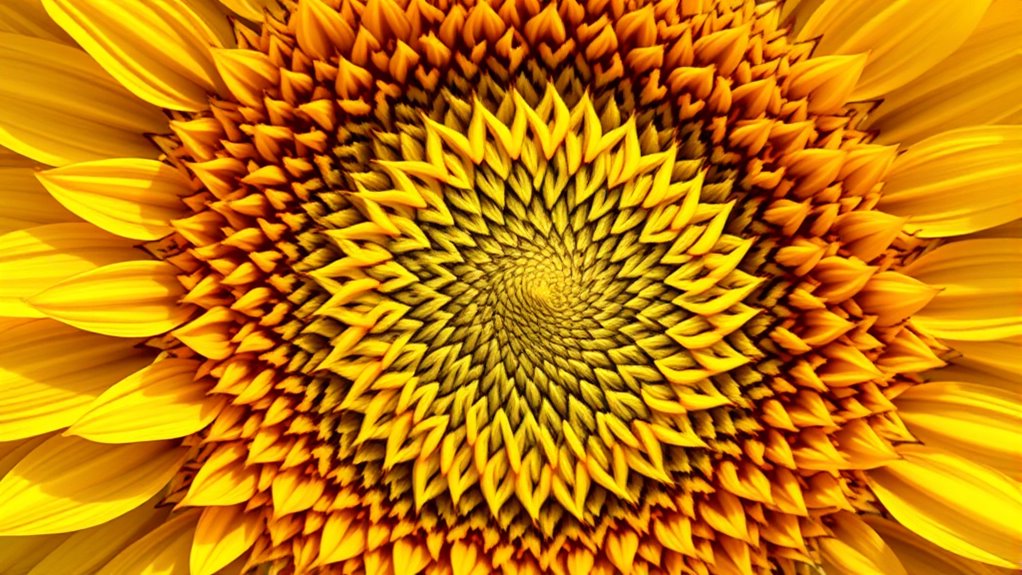
Mathematical patterns like the Fibonacci sequence are embedded deeply within natural formations. This sequence, where each number is the sum of the two preceding ones, results in ratios that closely approximate the golden ratio. This ratio is renowned for its aesthetic harmony and appears frequently in nature, architecture, and art. As you look at sunflower heads, notice how the seeds are arranged in spirals that curve outward—these spirals follow Fibonacci numbers, ensuring prime packing without gaps. It’s as if nature has found a way to maximize space and resources, creating a pattern that’s both functional and visually appealing.
Mathematical patterns like Fibonacci ratios optimize space, function, and beauty in nature’s designs.
The Fibonacci spiral is constructed by drawing circular arcs connecting the opposite corners of squares whose side lengths follow the Fibonacci sequence. When you visualize this, it’s clear how the spiral expands proportionally, maintaining its shape as it grows. This geometric pattern recurs in everything from the spiral shells of mollusks to the swirling arms of galaxies. It’s a universal language of design, revealing how mathematical patterns shape the universe at every scale. Nature’s ability to embed these spirals into its formations isn’t accidental; it’s a result of evolutionary efficiency, where structures that adhere to these patterns tend to be stronger, more stable, and better suited to their environments.
Additionally, the golden ratio frequently appears in these natural designs, contributing to their perfect proportions and visual harmony. Understanding the connection between mathematical patterns and natural formations enriches your appreciation of the world around you. Every seashell, sunflower head, or spiral galaxy shares a common blueprint rooted in the Fibonacci sequence and the golden ratio. These principles aren’t just mathematical curiosities—they’re fundamental to how nature organizes its complexity into harmonious, functional forms. The next time you see a sunflower or a shell, take a moment to marvel at the mathematical precision behind its beauty. Recognizing these patterns transforms ordinary observations into a deeper understanding of the elegant, underlying order that governs natural formations across the universe.
Frequently Asked Questions
How Do Fibonacci Spirals Compare to Other Natural Spirals?
Fibonacci spirals stand out for their mathematical modeling and perfect spiral symmetry, making them uniquely efficient in nature. Compared to other natural spirals, like logarithmic or Archimedean spirals, Fibonacci spirals often appear more harmonious and optimized for growth. You’ll notice these spirals in sunflower heads and shells, where they help plants maximize space and resources. Their mathematical basis makes them a fascinating example of nature’s intrinsic design.
Are Fibonacci Spirals Unique to Specific Plant Species?
Fibonacci spirals aren’t exclusive to specific plant species; they showcase a fascinating mathematical uniqueness across various organisms. You’ll find these spirals in sunflowers, pinecones, and shells, demonstrating botanical specificity that highlights nature’s efficiency. This pattern’s recurring presence suggests a universal principle rather than species dependence. So, while some plants prominently feature Fibonacci spirals, their mathematical uniqueness extends broadly, revealing nature’s elegant use of Fibonacci sequences for ideal growth and structure.
Can Fibonacci Spirals Be Found in Man-Made Objects?
Beauty is in the eye of the beholder, and Fibonacci spirals prove it. You’ll find these spirals in man-made objects like architectural designs and mathematical applications, where they add harmony and efficiency. From ancient spiraling staircases to modern sculptures, these patterns serve both aesthetic and functional purposes. So yes, Fibonacci spirals aren’t just nature’s secret—they’re a powerful tool in design, blending math and artistry seamlessly.
How Do Fibonacci Numbers Influence Plant Growth Patterns?
You notice how Fibonacci numbers influence plant growth patterns by guiding seed dispersal and leaf arrangement. These numbers help plants optimize space and sunlight, leading to efficient packing of seeds in sunflower heads and spiral leaf arrangements on stems. By following Fibonacci sequences, plants maximize their growth potential, ensuring better survival chances. This natural pattern demonstrates how mathematics directly shapes the way plants develop and thrive in their environments.
Are Fibonacci Spirals Present in Microscopic Organisms?
You might think microscopes can’t reveal Fibonacci spirals, but they do appear in some microscopic organisms. These tiny creatures exhibit natural patterns in their cellular structures and microscopic patterns that follow Fibonacci sequences. By observing these organisms closely, you see how nature’s design principles, like Fibonacci spirals, extend even to the microscopic world, demonstrating that mathematical harmony isn’t limited to larger plants and shells but is woven into life’s very fabric.
Conclusion
Now that you’ve seen how Fibonacci spirals shape sunflowers and shells, it’s clear nature truly follows a master plan. These patterns aren’t just pretty—they’re efficient and functional, proving that beauty and brains often go hand in hand. Remember, the devil’s in the details, and by spotting these spirals, you’re uncovering nature’s secret code. Keep your eyes open; there’s more to discover when you look beyond the surface. Nature’s secrets are waiting to be unraveled.