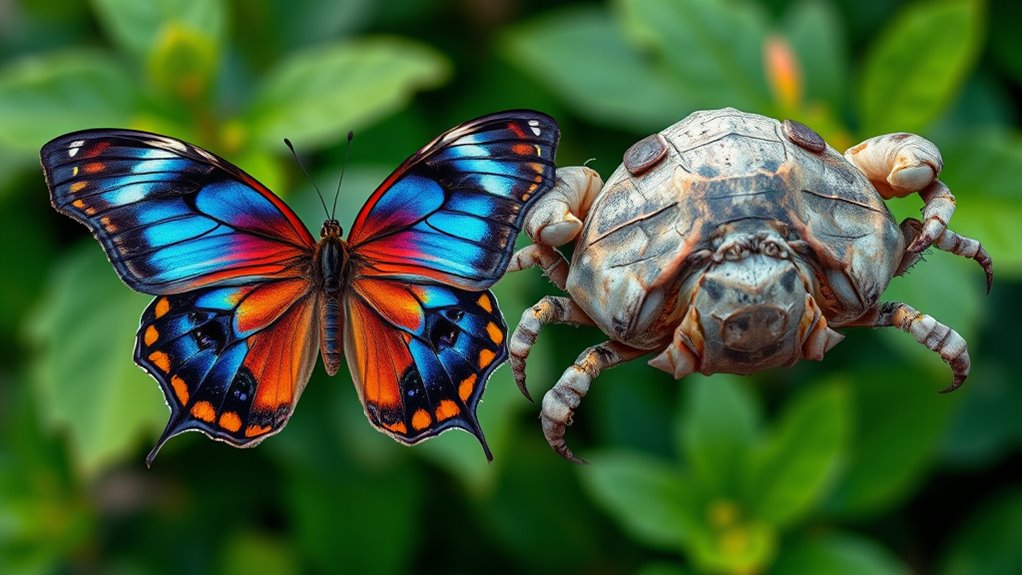

Butterflies are symmetric because their body plan develops for balanced movement, attraction, and coordination, making them efficient flitters and appealing to mates. Crabs, on the other hand, are asymmetrical, which helps them hide, burrow, and protect themselves in their environment. This difference shows how body shapes adapt to specific lifestyles. If you want to understand how these forms evolved and what they reveal about animal survival, keep exploring further.
Key Takeaways
- Butterflies have bilateral symmetry to enhance balance, flight, and attract mates through visual displays.
- Crabs are asymmetrical due to their body adaptations for protection, burrowing, and environmental interactions.
- Bilateral symmetry in butterflies results from embryonic development, supporting coordinated movement and navigation.
- Asymmetry in crabs offers functional advantages like better grip and camouflage in their habitats.
- Evolution shapes butterflies for mobility and display, while crabs develop asymmetry for defense and survival tactics.
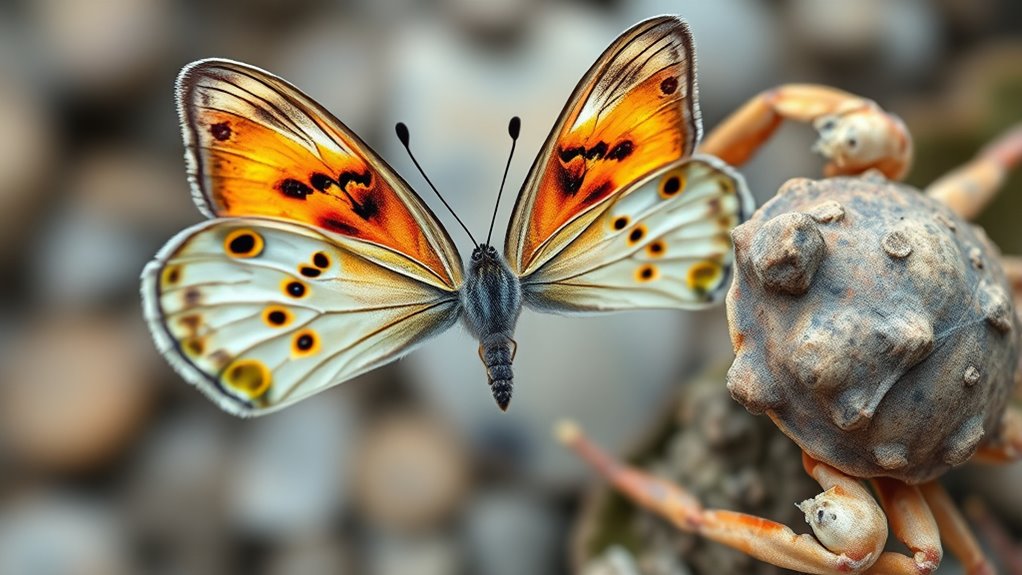
Have you ever wondered why many animals have symmetrical bodies? It’s a fascinating aspect of biology that helps explain how different creatures live, move, and survive. Bilateral symmetry, where an organism can be divided into two mirror-image halves along a single plane, is common among animals like butterflies and humans. This symmetry isn’t just for looks; it plays a vital role in how animals interact with their environment. On the other hand, some animals are asymmetrical, lacking this mirror-image quality altogether. Understanding why certain animals are symmetrical while others aren’t reveals a lot about their evolutionary history and lifestyle.
Bilateral symmetry is especially prominent in animals that rely heavily on movement and coordination. When you look at a butterfly, its wings are perfectly symmetrical on both sides, giving it balance and agility. This type of symmetry allows for streamlined movement and helps butterflies navigate through the air efficiently, whether they’re searching for nectar or avoiding predators. It also plays a role in mating displays, where symmetry can signal good health and genetic fitness to potential mates. Since bilateral symmetry involves a clear front and back, it supports directional movement—think about how a butterfly’s head faces forward, enabling it to hunt or find food with precision.
Contrast this with asymmetrical animals, such as crabs or sponges. Crabs, for example, have a body plan that’s not symmetrical, especially when viewed from different angles. Their asymmetry is often a result of their lifestyle and habitat. Crabs have a hard shell that’s adapted for protection and burrowing into the sand or mud. Their asymmetrical body can provide advantages, like better grip or a more effective way to carry food or mates. Unlike butterflies, crabs don’t rely on streamlined movement or visual displays of symmetry; instead, their body shape aids in their survival strategies, including defense and camouflage.
The presence of bilateral symmetry in animals like butterflies is also linked to their development during embryonic stages. During early growth, bilateral symmetry ensures that organs and limbs develop correctly and proportionally. This symmetry becomes a blueprint for their complex movements and behaviors later in life. Additionally, developmental processes play a crucial role in establishing symmetry in animals, shaping their overall body plan from an early stage. Conversely, asymmetrical animals have evolved body plans that suit their specific environments and survival tactics, even if it means sacrificing symmetry. Their body forms are shaped by natural selection to optimize their way of living, whether that’s burrowing, feeding, or avoiding predators.
In essence, whether an animal is symmetrical or asymmetrical depends on its evolutionary needs and how it interacts with its surroundings. While bilateral symmetry offers advantages for mobility and display in many animals, asymmetry often provides benefits tailored to particular lifestyles or environments. Both body plans serve their purposes, illustrating the incredible diversity of life on Earth.
Frequently Asked Questions
Do All Insects Have Symmetrical Wings?
Not all insects have symmetrical wings, but many do, especially butterflies, which display mirrored wing patterns due to their bilateral symmetry. Insect diversity is vast, so wing symmetry varies across species. Some insects, like beetles, may have asymmetrical or irregular wing patterns, serving different functions. Understanding wing symmetry helps you appreciate the evolutionary adaptations in insects, highlighting how their wing patterns contribute to survival and mating strategies.
How Does Symmetry Affect a Butterfly’s Flight?
Symmetry in butterfly wings enhances wing aerodynamics, allowing smooth and efficient flight. When your wings are symmetrical, you gain better control and stability, making it easier to escape predators through quick, agile movements. Additionally, symmetrical wings help you blend into your environment via predator camouflage, making it harder for predators to spot you. This perfect balance of form and function improves your chances of survival and successful navigation through your surroundings.
Why Do Crabs Have Asymmetrical Claws?
Think of crabs as a pair of dancers with one shoe bigger than the other. Their asymmetry in crustaceans has evolved to give them an advantage; one claw becomes a powerful weapon, the other a delicate tool for feeding. This crab claw evolution, driven by natural selection, results in asymmetrical claws that help crabs excel in their environment, making them masters of both offense and defense.
Can Symmetry Change During an Animal’s Lifespan?
Yes, symmetry can change during an animal’s lifespan due to developmental variations. As animals grow, they might experience shifts in symmetry because of genetic factors, injuries, or environmental influences. These changes can offer evolutionary advantages, such as improved mobility or camouflage. You might notice this in some species where juvenile symmetry differs from adult symmetry, helping them adapt better to their environments or enhance survival chances over time.
Are There Any Animals With Perfectly Symmetrical Bodies?
You might be surprised, but only a few animals have perfectly symmetrical bodies—like some flatworms and certain jellyfish. About 10% of these creatures exhibit near-perfect symmetry, which offers evolutionary advantages like better movement and camouflage. Their developmental processes are highly precise, ensuring symmetry from early stages. This precise symmetry helps them survive and thrive, making them fascinating examples of nature’s intricate design, even if absolute perfection remains rare.
Conclusion
You now see how animal symmetry is a dance of evolution, guiding creatures like butterflies to mirror themselves beautifully, while crabs keep their asymmetry as a quirky trait. Symmetry acts like a mirror reflecting nature’s perfect balance, but sometimes, irregularity adds character, just like a splash of color on a canvas. Whether symmetrical or not, each animal’s design tells a story of survival and adaptation—nature’s way of composing a symphony of life, unique and endlessly fascinating.