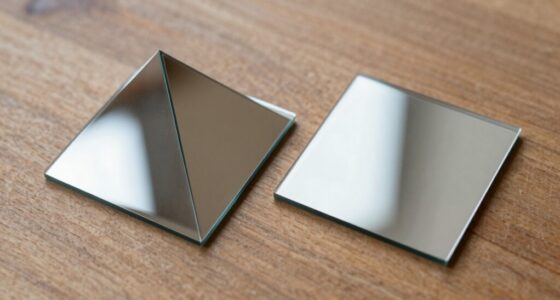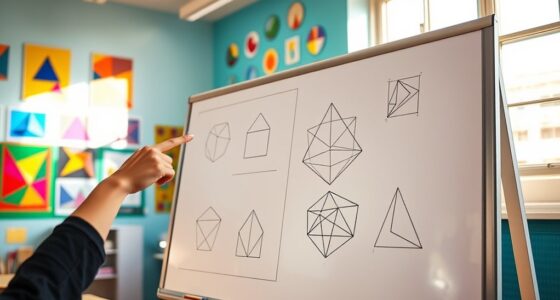

Transformations connect art, motion, and math by showing how shapes and patterns can change and stay balanced through operations like reflection, rotation, and scaling. These processes reveal symmetry, create illusions, and form dynamic visuals. They also drive motion in animation and interactive designs, making art feel alive. By understanding these mathematical operations, you’ll see how art can express movement and complex patterns. Keep exploring to discover how these ideas shape visual worlds around you.

Prime made for students and young adults
- Fast, free delivery for dorm and study essentials
- Prime Video and Amazon Music included
- Member-only deals
Key Takeaways
- Transformations serve as a mathematical framework that explains how shapes evolve in art and motion, creating dynamic visual effects.
- Symmetry and geometric operations underpin artistic designs, linking aesthetic harmony with mathematical principles.
- Visual illusions and perception are manipulated through transformations like scaling and shearing, illustrating their role in visual phenomena.
- In animation and interactive art, transformations govern movement and shape changes, bridging digital technology with mathematical rules.
- Transformations reveal the underlying structure of complex patterns, connecting geometry, aesthetics, and scientific understanding.
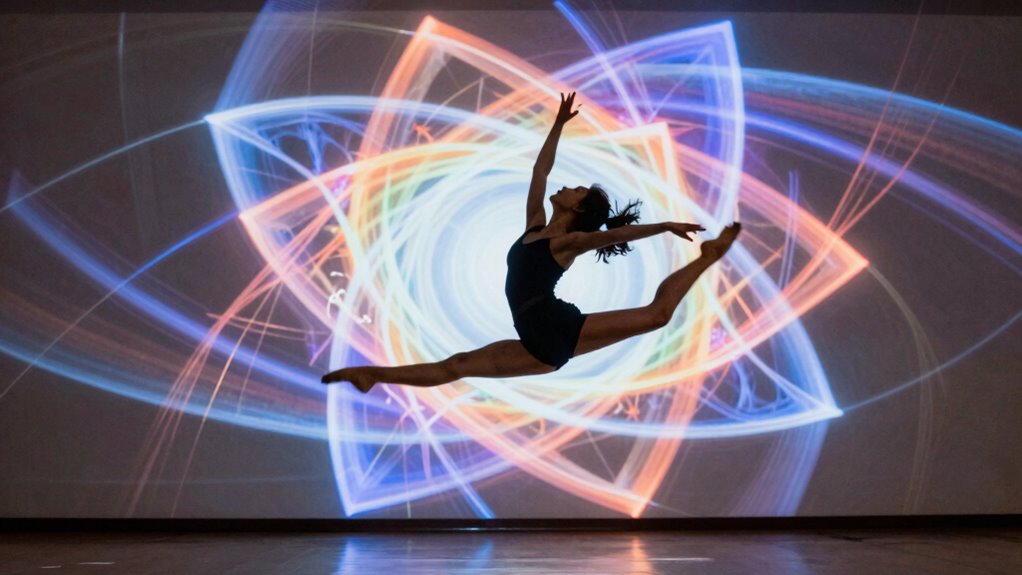
Transformations serve as a fascinating bridge between art, motion, and mathematics, revealing how shapes and patterns can change and evolve through precise operations. When you explore symmetry patterns, you see how a simple shape can be reflected, rotated, or translated to create a balanced, harmonious design. Symmetry isn’t just an aesthetic choice; it’s a mathematical principle that underpins many artistic works and natural phenomena. As you observe these patterns, you notice how they maintain their integrity despite transformations, illustrating the core idea of invariance under specific operations. This connection deepens your understanding of how artists and mathematicians use symmetry to craft visually pleasing compositions that also obey mathematical rules. Additionally, recognizing how these principles extend into natural phenomena helps deepen your appreciation of their universal relevance beyond art and design. Recognizing the role of mathematical principles in these transformations enhances your grasp of how complex patterns are generated and understood.
You also discover that geometric illusions harness the power of transformations to trick the eye. These illusions manipulate perspective, contrast, and shape to create images that seem to move or shift even when they’re still. You realize that geometric illusions are not just visual tricks but are rooted in the way our brains interpret spatial transformations. For instance, when you see a pattern that appears to ripple or bend, it’s often the result of carefully applied transformations that distort our perception. These illusions demonstrate how mathematical operations, such as scaling or shearing, can produce effects that seem to defy reality, blurring the line between perception and actual shape.
You also notice that transformations serve as the foundation for motion in animation and interactive art. When objects move across a screen or change shape over time, they follow mathematical rules—translations, rotations, or dilations—that guide their behavior. This linkage makes your experience of digital art more intuitive, as you understand that each movement is a precise application of geometric principles. Whether it’s a kaleidoscope of symmetrical patterns or a shifting illusion, the underlying transformations dictate how the art evolves and interacts with your perception.
Ultimately, you see that transformations are central to connecting art, motion, and math. They allow you to analyze and create complex patterns and illusions, revealing the deep structure behind visual phenomena. By understanding how shapes change through transformations, you gain insight into the universal language of geometry that underpins both aesthetic creativity and scientific understanding. This interconnectedness invites you to appreciate how mathematical concepts shape your visual world, transforming simple shapes into intricate, dynamic works of art.
geometric transformation art kit
As an affiliate, we earn on qualifying purchases.
As an affiliate, we earn on qualifying purchases.
Frequently Asked Questions
How Do Transformations Influence Contemporary Digital Art?
Transformations shape contemporary digital art by allowing you to manipulate images creatively, influencing your digital identity. You can use visual distortion techniques to challenge perceptions and evoke emotional responses. These transformations enable you to experiment with abstract forms, blending art and technology seamlessly. As a result, your digital artwork becomes more dynamic, engaging, and reflective of personal or societal narratives, highlighting how transformations serve as powerful tools in modern artistic expression.
Can Transformations Be Used to Predict Motion in Real-World Physics?
Yes, transformations can be used to predict motion in real-world physics. By applying principles of predictive modeling, you analyze current physical dynamics to forecast future movement. Transformations help you understand how objects change position, orientation, or shape over time, making them vital tools in simulating real-world scenarios. This approach improves accuracy in areas like robotics, animations, and engineering, where anticipating motion is essential for effective design and control.
What Are the Most Common Mathematical Transformations in Art Design?
You mainly encounter symmetry patterns and fractal geometry as common mathematical transformations in art design. Symmetry patterns create balance and harmony, often seen in wallpapers, mosaics, and logos. Fractal geometry adds intricate, self-similar details that captivate viewers, like in natural landscapes or abstract artworks. These transformations help artists explore complex, visually appealing designs, blending math with creativity to produce engaging, harmonious compositions.
How Do Transformations Help in Creating 3D Animations?
Transformations are your secret weapon for creating 3D animations that pop. They help you manipulate objects, adding depth perception and realistic shape deformation, making scenes more convincing. By applying rotations, translations, and scaling, you can bring characters and environments to life, giving viewers a sense of movement and space. Fundamentally, transformations let you tell stories with motion, turning flat ideas into immersive visual experiences.
Are There Cultural Differences in the Perception of Transformations?
You’ll find that cultural interpretation influences how transformations are perceived, affecting aesthetic variation across societies. Different cultures may emphasize certain transformations or interpret them symbolically, shaping visual and artistic preferences. This means what’s considered dynamic or harmonious in one culture might differ elsewhere. By understanding these cultural nuances, you can better appreciate diverse artistic expressions, recognizing that perceptions of transformations are shaped by cultural contexts and aesthetic values worldwide.
As an affiliate, we earn on qualifying purchases.
Conclusion
As you see, transformations bridge the worlds of art, motion, and math, revealing their deep interconnectedness. They allow you to manipulate shapes, create dynamic visuals, and understand complex patterns with ease. Isn’t it fascinating how a simple shift or rotation can open a universe of creativity and understanding? Embracing these connections empowers you to see beyond boundaries and appreciate the beauty in mathematical precision and artistic expression alike.
As an affiliate, we earn on qualifying purchases.
animation motion graphics software
As an affiliate, we earn on qualifying purchases.
As an affiliate, we earn on qualifying purchases.
Fall Picks
fall essentials
As an affiliate, we earn on qualifying purchases.