
When you work on simple geometry tasks, small measurement errors can quickly grow and impact your results. For instance, a tiny mistake in measuring a side can lead to bigger inaccuracies in calculating area or hypotenuse. These errors multiply through calculations, making your final answer less reliable. Understanding how these errors spread helps you see why precise measurements matter. If you keep exploring, you’ll discover ways to control and minimize these errors for better results.
Key Takeaways
- Small measurement errors in sides or angles can lead to larger inaccuracies in area or length calculations.
- Errors in measuring one component propagate through formulas like the Pythagorean theorem, amplifying inaccuracies.
- Combining multiple measurements increases overall error, affecting the reliability of geometric results.
- Precise initial measurements and techniques help minimize the impact of error propagation.
- Understanding how errors spread guides better measurement practices and improves result accuracy.

Have you ever wondered how small measurement errors can affect the accuracy of your geometric calculations? It’s a common question, especially when working with simple tasks like measuring lengths or angles. In geometry, your goal is often to find precise results based on measurements, but even tiny inaccuracies can snowball through your calculations, leading to surprisingly large errors. This is where understanding error propagation becomes essential. When you measure a side of a rectangle with a slight overestimation, this small error influences the area calculation. When you multiply the length by the width, even a tiny measurement error gets amplified, making your area estimate less accurate. Similarly, suppose you’re calculating the length of a diagonal using the Pythagorean theorem. A small mistake in measuring the legs of the right triangle can lead to a more considerable error in the hypotenuse. This illustrates how initial measurement inaccuracies ripple through your calculations, affecting the final result. The key is understanding how these errors propagate, so you can better estimate the reliability of your results. Recognizing the relationship between measurement errors helps you assess the quality of your results and decide how to improve your measurement techniques. Additionally, understanding the uncertainty in measurements can guide you in choosing appropriate tools and methods for greater accuracy.
In simple geometry tasks, error propagation isn’t just about acknowledging inaccuracies; it’s about controlling them. You want to maximize your measurement accuracy from the start, using precise tools and careful techniques. By doing so, you limit how much errors can grow in subsequent calculations. Also, understanding the relationship between measurement errors and their impact helps you assess the quality of your results. For instance, if you know the potential margin of error in your measurements, you can estimate how much that margin influences your final answer. This awareness allows you to decide whether your results are reliable enough or if you need more precise measurements.
Ultimately, error propagation in basic geometry tasks underscores the importance of precision in every step. Small measurement errors may seem inconsequential initially, but their effects accumulate, leading to less reliable results. Recognizing this helps you develop better measurement habits and more accurate calculation techniques. By paying close attention to measurement accuracy and understanding how errors propagate, you ensure that your geometric work maintains the highest possible level of precision, giving you confidence in your results.
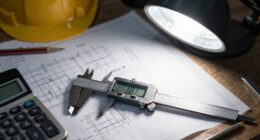
digital caliper for precise measurements
As an affiliate, we earn on qualifying purchases.
As an affiliate, we earn on qualifying purchases.
Frequently Asked Questions
How Do Measurement Errors Affect Angle Calculations in Geometry?
Measurement errors can considerably impact your angle calculations in geometry. Measurement uncertainty, stemming from imperfect instrument calibration or user handling, causes slight deviations in your measurements. When you use these measurements to calculate angles, these small errors propagate, leading to inaccuracies. To minimize this, make certain your instruments are properly calibrated, handle measurements carefully, and account for potential uncertainties, which helps improve the accuracy of your angle calculations.
What Tools Can Minimize Error Propagation in Geometric Measurements?
You can enhance measurement accuracy by choosing precise tools and ensuring proper instrument calibration. Using high-quality instruments reduces the chance of errors creeping into your measurements. Regularly calibrate your tools to catch any deviations early, keeping your measurements reliable. Additionally, double-check your work and use consistent techniques, which together help minimize error propagation. This approach keeps your geometric calculations as accurate and trustworthy as possible, making your work smoother and more precise.
How Does Error Propagation Differ Between 2D and 3D Geometrical Tasks?
In 2D tasks, error propagation mainly involves coordinate transformations within a plane, which can be straightforward. However, in 3D tasks, errors multiply through additional dimensions, making dimensional analysis vital to understand how uncertainties in measurements affect the overall result. You need to account for more complex transformations, and errors tend to compound more markedly, requiring careful consideration of measurement precision and the propagation process to guarantee accuracy.
Can Error Propagation Be Completely Eliminated?
Sure, error propagation can’t be entirely eliminated—life’s too unpredictable. However, you can minimize it with good calibration techniques and thorough error analysis. Think of calibration as your safety net, catching inaccuracies before they grow. While you won’t erase all errors, diligent calibration and analysis help keep them manageable, making your measurements more reliable. So, perfection’s a myth, but precision? That’s well within reach.
How Do Errors Accumulate in Complex Geometric Constructions?
In complex geometric constructions, errors accumulate through error correlation and propagation modeling. As you combine multiple measurements, small inaccuracies can become magnified, especially if errors are correlated, meaning they influence each other. By understanding how errors propagate through each step, you can better predict overall accuracy. Using propagation modeling helps you identify where errors may increase, allowing you to implement strategies to minimize their impact on the final construction.
laser distance meter for geometry tasks
As an affiliate, we earn on qualifying purchases.
As an affiliate, we earn on qualifying purchases.
Conclusion
By understanding how errors propagate in simple geometry tasks, you can better assess the accuracy of your measurements and calculations. Notably, studies show that even small measurement errors can double or triple in complex calculations, emphasizing the importance of precision. So, next time you measure or calculate, remember that careful measurement reduces cumulative errors. Mastering error propagation not only sharpens your geometric skills but also boosts your confidence in obtaining reliable results.
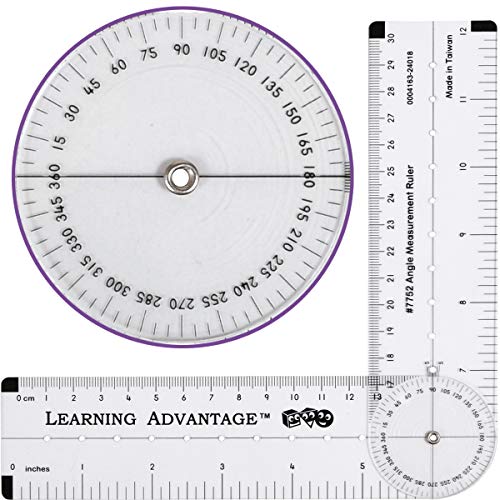
Learning Advantage Angle Measurement Ruler, Clear, Flexible and Adjustable
- Versatile Measurement Tool: Measures angles and lengths up to 360° and 12 inches
- Precise Angle Measurement: Measures angles to the nearest degree or 5°
- Easy Angle Marking: 20 spaced holes for quick marking
As an affiliate, we earn on qualifying purchases.
As an affiliate, we earn on qualifying purchases.
precision ruler for accurate measurements
As an affiliate, we earn on qualifying purchases.
As an affiliate, we earn on qualifying purchases.