
Assumptions quietly shape every geometry answer by serving as the unspoken rules that guide your reasoning and determine what you accept as true. They influence how you interpret shapes, distances, and angles, often without you realizing it. These foundational beliefs set the framework within which you work, ensuring logical consistency. Recognizing these assumptions reveals how much your conclusions depend on them—and if you keep exploring, you’ll uncover how they underpin every geometric idea you encounter.
Key Takeaways
- Assumptions serve as the foundational rules that determine the validity of geometric proofs and conclusions.
- They influence how geometric concepts like distance, angles, and shape are interpreted and applied.
- Assumptions about ideal tools and constructions enable precise replication and verification of geometric properties.
- They underpin transformations and models that shape our understanding of space and geometric relationships.
- Recognizing these assumptions reveals the underlying framework guiding every geometric answer.
Have you ever wondered how mathematicians build the foundation of geometry? It all begins with assumptions—those unspoken rules that guide every proof, calculation, and conclusion. When you think about geometric principles, it’s easy to forget that much of what you accept as fact relies on foundational assumptions. These assumptions serve as the silent backbone, shaping how you interpret shapes, distances, and angles.
One key way assumptions influence geometry is through coordinate transformations. When you change from one coordinate system to another—say, from Cartesian to polar coordinates—you’re relying on the assumption that the relationships between points remain consistent. These transformations are built on the idea that space can be reshaped mathematically without altering the fundamentally of geometric figures. It’s a core assumption that allows you to analyze figures from different perspectives or simplify complex problems. Without this, solving geometric problems would be far more complicated, as you’d be stuck in a fixed frame of reference. The assumption that transformations preserve certain properties, like distances or angles, underpins many advanced geometric techniques. It’s what makes it possible to rotate, translate, or scale figures and still understand their core relationships. Recognizing the fundamental assumptions behind these transformations can also help in understanding the limitations and potential errors in practical applications.
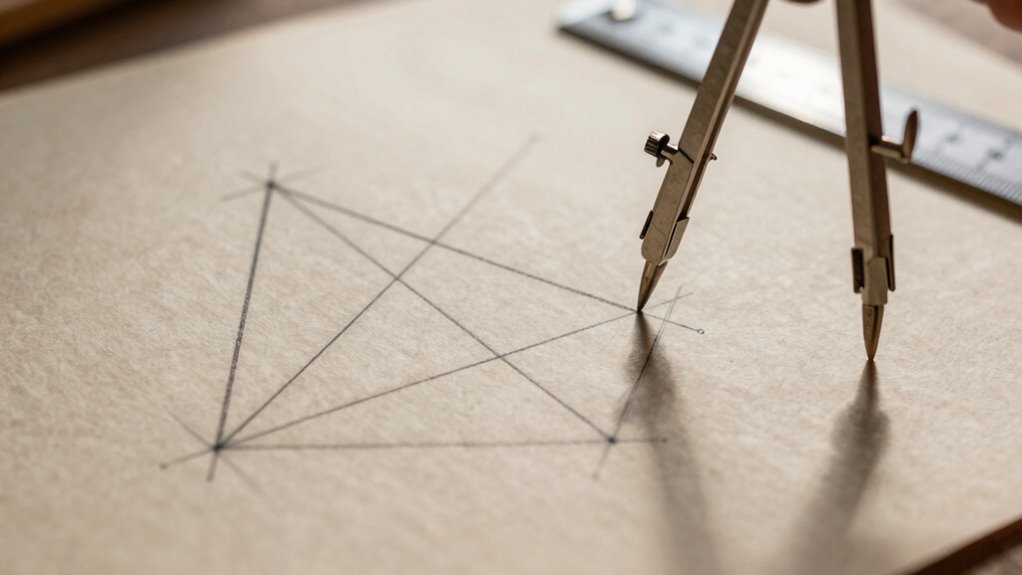
Geometric constructions, another cornerstone of geometry, also rely heavily on assumptions. When you draw circles, bisect lines, or construct angles, you’re operating under the assumption that certain tools and steps will lead to precise, repeatable results. These constructions assume the existence of ideal points, lines, and circles that can be perfectly drawn with compass and straightedge. They also presuppose that these tools obey specific rules—like a compass maintaining a fixed radius—so that the constructions are accurate. These assumptions allow you to replicate and verify geometric properties, even when working without measurements. Fundamentally, geometric constructions are built on the assumption that the tools and methods used are perfect, which isn’t always possible in real life but holds true in the idealized world of mathematical reasoning. Interestingly, understanding the assumptions in geometry can also help mathematicians develop more flexible models that account for real-world imperfections. This awareness of idealizations underscores the importance of mathematical modeling in applying geometric principles to practical scenarios.
Additionally, the assumption that the Euclidean geometry principles hold true in an idealized space forms the basis for many geometric proofs and theorems. When considering models of non-Euclidean geometries, such as hyperbolic or spherical geometry, mathematicians are explicitly challenging these assumptions, which broadens our understanding of space. Recognizing these core assumptions allows mathematicians to explore alternative geometric systems and their applications.
Every answer in geometry, whether it’s about the size of an angle or the congruence of figures, is shaped by these underlying assumptions. They quietly set the boundaries within which you operate, guiding you toward logical conclusions. Recognizing these assumptions helps you understand that geometry isn’t just about figures, but about the foundational beliefs that make those figures meaningful. Without them, the entire structure of geometric reasoning would crumble, and your answers would lack certainty. Basically, assumptions in geometry are the unseen scaffolding that supports every logical step you take, quietly shaping your understanding of space and form.
geometric construction compass and straightedge set
As an affiliate, we earn on qualifying purchases.
As an affiliate, we earn on qualifying purchases.
Frequently Asked Questions
How Do Assumptions Differ From Explicit Given Data?
Assumptions differ from explicit given data because they involve implicit reasoning and unstated premises that you naturally consider to fill gaps in information. While explicit data is directly provided, assumptions are the unstated ideas you infer to complete the problem. You rely on these unstated premises to make logical connections, which shape your understanding and solutions, often without realizing they influence your reasoning process behind your geometric answers.
Can Assumptions Lead to Incorrect Geometry Conclusions?
Like a detective relying on hunches, your assumptions can lead you astray in geometry. Implicit biases in visual reasoning might cause you to overlook critical details, resulting in incorrect conclusions. For example, assuming a shape’s symmetry without proof can mislead your proof steps. Always question your assumptions, verify with explicit data, and avoid letting implicit biases distort your reasoning, ensuring accurate, reliable geometric solutions.
Are Assumptions Always Necessary in Geometric Proofs?
Assumptions aren’t always necessary in geometric proofs. You can rely on intuitive reasoning and visual intuition to guide your understanding, especially with well-known theorems or properties. However, explicit assumptions often clarify your reasoning and guarantee rigor. While intuition helps you see patterns and relationships, formal proofs require assumptions to establish a solid foundation. Balance between visual intuition and explicit assumptions is key to sound geometric reasoning.
How Can I Identify Hidden Assumptions in a Problem?
To identify hidden assumptions, look for unstated premises that the problem relies on without explicit mention. Pay attention to implicit reasoning, where conclusions seem obvious but aren’t directly explained. Ask yourself what must be true for the argument to hold, and test whether these unstated ideas are valid. Recognizing these hidden assumptions helps you understand the true foundation of the problem and avoid faulty conclusions.
Do Assumptions Vary Across Different Branches of Geometry?
Yes, assumptions vary across branches of geometry. In coordinate systems, you might assume certain axes are perpendicular or that points lie in specific locations, affecting your solutions. Transformations often rely on assumptions about preserving angles or distances. Recognizing these assumptions helps you understand each branch’s unique approach. By questioning the coordinate system or transformation properties, you can better grasp how assumptions influence your geometric reasoning.
coordinate geometry tools for students
As an affiliate, we earn on qualifying purchases.
As an affiliate, we earn on qualifying purchases.
Conclusion
Every geometry answer is like a carefully crafted story, with assumptions acting as the silent characters guiding your journey. They’re the unseen brushstrokes shaping the picture, the quiet whispers steering your reasoning. Without them, the landscape would be a tangled maze, lost and uncertain. So, next time you solve a problem, remember—your assumptions are the steady compass, quietly steering you through the intricate maze of shapes and lines toward clarity and understanding.
geometry proof ruler and protractor set
As an affiliate, we earn on qualifying purchases.
As an affiliate, we earn on qualifying purchases.
mathematical modeling geometric tools
As an affiliate, we earn on qualifying purchases.
As an affiliate, we earn on qualifying purchases.