To convert between degrees and radians, remember that 360° equals 2π radians. To go from degrees to radians, multiply the degree measure by π/180. To convert radians to degrees, multiply the radian measure by 180/π. These formulas make switching between the two units simple and quick. As you keep exploring, you’ll see how understanding this conversion helps in many math and science applications.
Key Takeaways
- Use the conversion formulas: degrees to radians multiply by π/180; radians to degrees multiply by 180/π.
- Recognize that 360° equals 2π radians to understand the fundamental relationship.
- Convert degrees to radians by multiplying the degree measure by π/180; convert radians to degrees by multiplying radians by 180/π.
- Utilize the unit circle to identify key angles and their radian counterparts for quick reference.
- Practice with common angles like 30°, 45°, 60°, and their radian equivalents to improve conversion speed and accuracy.
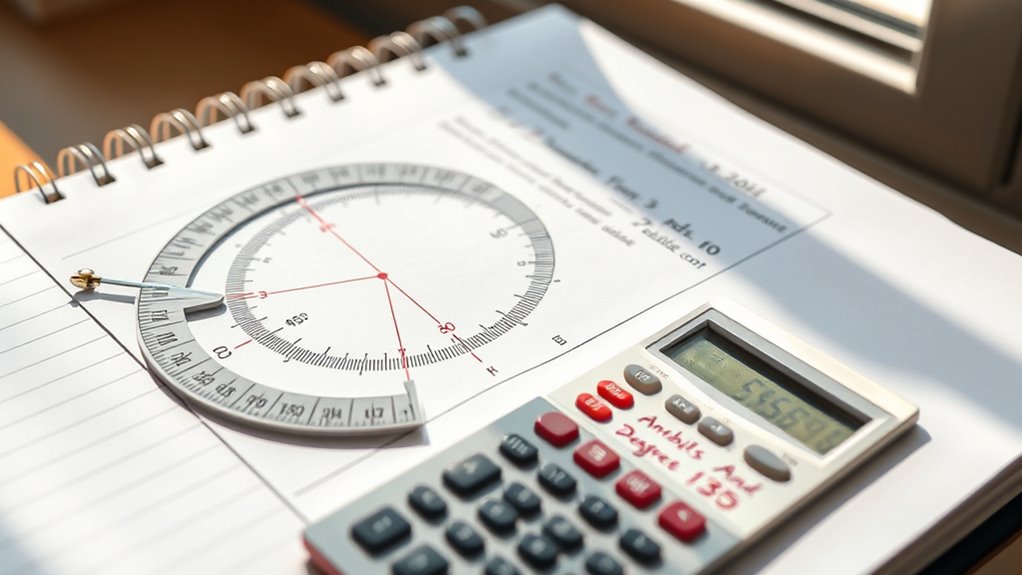
Understanding how to convert between degrees and radians is essential for working with angles in both mathematics and real-world applications. When you’re dealing with angle measurement, knowing how to switch between these two units allows you to interpret and manipulate angles accurately across different contexts. This skill is particularly important when working with the unit circle, which provides a visual and conceptual foundation for understanding angles in radians and degrees. The unit circle defines angles based on the length of the arc subtended at the center of a circle with radius one, making it a key tool for conversions. In addition, mastering the relationship between degrees and radians can help you recognize common angles and their measures more intuitively. To convert from degrees to radians, you need to remember that a full circle measures 360 degrees, which is equivalent to ( 2pi ) radians. This relationship forms the basis for the conversion factor. Specifically, to convert an angle from degrees to radians, you multiply the degree measurement by ( frac{pi}{180} ). For example, if you have an angle of 60 degrees, you multiply: ( 60 times frac{pi}{180} = frac{pi}{3} ) radians. This conversion is straightforward once you keep the ratio in mind. Conversely, converting from radians to degrees involves multiplying the radian measure by ( frac{180}{pi} ). So, if you’re given ( frac{pi}{4} ) radians, you can convert it by calculating: ( frac{pi}{4} times frac{180}{pi} = 45 ) degrees.
Converting degrees and radians is key to understanding angles and the unit circle.
Understanding these conversions becomes easier when you reference the unit circle. The unit circle illustrates key angles, such as 0°, 30°, 45°, 60°, and 90°, along with their radian equivalents like 0, ( frac{pi}{6} ), ( frac{pi}{4} ), ( frac{pi}{3} ), and ( frac{pi}{2} ). Recognizing these pairs helps you quickly switch between the two units and grasp the concept of angle measurement in a more intuitive way. When working with the unit circle, you’ll notice how each angle corresponds to a specific point on the circle, with its coordinates revealing the sine and cosine values tied to that angle. This connection makes converting between degrees and radians not just a mathematical exercise but also a way to deepen your understanding of how angles relate to real-world phenomena. Additionally, understanding angle measurement is fundamental for applying trigonometry in various scientific and engineering fields.
Mastering the conversion process ensures you’re comfortable with a variety of mathematical problems and practical scenarios. Whether you’re calculating the period of a wave, analyzing rotational motion, or working on trigonometry problems, knowing how to switch between degrees and radians keeps your work precise and consistent. The key is to internalize the relationship between the two units and use the conversion factors confidently, especially when referencing the unit circle to visualize angles and their measurements.
Frequently Asked Questions
Can I Convert Between Degrees and Radians Without a Calculator?
Yes, you can convert between degrees and radians without a calculator by using manual conversion and unit circle techniques. Remember that 180 degrees equals π radians. To convert degrees to radians, multiply the degree measure by π/180. Conversely, to convert radians to degrees, multiply the radian measure by 180/π. Familiarizing yourself with the unit circle helps visualize common angles and simplifies these conversions.
How Do I Convert Negative Angles Between Degrees and Radians?
You can convert negative angles between degrees and radians by first performing angle normalization. To do this, add 360° or 2π radians to the negative angle to find its positive equivalent within a full rotation. For example, if your angle is -45°, adding 360° gives you 315°, which you then convert to radians. This negative angle adjustment guarantees your angle stays within a standard, manageable range.
Are There Specific Tools Recommended for Quick Conversions?
You should use digital tools and conversion apps for quick, accurate degree-to-radian and radian-to-degree conversions. These tools often feature user-friendly interfaces and instant calculations, saving you time. Popular options include online calculators, mobile apps like Wolfram Alpha, and dedicated conversion websites. Simply input your angle, select the conversion type, and get the result instantly, making your work much more efficient.
How Does Converting Between Degrees and Radians Apply in Real-World Scenarios?
Think of yourself as a navigator or engineer, where converting degrees to radians helps you find your way or design precise systems. In navigation systems, it guarantees accurate direction calculations, while in engineering applications, it allows for proper trigonometric functions and measurements. This conversion makes complex calculations manageable, enabling you to work seamlessly across different fields and ensuring your projects and routes stay on course with mathematical precision.
Is There a Difference in Converting Between Degrees and Radians for Angles Greater Than 360°?
Yes, there’s a difference in converting between degrees and radians for angles greater than 360°. When doing unit conversion, you just treat the angle measurement as usual, but remember that angles exceeding 360° or 2π radians represent multiple rotations. Convert by applying the same formulas, and you’ll get the equivalent measurement in the other unit. This helps you understand the true size of the angle regardless of how many rotations it includes.
Conclusion
Now that you know the basics, converting between degrees and radians is a straightforward task—no need to call upon Merlin’s magic! Remember, whether you’re steering the stars or just solving math problems, understanding this conversion keeps your calculations accurate and your mind sharp. So, keep your compass handy and don’t be daunted by the difference; even the wise Leonardo would agree, mastery comes with practice. Embrace it, and you’ll conquer angles with confidence!