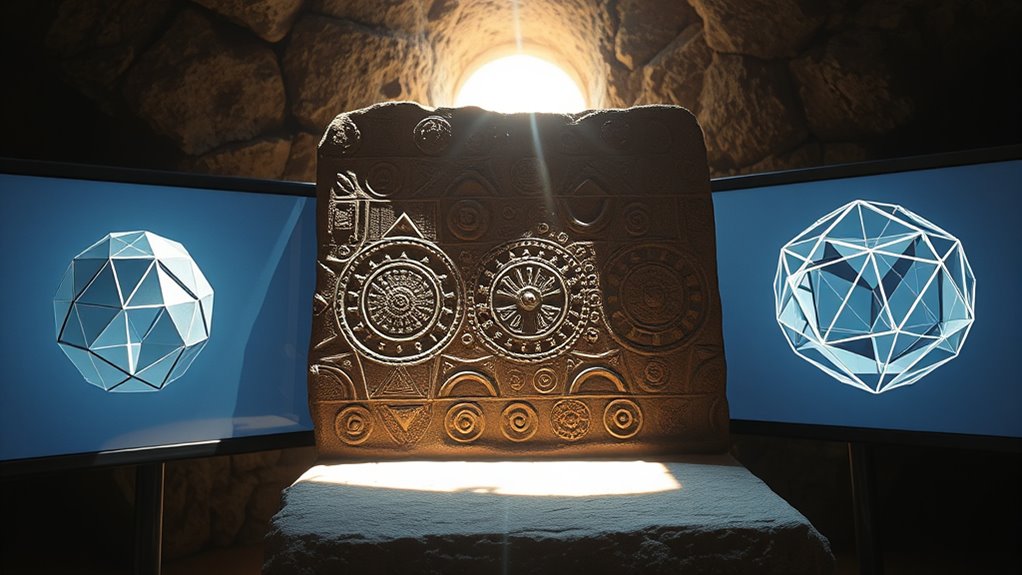

Geometry’s roots go back thousands of years, starting with early civilizations observing their surroundings. Euclidean principles dominated for centuries, shaping architecture, maps, and everyday understanding of space. When scientists faced limitations, non-Euclidean geometries emerged, revealing curves and warped spaces, which are vital today in physics and cosmology. These ancient ideas still influence modern design and technology. As you explore further, you’ll discover how these timeless concepts continue to shape our world in surprising ways.
Key Takeaways
- Euclidean geometry laid the foundation for understanding physical space, influencing architecture, mapping, and engineering for centuries.
- Non-Euclidean geometries emerged in the 19th century, revealing curved spaces and expanding our grasp of the universe.
- Modern physics, especially Einstein’s relativity, relies on non-Euclidean principles to explain gravity and the fabric of spacetime.
- Technologies like GPS account for Earth’s curvature, demonstrating how ancient and modern geometry principles underpin daily life.
- The evolution from ancient Euclidean to modern geometries continues to shape scientific innovation and our perception of reality.

Have you ever wondered how humans first began to understand shapes and spaces? It’s a fascinating journey that starts thousands of years ago when early civilizations looked at the world around them and sought to make sense of it. The foundation of this understanding lies in what we now call Euclidean principles, named after the ancient Greek mathematician Euclid. These principles form the basis of classical geometry, emphasizing flat surfaces, straight lines, and predictable angles. When you think about how we measure distances, design buildings, or create maps, you’re tapping into Euclidean geometry’s logical framework. It’s intuitive, straightforward, and has been the backbone of mathematics for centuries, allowing us to navigate and manipulate our physical environment with confidence. Throughout history, mathematicians have expanded upon these ideas, leading to the development of Non-Euclidean geometries, which challenge traditional concepts of space and shape. However, as humans pushed the boundaries of knowledge, they realized that Euclidean principles don’t always describe reality perfectly. This realization led to the development of Non Euclidean geometries in the 19th century. These geometries challenge the idea that parallel lines never meet and introduce curved spaces, where the rules of Euclidean geometry no longer apply. Imagine trying to understand the surface of the Earth — a sphere rather than a flat plane. In this situation, Non Euclidean geometries help explain phenomena like the curvature of space itself, which was a revolutionary leap in how we understand the universe. They play a vital role in Einstein’s theory of general relativity, where gravity warps space and time, making Non Euclidean concepts essential for explaining our cosmos. The shift from Euclidean to Non Euclidean geometries marked a pivotal moment in the history of mathematics. It expanded our understanding of space beyond the flat, two-dimensional plane, allowing us to grasp the complex, four-dimensional fabric of spacetime. This transition didn’t just alter academic thought; it transformed technology, navigation, and even our perception of reality. Today, when you look at GPS devices, you’re indirectly relying on non-Euclidean principles because they account for the curvature of Earth’s surface to pinpoint locations accurately. In architecture, understanding curved spaces enables innovative designs that challenge traditional forms.
Frequently Asked Questions
How Did Ancient Cultures Independently Develop Geometric Concepts?
Imagine each ancient culture as a brave explorer, charting unknown territories independently. You see, despite vast distances and different landscapes, they developed geometric concepts through their unique needs and cultural influences. Their mathematical independence emerged from observing nature, constructing buildings, or steering stars, proving that each civilization’s curiosity and ingenuity led to similar discoveries. These shared insights reveal how human curiosity, driven by necessity, independently shaped the foundation of geometry across the world.
What Are Some Modern Technologies Derived From Ancient Geometry?
Modern technologies like computer graphics heavily rely on ancient geometry. You use fractal patterns, inspired by early geometric principles, to create realistic textures and complex visuals. These patterns allow you to generate intricate designs efficiently, making animations and virtual environments more immersive. Without ancient geometry, advancements in digital art and simulation wouldn’t be possible, demonstrating how timeless geometric concepts continue to shape your world today.
How Does Geometry Influence Contemporary Architectural Design?
You see how geometry influences modern architecture through architectural symmetry, creating visually balanced and harmonious designs. It also guarantees structural stability by analyzing forces and load distribution. When you observe buildings, you notice geometric principles guiding their shapes, proportions, and placements. This application of geometry helps architects craft safe, functional, and aesthetically pleasing structures, proving how ancient mathematical concepts continue to shape our world today.
Are There Any Lesser-Known Civilizations That Contributed to Geometry?
You might not realize that lesser-known civilizations, like the Indus Valley and the Olmecs, contributed to geometry through cultural exchanges. These lost civilizations developed early concepts of measurement and spatial understanding that influenced later societies. Their innovations often faded into obscurity but left a subtle mark on mathematical development. Recognizing these contributions helps you appreciate how diverse cultures shaped the foundations of geometry, enriching your understanding of its global history.
How Has the Study of Geometry Evolved Over the Centuries?
You see, the study of geometry has evolved greatly over centuries. You now use coordinate systems to plot points precisely and develop geometric proofs to verify theorems. Early civilizations laid the groundwork, but modern math builds on these ideas with algebra and calculus. Today, technology enhances your understanding, allowing you to explore complex shapes and spaces, showing how geometry continues to shape your world in innovative ways.
Conclusion
So, next time you step into a building or look at a map, remember that ancient geometry’s influence is like an invisible force shaping your world. It’s astonishing how these age-old ideas continue to underpin everything around you—more essential than the air you breathe. Without it, our modern world would be a chaotic mess. Ancient math isn’t just history; it’s the silent hero turning dreams into reality, and it’s more powerful than you ever imagined.