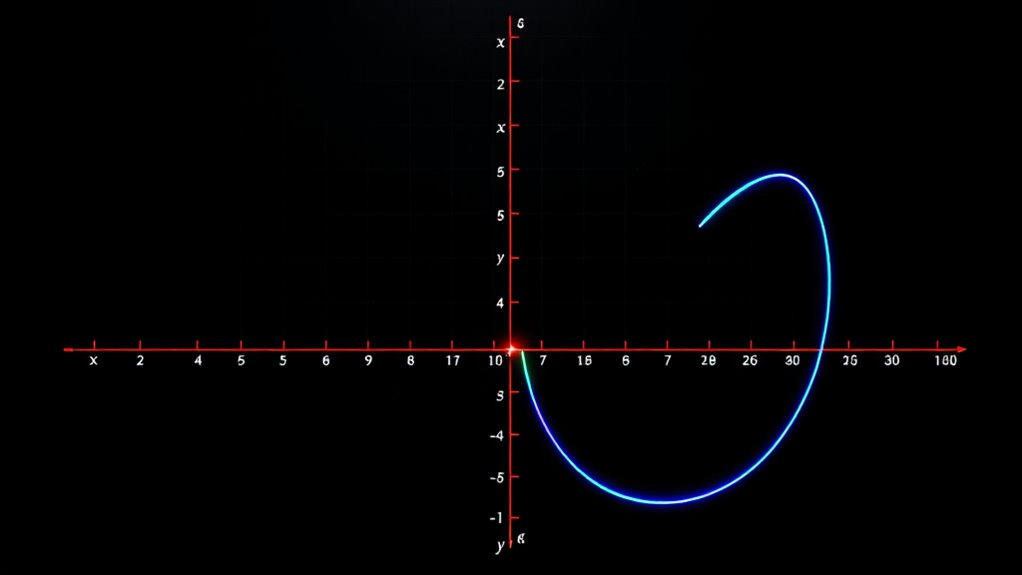

In coordinate geometry, you start by plotting points using (x, y) coordinates on the plane, then learn to find distances with the distance formula, and midpoints with simple averages. These basics help you analyze shapes, lines, and relationships, leading to understanding slopes, line equations, and more complex figures like conics. By mastering these tools, you’ll be able to explore a wide range of geometric concepts and their algebraic counterparts, opening the door to deeper understanding.
Key Takeaways
- Understand how to locate points using (x, y) coordinates on the Cartesian plane.
- Use the distance formula to find the length between two points accurately.
- Calculate midpoints to identify the center point of segments or symmetry lines.
- Apply these concepts to analyze geometric shapes, check collinearity, and construct figures.
- Build a foundation for advanced topics like slopes, equations of lines, and conic sections.

Have you ever wondered how to find the distance between two points or determine if three points are collinear? In coordinate geometry, these questions are fundamental, and understanding how to approach them can make solving many problems much easier. The key tools you’ll use are the distance formula and midpoint calculation, both of which rely on the coordinates of the points involved.
The distance formula helps you determine the straight-line distance between two points in a plane. If you have points ( (x_1, y_1) ) and ( (x_2, y_2) ), the formula is derived from the Pythagorean theorem:
[ d = sqrt{(x_2 – x_1)^2 + (y_2 – y_1)^2} ]This calculation gives you the length of the segment connecting the two points, whether you’re measuring distance between cities on a map or analyzing the length of a side in a geometric figure. To apply it, subtract the x-coordinates and square the difference, then do the same for the y-coordinates. Adding these squares and taking the square root yields the distance. It’s a straightforward process, but it’s essential for accurately measuring lengths in coordinate space.
Another critical concept is the midpoint calculation, which finds the exact middle point between two coordinates. For points ( (x_1, y_1) ) and ( (x_2, y_2) ), the midpoint ( M ) is given by:
[ M = left( frac{x_1 + x_2}{2}, frac{y_1 + y_2}{2} right) ]This is useful for dividing segments into equal parts, finding the center of a line segment, or establishing symmetry in geometric figures. Instead of working with the original points, the midpoint gives you a single coordinate that lies exactly halfway along the segment connecting them. Recognizing how coordinate geometry principles are applied also helps in understanding more complex topics like slopes and conic sections.
Both the distance formula and midpoint calculation are foundational tools in coordinate geometry. They’re used repeatedly, whether you’re checking if three points are collinear, constructing geometric shapes, or analyzing graphs. Mastering these calculations enables you to interpret and manipulate the coordinate plane confidently. Once you’re comfortable with these, you’ll find it much easier to explore more complex topics like slopes, equations of lines, and conic sections, all of which build upon these basic principles.
Frequently Asked Questions
How Do I Determine the Equation of a Circle From Its Graph?
To find the equation of a circle from its graph, you analyze the graph to identify the center and radius. Find the center point (h, k) by locating the midpoint of the circle’s diameter or using the graph’s symmetry. Measure the radius (r) with a ruler or grid. Then, plug these values into the standard form of circle equations, (x – h)² + (y – k)² = r², based on your graph analysis.
What Are the Real-World Applications of Conic Sections?
Conic sections craft vital careers in countless cases. You use conic sections in satellite navigation systems to accurately analyze paths and positions, ensuring precise location tracking. Architects adopt conic principles to design stunning structures, from domes to arches, that combine beauty with stability. These curves also contribute to physics, engineering, and astronomy, making them essential tools in solving real-world problems. Their versatile applications make conic sections indispensable in everyday life and advanced technology.
How Can I Visualize 3D Coordinate Systems?
To visualize 3D coordinate systems, imagine a space with three perpendicular coordinate axes—x, y, and z—that intersect at the origin. Use 3D visualization tools or graphing software to see how points and shapes extend in all directions. This helps you understand spatial relationships and how objects are positioned in three-dimensional space, making complex concepts like volume and depth much clearer.
What Are Common Mistakes in Plotting Points Accurately?
You often make labeling errors or scaling inaccuracies that can throw off your entire plot. Double-check your labels for each point and make sure your axes are scaled equally; otherwise, your graph will look wildly distorted. Avoid rushing through plotting, because even small mistakes in labeling or scaling can lead to huge misunderstandings. Take your time, verify each coordinate, and keep your axes consistent—precision is key!
How Does Coordinate Geometry Relate to Algebra and Calculus?
Coordinate geometry connects closely with algebra and calculus by using algebraic methods to analyze geometric figures. You can solve equations of lines, circles, and conics to understand their properties. Calculus comes into play with integration, helping you find areas and volumes of shapes defined by coordinate points. This relationship lets you shift seamlessly between visual geometry and algebraic calculations, deepening your understanding of how shapes behave mathematically.
Conclusion
Think of coordinate geometry as your map to the universe of shapes and lines. With each point plotted and each equation understood, you’re building a spaceship that can navigate through the cosmos of math. Mastering these concepts turns complex diagrams into familiar territory, making problem-solving feel like a smooth ride. Keep exploring, keep practicing, and soon you’ll be charting your own course through any geometric challenge that comes your way.