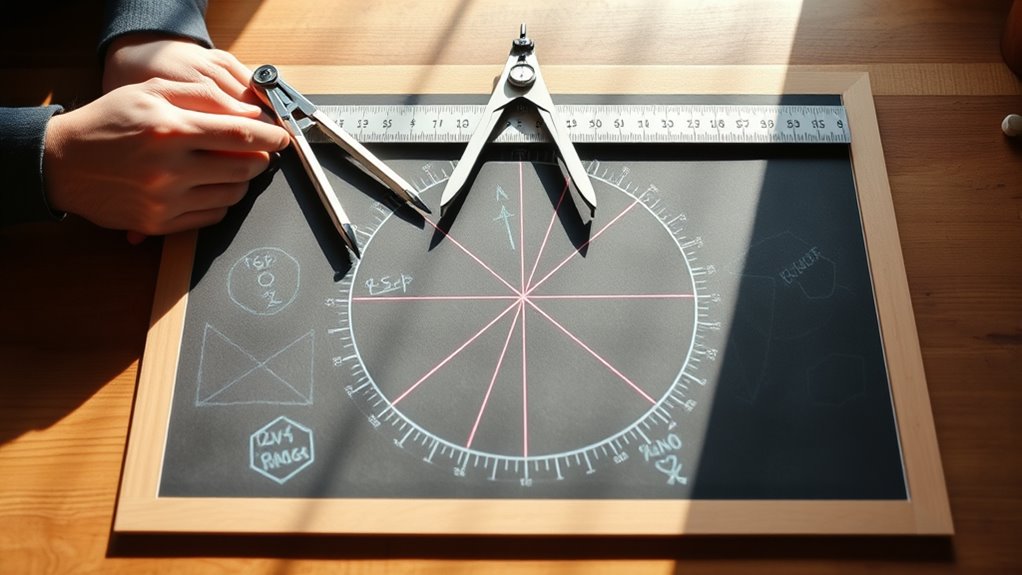

To master classical constructions like bisectors, angles, and perpendicular bisectors, you use only a compass and straightedge. Start by creating arcs and intersecting points to accurately divide angles or find midpoints. These methods rely on drawing precise arcs and lines based on geometric properties, without measurements. If you keep exploring, you’ll discover how these simple tools reveal the elegance of geometry and enable accurate figure construction through careful steps.

Prime made for students and young adults
- Fast, free delivery for dorm and study essentials
- Prime Video and Amazon Music included
- Member-only deals
Key Takeaways
- Use a compass and straightedge to construct angle bisectors by creating intersecting arcs from the vertex and side points.
- Construct perpendicular bisectors of segments by drawing intersecting arcs from segment endpoints and connecting their intersection points.
- Draw angle bisectors to divide angles into two equal parts, ensuring accurate division through arc intersections.
- Apply classical methods to create precise geometric figures without measurements, relying on circle and intersection properties.
- Understand the fundamental principles behind each construction to master classical geometric techniques efficiently.

Have you ever wondered how ancient mathematicians created precise geometric figures without modern tools? It’s fascinating to think about how they relied solely on simple instruments like a compass and straightedge. These tools, combined with clever techniques, allowed them to construct accurate bisectors, angles, and other fundamental shapes that form the backbone of classical geometry. Mastering these methods requires understanding the principles behind compass techniques and straightedge methods, which are both elegant and powerful.
Ancient mathematicians achieved precise geometric constructions using only compass and straightedge techniques.
When constructing a bisector of an angle or a segment, you typically start with just your straightedge and compass. For example, to bisect an angle, you first draw it with your straightedge, then place your compass point at the vertex and draw arcs that intersect the sides of the angle. By carefully setting your compass to a fixed width, you create arcs from each side that intersect at points away from the vertex. Using your straightedge, you draw a line connecting these intersection points, and this line precisely divides the original angle into two equal parts. This process exemplifies how compass techniques and straightedge methods work hand in hand, relying on basic properties of circles and intersecting arcs to achieve accurate results.
Constructing the perpendicular bisector of a segment follows a similar logic. You set your compass to a radius longer than half the segment’s length, then draw arcs from each endpoint. These arcs intersect above and below the segment, creating points that you connect with your straightedge. The resulting line cuts the segment into two equal parts at a right angle, and it’s a classic example of how simple tools can produce complex, accurate constructions. These techniques highlight the importance of understanding the properties of circles and intersections, which were *essential* for ancient geometrists working without rulers or compasses with measurement markings.
In addition, understanding the concept of angle bisectors and their properties is fundamental for many geometric constructions, as it allows for dividing angles accurately without measurement.
Throughout these constructions, the core idea is to use the compass to replicate distances and create intersecting arcs, while the straightedge helps you draw lines through specific points. This process *guarantees* that your figures are precise, relying solely on geometric principles rather than numerical measurements. With practice, you’ll find that these methods become intuitive, enabling you to construct bisectors, angles, and other shapes with remarkable accuracy. These classical techniques, developed centuries ago, continue to serve as the foundation for understanding geometry today, illustrating the ingenuity of mathematicians who achieved such precision with only simple tools.
classical geometry compass and straightedge set
As an affiliate, we earn on qualifying purchases.
As an affiliate, we earn on qualifying purchases.
Frequently Asked Questions
Can Classical Constructions Be Used to Solve All Geometric Problems?
Classical constructions can solve many geometric problems, but they have limitations, especially with more complex or modern challenges. They’re historically significant, showcasing the foundations of geometry, yet some issues require algebraic or analytic methods. You might find that while classical tools excel at bisectors and angles, they can’t address every problem, highlighting both their usefulness and their boundaries in the evolution of geometric problem-solving.
What Tools Are Necessary Besides a Compass and Straightedge?
Think of classical tools as a painter’s brush and canvas—you might wonder if they’re enough. Besides a compass with precise calibration and a straightedge, you don’t need much. However, understanding straightedge limitations helps you recognize that no additional tools are necessary for most constructions. Sometimes, patience and careful measurement are your best allies, turning simple tools into powerful instruments for solving complex geometric problems.
How Accurate Are Classical Constructions in Practical Applications?
Classical constructions are quite precise for most practical purposes, but they do have some precision limitations due to manual execution and instrument quality. You can expect high accuracy in ideal conditions, but slight errors might occur, especially with small or complex angles. Overall, these methods are feasible for many practical applications, though they may not match the precision of modern tools like digital measurement devices.
Are There Modern Alternatives to Classical Geometric Constructions?
You can now imagine a modern workspace where digital geometric tools replace traditional compass and straightedge. These tools, like computer software and apps, offer precise alternatives to classical constructions, making your work faster and more accurate. With digital options, you skip manual steps and reduce errors, streamlining your geometric tasks. So, yes—modern technology provides powerful alternatives, enhancing your ability to create exact constructions without relying solely on classical methods.
Can These Methods Be Applied to Non-Euclidean Geometries?
You can’t directly apply classical geometric constructions to non-Euclidean geometries because of their limitations, such as the curvature of space. However, mathematicians develop alternative methods tailored to these geometries, like hyperbolic or spherical constructions. While the fundamental principles differ, understanding these alternative geometries broadens your perspective on how shapes and angles behave beyond Euclidean limitations, allowing you to explore complex geometrical concepts in new contexts.
geometric construction tools for students
As an affiliate, we earn on qualifying purchases.
As an affiliate, we earn on qualifying purchases.
Conclusion
Now that you’ve explored classical constructions like bisectors and angles, you’re equipped to create precise geometric figures with simple tools. Did you know that in ancient Greece, mathematicians like Euclid laid the foundation for these techniques, which are still relevant today? Mastering these constructions not only sharpens your problem-solving skills but also connects you to a rich mathematical history. Keep practicing, and you’ll develop a deeper understanding of geometry’s beautiful, timeless principles.
angle bisector compass and straightedge
As an affiliate, we earn on qualifying purchases.
As an affiliate, we earn on qualifying purchases.
perpendicular bisector construction kit
As an affiliate, we earn on qualifying purchases.
As an affiliate, we earn on qualifying purchases.
Fall Picks
fall essentials
As an affiliate, we earn on qualifying purchases.