
In game design, geometry shapes every part of your experience. You influence how worlds are crafted, making landscapes and structures believable and immersive. Geometry also guides object interactions, collision detection, and navigation, ensuring smooth gameplay. Using geometric algorithms like Voronoi diagrams or octrees boosts performance and visual quality. If you want to understand how these principles come together to create compelling, seamless worlds, stay with us to explore more insider insights.
Key Takeaways
- Geometry shapes game environments to create immersive, believable worlds that guide navigation and enhance realism.
- Procedural generation uses geometric algorithms to produce diverse, unique landscapes efficiently, boosting replayability.
- Geometric constraints ensure visual coherence and realism in features like mountains, forests, and city layouts.
- Collision detection relies on geometric calculations to enable accurate, responsive object interactions within the game world.
- Spatial partitioning techniques optimize geometric computations, improving rendering speed and real-time performance.
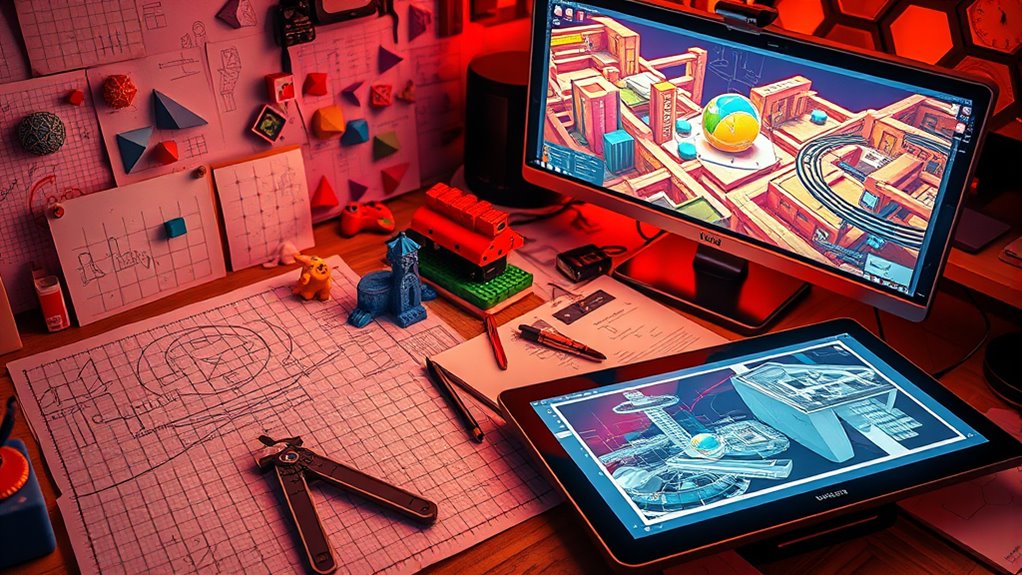
Geometry plays a vital role in designing engaging and immersive video game worlds, shaping everything from character movement to environment layout. As a game developer or designer, you rely heavily on geometric principles to create believable environments that players can explore seamlessly. One of the most powerful techniques in your toolkit is procedural generation, which uses algorithms rooted in geometry to produce vast, varied worlds without manually crafting every detail. With procedural generation, you define rules and parameters, and your computer generates landscapes, structures, and even entire ecosystems dynamically. This approach not only saves time but also guarantees that no two players experience exactly the same environment, boosting replayability and immersion.
Procedural generation uses geometric algorithms to create diverse, realistic game worlds efficiently and uniquely for every player.
In the domain of procedural generation, geometry ensures that every element fits together perfectly. You might generate a mountain range with specific slopes, peaks, and valleys that follow geometric constraints for realism. The same applies to forests, cities, or dungeons, where the layout is determined by algorithms that respect geometric rules, making wayfinding intuitive and visually coherent. These algorithms often rely on grid systems, Voronoi diagrams, or fractal mathematics to produce natural or stylized environments that feel authentic. As you tweak parameters, your worlds evolve, maintaining internal consistency thanks to the geometric foundations guiding their creation.
Collision detection is another critical aspect where geometry is indispensable. When players interact with your world, whether jumping over obstacles or navigating narrow corridors, the game engine constantly checks for collisions to prevent characters from passing through solid objects. Geometric calculations determine whether a player’s bounding volume intersects with the environment’s geometry, ensuring interactions are realistic and responsive. Efficient collision detection hinges on understanding the shapes involved—be they spheres, boxes, or complex meshes—and applying geometric algorithms to quickly and accurately identify intersections. This process is essential for gameplay fluidity, as delays or inaccuracies can break immersion and frustrate players.
Both procedural generation and collision detection depend on precise geometric computations. You need robust mathematical models to generate diverse environments while maintaining performance. Optimizing these operations often involves spatial partitioning techniques like octrees or BSP trees, which organize geometry to accelerate collision checks and rendering. These methods rely on geometric principles to subdivide space, making real-time interactions smooth even in complex worlds. As you design your game, understanding how geometry influences these systems allows you to create worlds that are not only visually impressive but also functionally sound, providing players with a seamless, immersive experience from start to finish.
Frequently Asked Questions
How Does Geometry Influence Game Story Development?
Geometry influences your game story development by shaping storytelling mechanics and guiding narrative pacing. You use geometric structures to create immersive environments that enhance storytelling, making scenes more engaging. Strategic geometric placement helps control pacing, building tension or providing relief as needed. By understanding geometry, you can design unique pathways and visual cues that deepen the story, ensuring players stay captivated and the narrative flows smoothly throughout the game.
What Tools Are Best for Geometric Game Design?
You’ll find that tools like Unity and Unreal Engine are fantastic for geometric game design, especially with features like procedural generation that create dynamic environments and collision detection that keeps gameplay smooth. These platforms offer intuitive interfaces and powerful scripting options, making it easier to craft complex geometry without getting lost in the details. Explore these tools, and you’ll reveal endless creative possibilities while maintaining precise control over your game’s spatial logic.
Can Geometry Improve Game AI Behavior?
Yes, geometry can improve game AI behavior by enhancing pathfinding algorithms and spatial awareness. You can design more efficient navigation meshes and obstacle detection, making AI characters smarter and more realistic. By leveraging geometric principles, your AI can better interpret environments, avoid collisions, and make smarter decisions. This leads to more immersive gameplay, where enemies and allies behave naturally, creating a richer, more engaging experience for players.
How Do Players Interact With Geometric Environments?
You wander through geometric environments, pretending you’re an explorer rather than a pixelated pawn. From your perspective, environment navigation becomes a dance with shapes and angles—sliding, climbing, or dodging through intricate designs. Geometry guides your every move, turning simple navigation into a strategic puzzle. It’s as if the game’s architecture whispers secrets, daring you to unseal new paths and immerse yourself deeper into a world crafted with mathematical precision.
What Challenges Arise From Complex Geometric Designs?
You face challenges with complex geometric designs that test your spatial reasoning and can overwhelm players. Aesthetic complexity might make environments visually stunning but also confusing, leading to frustration. You need to balance intricate geometry with clarity, ensuring players can navigate without feeling lost. Simplifying key elements or guiding visual cues helps manage this complexity, making gameplay engaging without sacrificing the artistic appeal of your geometric environments.
Conclusion
Think of geometry as the blueprint of your imagination, guiding your every move like a compass through uncharted worlds. With each shape and angle, you craft a universe where players feel like explorers uncovering hidden treasures. Embrace this silent architect within you, and let your designs become the stars that light up their journey. Remember, in the game of creation, geometry is your loyal map—leading you to endless adventures.