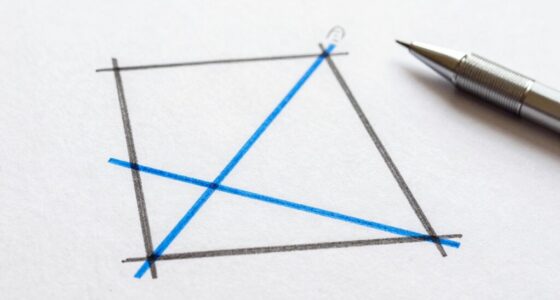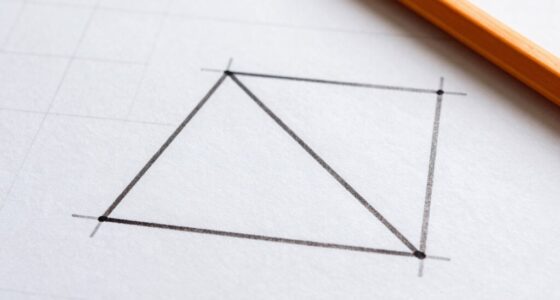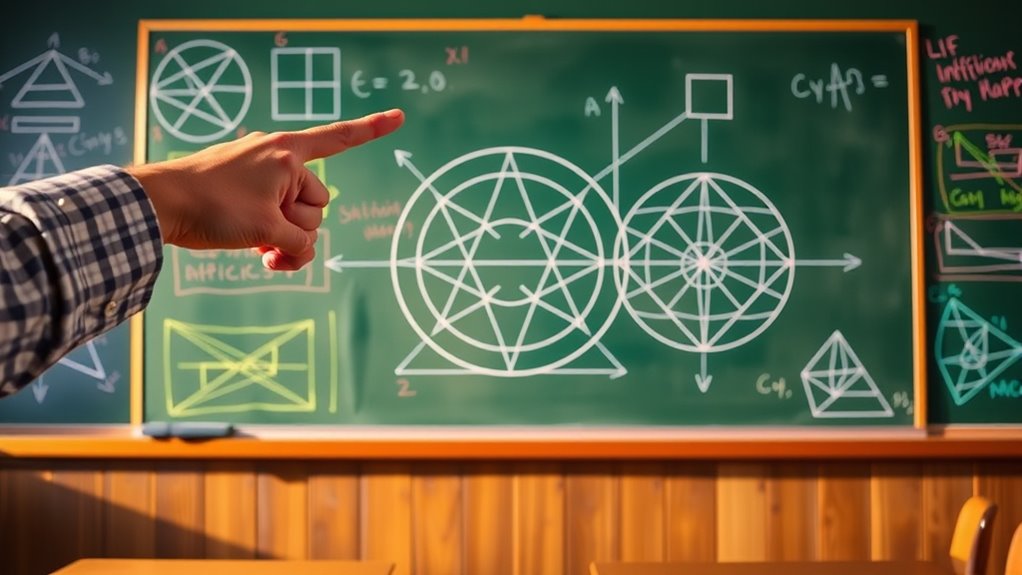

Inversion in geometry is a technique where you flip the plane around a fixed point, called the pole, to simplify complex circle and line arrangements. It transforms difficult configurations into easier-to-analyze forms, like turning circles through the pole into lines or transforming complicated shapes into manageable ones. This method preserves angles, making it great for tackling problems involving tangencies and intersections. Keep exploring, and you’ll discover how inversion can open solutions to challenging geometric puzzles.

Prime made for students and young adults
- Fast, free delivery for dorm and study essentials
- Prime Video and Amazon Music included
- Member-only deals
Key Takeaways
- Inversion transforms complex figures into simpler ones, making difficult geometric problems more manageable.
- Circles through the pole invert into lines, converting intricate circle configurations into easier-to-analyze forms.
- The technique preserves angles, allowing for angle-chasing proofs and establishing relationships in transformed figures.
- Understanding pole and polar lines helps predict how points, lines, and circles are mapped during inversion.
- Using inversion reveals hidden symmetries and relationships, offering alternative perspectives to solve challenging problems.
Have you ever wondered how geometric figures can be transformed while preserving their core properties? Inversion in geometry offers a fascinating way to do just that. It’s a transformation that flips the plane around a fixed point, called the pole, and maps points to new positions while maintaining certain relationships. When you perform circle transformations through inversion, circles that once seemed complex or tangled can become simpler, sometimes transforming into lines or other circles. This process allows you to analyze problems from new perspectives, making seemingly impossible tasks manageable.
Imagine a circle on your plane. When you invert it with respect to a chosen circle, its shape and size can change dramatically, but specific properties remain intact. For example, the inversion preserves angles, which means the measure of angles between intersecting curves stays the same. This is powerful because it enables you to study geometric configurations more easily, especially when dealing with tangencies or intersection points. The concept of pole and polar becomes essential here: the pole is the fixed point around which you invert, and the polar is a line associated with a point, often helping to define the inversion’s behavior. When you look at a point and its polar line, you gain insight into how the inversion will transform that point, and similarly, how the entire figure will morph.
Circle transformations via inversion are particularly useful because they can convert complicated curves into more manageable forms. For instance, a circle passing through the pole becomes a straight line after inversion, which simplifies many problems. Conversely, a line not passing through the pole inverts into a circle passing through the pole. This duality allows you to switch between different representations to find elegant solutions. Recognizing these patterns relies heavily on understanding the pole and polar relationship, which guides you in predicting how figures will change under inversion.
As an affiliate, we earn on qualifying purchases.
Frequently Asked Questions
How Does Inversion Relate to Other Geometric Transformations?
Inversion relates to other geometric transformations like circle transformations and conformal mappings by preserving angles and transforming circles into other circles or lines. You’ll notice inversion often acts as a powerful tool to simplify complex problems, flipping the plane and turning difficult shapes into manageable ones. Unlike rigid motions, inversion changes distances but maintains the shape’s local angles, making it an essential technique in advanced geometry.
Can Inversion Be Applied in Three-Dimensional Geometry?
Think of inversion as a magic mirror—you can use it in three-dimensional space too. Yes, you can apply spherical inversion for three-dimensional mapping, turning points inside out across a sphere. This technique helps solve complex problems involving spheres, cylinders, and other 3D shapes. By extending the concept, you can manipulate geometric figures in space, making tricky problems more manageable and revealing hidden symmetries.
What Are Common Real-World Applications of Inversion?
You can see inversion’s real-world applications in areas like circle transformations and conformal mappings. For example, in electrical engineering, they help optimize antenna designs by transforming complex wave patterns into simpler ones. In computer graphics, they assist in creating realistic reflections and distortions. These transformations preserve angles and shapes locally, making inversion a powerful tool for shaping images, designing circuits, and solving geometric problems efficiently.
How Does Inversion Simplify Complex Geometric Constructions?
You simplify complex geometric constructions by using circle transformations through inversion, which turns intricate figures into more manageable shapes. This technique makes it easier to analyze relationships like radical axes, which become straight lines after inversion. By flipping the plane, you convert difficult angle or length problems into straightforward problems, allowing you to apply simpler geometric principles and find solutions more efficiently.
Are There Limitations to Using Inversion in Problem-Solving?
You might think inversion is limitless, but limitations overview reveals its constraints. Inversion constraints include difficulty applying it to certain configurations, especially when circles or lines don’t map neatly or when the inversion point causes degeneracy. It also requires careful choice of the inversion circle’s center and radius. These factors can complicate problem-solving, making inversion less effective in some scenarios, so always evaluate if its constraints impact your specific geometric challenge.
As an affiliate, we earn on qualifying purchases.
Conclusion
Just like flipping a coin reveals a new perspective, inversion in geometry transforms complex problems into simpler ones. Imagine you’re trying to find a hidden treasure buried beneath a tangled web—by turning the web inside out, the path becomes clear. Embracing inversion *unlocks* fresh insights and solutions, making tough problems feel like opportunities rather than obstacles. So next time you face a challenge, think of it as flipping the plane—sometimes, all it takes is a new angle to see the answer.
math problem solving geometry kit
As an affiliate, we earn on qualifying purchases.
As an affiliate, we earn on qualifying purchases.
geometry compass and protractor set
As an affiliate, we earn on qualifying purchases.
As an affiliate, we earn on qualifying purchases.
Halloween Picks
halloween
As an affiliate, we earn on qualifying purchases.