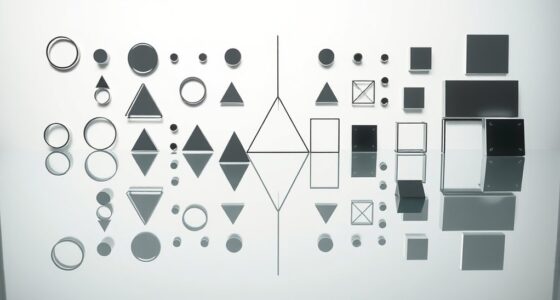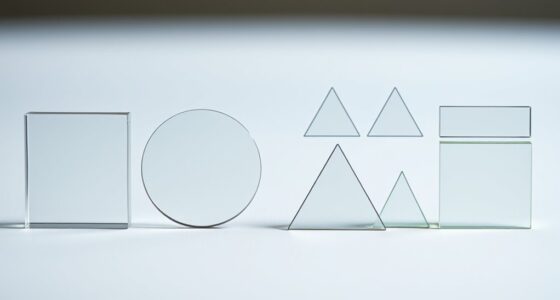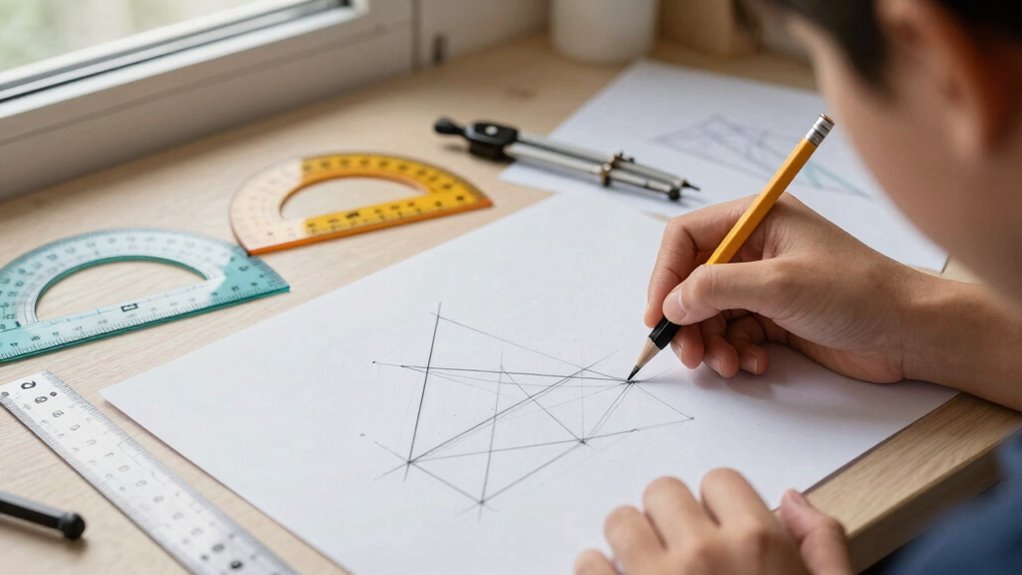
To build a strong geometry foundation without memorizing everything, focus on understanding the ideas behind concepts like transformations, properties, and coordinate systems. Practice visualizing shapes and how they change with different transformations to develop spatial reasoning. Recognize relationships instead of just memorizing facts, and connect ideas to see the bigger picture. By grasping these core ideas, you’ll develop flexible problem-solving skills—keep exploring, and you’ll discover even more helpful insights.

Prime made for students and young adults
- Fast, free delivery for dorm and study essentials
- Prime Video and Amazon Music included
- Member-only deals
Key Takeaways
- Focus on understanding the underlying concepts and reasons behind geometric properties instead of rote memorization.
- Practice visualizing shapes and transformations within coordinate systems to develop spatial reasoning skills.
- Connect different geometric ideas, such as properties, transformations, and shape relationships, to build a cohesive understanding.
- Use diagrams and hands-on activities to make abstract concepts tangible and enhance comprehension.
- Emphasize reasoning and problem-solving strategies that rely on principles rather than memorized formulas.
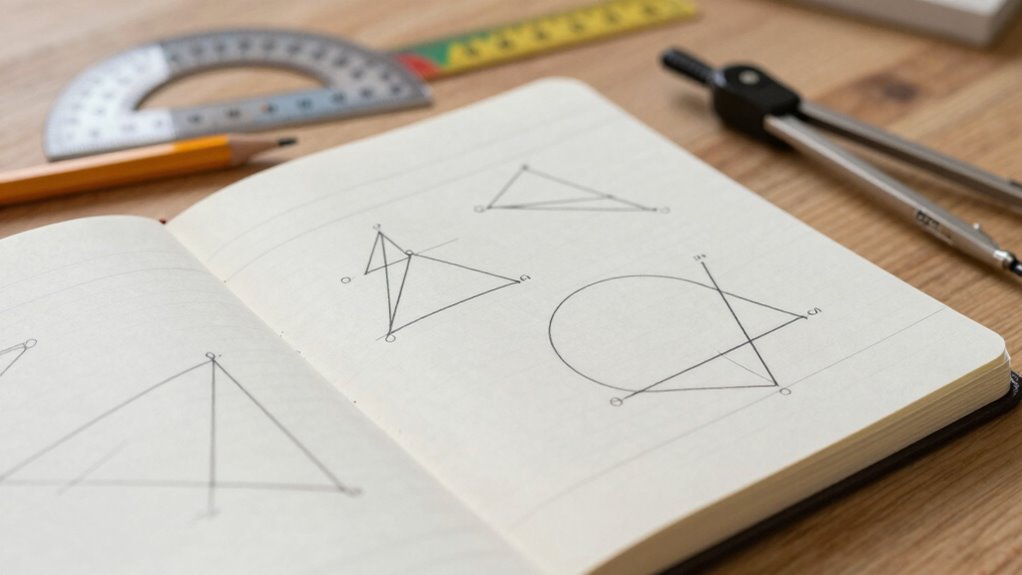
Have you ever wondered why a solid understanding of geometry is essential for more advanced math topics? It’s because geometry forms the backbone for many areas in mathematics, from algebra to calculus and beyond. Instead of rote memorization, focus on understanding the concepts behind the ideas. For example, grasping how coordinate systems work allows you to visualize and solve problems more effectively. When you learn about coordinate systems, you’re not just memorizing a grid; you’re understanding how to map points in space, which is fundamental for graphing functions, analyzing shapes, and performing transformations. Visualizing these systems helps you see relationships clearly and develop intuition, making abstract concepts more tangible. Developing a spatial reasoning skill allows you to approach problems with greater insight and flexibility. Next, immerse yourself in geometric transformations. These are operations that change the position, size, or shape of figures in a plane or space, like translations, rotations, reflections, and dilations. Instead of memorizing specific formulas for each transformation, aim to understand what each does conceptually. For instance, a translation slides a shape along a vector, while a rotation turns it around a point. Recognizing these actions as transformations helps you understand how figures relate to each other and how they can be manipulated. This approach makes it easier to predict outcomes and solve problems creatively, rather than relying solely on memorized procedures. Building a strong foundation also means practicing visualization. When you see how shapes relate within coordinate systems and how transformations alter their positions, you develop spatial reasoning. This skill allows you to approach complex problems with confidence, breaking them down into manageable pieces. Additionally, understanding geometric properties such as congruence and similarity deepens your grasp of how shapes relate to each other and supports your problem-solving abilities. Recognizing the fundamental concepts behind these properties encourages a deeper understanding rather than superficial memorization. For example, understanding why the sum of angles in a triangle is 180 degrees makes it easier to remember and apply this fact in different contexts. When you grasp the reasoning behind concepts, they become much easier to recall and use flexibly. Connecting new ideas with related mathematical principles further reinforces your comprehension and helps you see how different topics interconnect. Finally, connect new concepts to what you already know. Geometry is deeply interconnected, so seeing how coordinate systems underpin transformations or how angles relate to shapes helps reinforce your understanding. Avoid the trap of just memorizing facts; instead, aim to see the bigger picture. This way, your knowledge becomes a flexible tool you can adapt to new problems, not just a collection of isolated facts. By focusing on understanding the principles behind the topics, you’ll develop a strong, lasting foundation in geometry that will serve you well in advanced math and beyond.
As an affiliate, we earn on qualifying purchases.
Frequently Asked Questions
How Can I Improve My Spatial Visualization Skills Effectively?
To improve your spatial visualization skills, practice mental rotation exercises regularly. Challenge yourself to visualize objects from different angles and manipulate them mentally. Engaging in 3D modeling, either with software or physical models, helps you understand how shapes fit together in space. Consistent practice with these activities sharpens your ability to mentally rotate objects and enhances your overall spatial understanding, making complex geometric concepts easier to grasp.
What Are Common Mistakes Students Make When Learning Geometry?
You often fall into common misconceptions, like confusing angles and side lengths or assuming all triangles are similar. Learning pitfalls include rushing through proofs without understanding, skipping foundational concepts, or relying too much on memorization instead of reasoning. To avoid these mistakes, focus on understanding the why behind the rules, practice visualizing problems, and ask questions to clarify misconceptions. This approach helps you build a solid, intuitive grasp of geometry.
How Do Real-World Applications Enhance Geometry Understanding?
Imagine solving puzzles that directly impact your daily life—that’s what real-world applications offer. Practical examples and real-world scenarios make geometry come alive, revealing how angles and shapes influence everything from architecture to navigation. When you see these connections, your understanding deepens naturally, transforming abstract concepts into tangible skills. This active engagement keeps you motivated and helps you grasp geometry’s core principles without relying solely on memorization.
Can Visual Aids Replace Traditional Memorization Methods?
Visual aids can’t fully replace traditional memorization, but they considerably boost your understanding through visual memory and diagram interpretation. When you see geometric shapes and diagrams, you better grasp concepts without relying solely on memorization. Visual aids make abstract ideas tangible, helping you recognize patterns and relationships more intuitively. Incorporating diagrams into your study helps reinforce your knowledge, making learning geometry more engaging and effective.
How Often Should I Review Geometry Concepts to Retain Them?
You should review geometry concepts regularly, ideally every few days, to reinforce understanding and prevent forgetting. While memorization techniques help with quick recall, consistent review guarantees long-term retention. Think of it as watering a plant: frequent, small doses strengthen roots and promote growth. By balancing concept reinforcement with active learning, you’ll solidify your grasp without relying solely on memorization, making your foundation more durable and adaptable.
As an affiliate, we earn on qualifying purchases.
Conclusion
Building a solid geometry foundation is like planting a sturdy tree—you need strong roots to grow upward. Instead of rote memorization, focus on understanding concepts and practicing regularly. When you grasp the basics, complex problems become stepping stones, not obstacles. Remember, a well-built foundation doesn’t just support your current knowledge but also fuels your future learning. Keep nurturing your understanding, and you’ll find geometry becomes a landscape you can confidently explore, not a mountain to climb.
As an affiliate, we earn on qualifying purchases.
As an affiliate, we earn on qualifying purchases.
Halloween Picks
halloween
As an affiliate, we earn on qualifying purchases.