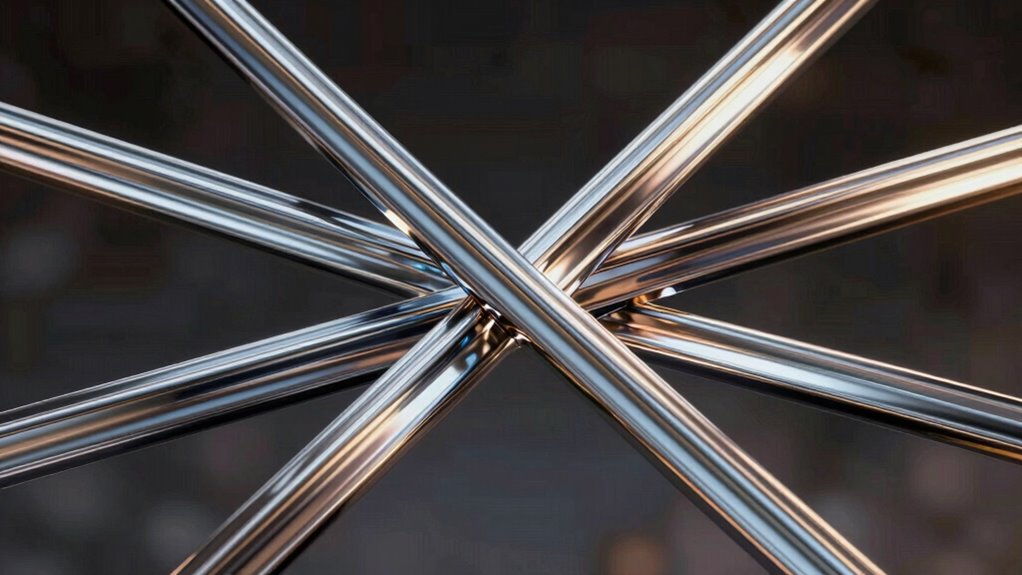

When lines intersect in 3D, they can meet at a point, run parallel, or be skew, meaning they don’t meet and are in different planes. Unlike in 2D, where lines either cross or stay parallel, 3D space adds complexity with skew lines that never intersect. Understanding these relationships helps you better visualize spatial arrangements. If you explore further, you’ll discover how projection techniques make analyzing these intersections clearer and easier to grasp.
Key Takeaways
- In 3D, lines can intersect at a single point in space, unlike in 2D where intersection is confined to the plane.
- Intersection in 3D requires lines to share the same spatial point, not just appear to cross in a projection.
- Lines that seem to intersect in 2D may actually be skew lines in 3D, meaning they do not meet.
- Determining 3D intersection involves analyzing the lines’ spatial positions and using geometric or parametric methods.
- Projection techniques assist in visualizing and verifying true line intersections in three-dimensional space.
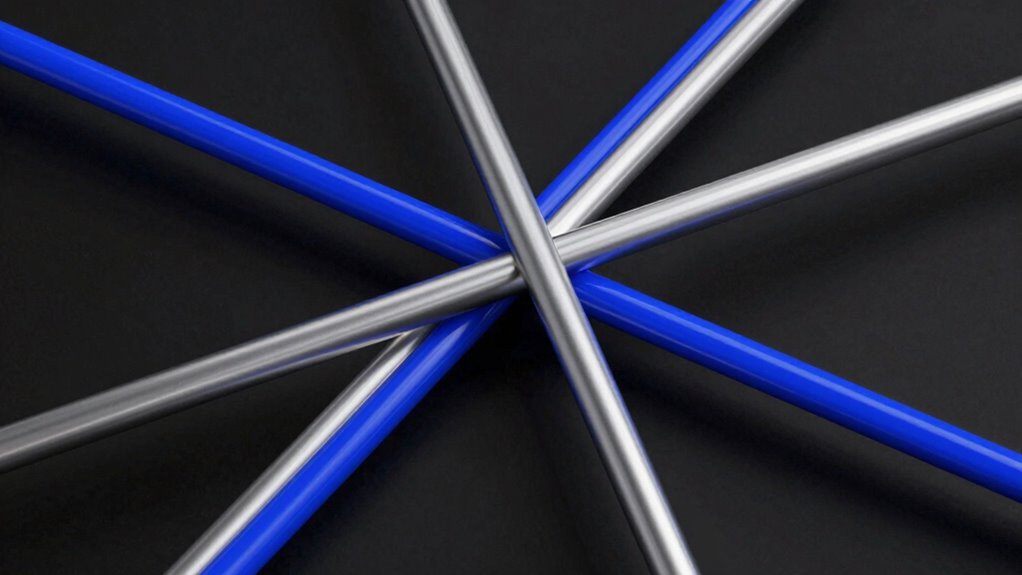
Have you ever wondered how lines can intersect in three-dimensional space? When you move beyond two dimensions, the way lines interact becomes much more complex and intriguing. In 2D, lines either intersect at a single point, are parallel, or coincide. But in 3D, lines can behave differently because they are no longer confined to a flat plane. They can be skew, meaning they don’t intersect and aren’t parallel, existing in separate planes that never meet. When lines do intersect in three dimensions, it’s essential to understand the spatial relationships involved. This is where projection techniques come into play, helping you visualize and analyze how lines behave in three-dimensional space.
Using projection techniques, you can transform a 3D scene into 2D representations, making complex spatial relationships easier to interpret. These methods include orthographic and perspective projections, which allow you to see how lines relate to each other from different viewpoints. Orthographic projection provides a parallel view, maintaining the true size and shape of objects, while perspective projection adds depth, mimicking how your eye perceives space. By applying these techniques, you can better understand whether lines truly intersect, are skew, or run parallel in three dimensions. This process enhances your spatial visualization skills, enabling you to mentally manipulate and interpret 3D structures on a 2D surface. Developing a solid understanding of geometric principles can further improve your ability to analyze complex spatial relationships.
Projection techniques help visualize and interpret complex spatial relationships between lines in 3D space.
When lines intersect in 3D, it’s not just a matter of crossing at a point; it requires considering their spatial positions. Two lines that appear to intersect in a 2D drawing may actually be skew in 3D, existing on different planes. To determine if they truly intersect, you need to analyze their parametric equations or use geometric constructions. Spatial visualization becomes crucial here, as you picture how lines move through space, understanding their orientation and position relative to each other. With practice, you can develop a mental model that helps you identify intersections more readily, even when the lines are not on the same plane. Improving your understanding of spatial relationships can significantly enhance your ability to interpret complex 3D diagrams and models.

3D Printer Tools Kit, Quality 3D Printing Tool Kit for Model Finishing/Deburring/Drilling, 3D Printer Accessories for All FDM/SLA Printers Removing Support, Cutting Filament, Cleaning Nozzle
- Complete 3D Printing Tool Kit: Includes essential tools for daily projects
- Supports Support Removal & Detachment: Safely remove supports without damaging prints
- Deburring & Finishing Tools: Smooth edges and improve print quality
As an affiliate, we earn on qualifying purchases.
As an affiliate, we earn on qualifying purchases.
Frequently Asked Questions
Can Two Skew Lines Ever Intersect in 3D Space?
Yes, two skew lines can intersect in 3D space, but only if they lie on parallel planes and are positioned so that their paths cross. Usually, skew lines are non-intersecting and not parallel, existing in different planes. However, if you shift one line within a parallel plane, they can meet at a point, creating an intersection. Without this, skew lines typically have no points of intersection, just infinite possibilities of their paths.
How Do You Determine if Lines Are Skew or Intersecting in 3D?
Imagine two lines in space, each described by parametric forms. To determine if they intersect or are skew, check if their equations share a common point. You can set their parametric equations equal and solve for parameters. If solutions exist, they intersect; if not, they’re skew. Alternatively, compare their plane equations. If the lines lie on the same plane, they may intersect; if not, they’re skew.
What Is the Significance of Intersecting Lines in 3D Modeling?
Intersecting lines in 3D modeling are essential for improving visualization techniques and ensuring modeling accuracy. When lines intersect correctly, they help define precise edges, vertices, and surfaces, making the model more realistic. Recognizing these intersections allows you to avoid errors like skew lines, which can distort the final design. Ultimately, understanding intersections enhances your ability to create complex, accurate 3D models that translate well into real-world applications.
Are There Real-World Examples of Intersecting Lines in 3D?
Did you know that over 70% of architects and engineers use 3D models daily to visualize complex structures? In the real world, intersecting lines are essential for understanding dimensional visualization and spatial relationships. For example, in bridge construction, intersecting beams and supports show how different components connect in three dimensions, ensuring stability and safety. These intersections help you see how objects relate and fit within a three-dimensional space.
How Does the Concept of Intersection Change in Higher Dimensions?
In higher dimensions, the concept of intersection becomes more complex due to increased dimensionality and spatial relationships. You’ll find that lines or objects that seem to intersect in lower dimensions might not do so in higher ones, as they can pass through different “hyperplanes.” This dimensional complexity means intersections are less inevitable, requiring you to contemplate additional factors like orientation and position in multiple dimensions to determine if and where objects intersect.

Caydo P3 Art Projector, Native 1080P Drawing Projector for Artists
- Bright, Vivid Projection: 400 ANSI lumens for clear daytime images
- Flexible Casting: 360° swivel base for versatile projection angles
- High-Quality Image: High contrast and accurate colors for precise tracing
As an affiliate, we earn on qualifying purchases.
As an affiliate, we earn on qualifying purchases.
Conclusion
When lines intersect in 3D, they don’t always cross like they do in 2D—they can pass above or below each other, creating a complex web of possibilities. Think of this as the universe’s secret dance, where appearances can deceive, and what seems like a meeting might just be a fleeting illusion. In this multidimensional domain, understanding intersections isn’t just about sight, but about seeing beyond the surface—because in 3D, nothing is quite as simple as it seems.

Perspective Made Easy (Dover Art Instruction)
As an affiliate, we earn on qualifying purchases.
As an affiliate, we earn on qualifying purchases.

Introduction to 3D Spatial Visualization: An Active Approach (Book & CD)
- Condition: Used Book in Good Condition
As an affiliate, we earn on qualifying purchases.
As an affiliate, we earn on qualifying purchases.