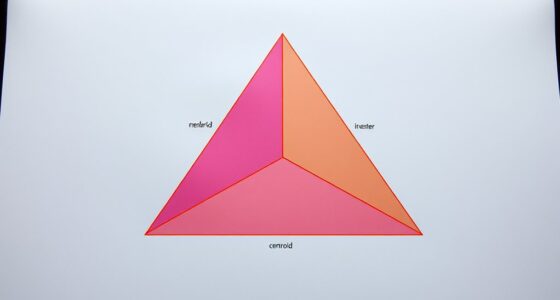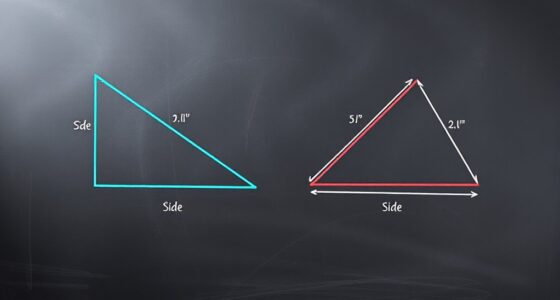

You notice how different triangle centers act in unique ways because they’re built from separate geometric ideas. The circumcenter is found at the intersection of perpendicular bisectors, making it related to the outside of the triangle and its vertices. The incenter, on the other hand, comes from angle bisectors and stays inside. These different constructions influence their positions and behaviors, revealing how each center reflects a distinct part of the triangle’s structure. Keep exploring to uncover more about these fascinating differences.

Prime made for students and young adults
- Fast, free delivery for dorm and study essentials
- Prime Video and Amazon Music included
- Member-only deals
Key Takeaways
- Different centers are defined by distinct geometric constructions, such as perpendicular bisectors and angle bisectors, influencing their behavior.
- The circumcenter’s position depends on vertex locations, shifting outside or inside based on triangle type.
- The incenter always lies inside the triangle due to its relation to internal angles and sides.
- External symmetry of the circumcenter contrasts with the internal symmetry of the incenter, affecting their locations.
- Variations in triangle shape and size cause centers to exhibit different positional and symmetrical properties.
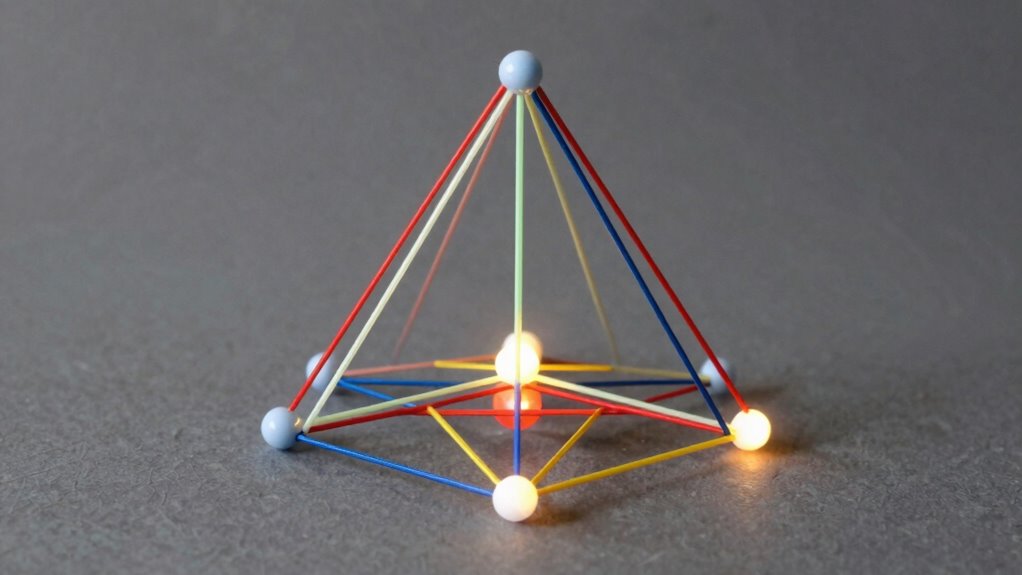
Triangle centers are fascinating points within a triangle that reveal different geometric properties and behaviors. Each center serves a unique purpose and behaves differently depending on the triangle’s shape and size. Understanding these differences helps you grasp the deeper structure of geometry. For instance, the circumcenter, which is the point where the perpendicular bisectors of the sides intersect, has some intriguing properties. It’s equidistant from all three vertices of the triangle, meaning you can draw circles centered at this point that pass through each vertex. This property makes the circumcenter especially significant in circumscribing the triangle. Its location varies depending on the type of triangle: inside for acute, on the hypotenuse for right, and outside for obtuse triangles. This variability showcases how the circumcenter’s position influences the triangle’s behavior and the nature of circumscribed circles. The behavior of the circumcenter demonstrates how different constructions affect the center’s position, which is fundamental in understanding triangle geometry. In contrast, the incenter is the point where the angle bisectors meet, and it holds a different kind of symmetry. The incenter is equidistant from all sides, making it the center of the inscribed circle that touches each side exactly once. The symmetry involved here is in the angle bisectors, which divide the angles into two equal parts. This symmetry ensures that the incenter always resides inside the triangle, regardless of its shape. The properties of the incenter highlight how internal angles and side distances shape the triangle’s internal harmony, contrasting with the circumcenter’s external focus on vertices. Additionally, the incenter’s internal symmetry emphasizes how internal angle bisectors influence the point’s position. Interestingly, the internal and external symmetries of these centers reflect the different ways they relate to the triangle’s overall structure. Why do these centers behave so differently? It’s because they are defined by fundamentally different geometric constructions—perpendicular bisectors versus angle bisectors—leading to distinct positional behaviors. The circumcenter responds to the triangle’s vertices and the circle passing through them, while the incenter relates to the internal angles and sides, emphasizing internal symmetry. This difference in construction explains why some centers can lie inside, on, or outside the triangle depending on its type. The behavior of each center reflects the underlying geometry: external symmetry in the case of the circumcenter, internal in the case of the incenter. Recognizing these fundamental differences helps you appreciate how each center reveals a unique aspect of the triangle’s structure, making the study of triangle centers both rich and insightful.
As an affiliate, we earn on qualifying purchases.
Frequently Asked Questions
How Are Triangle Centers Defined Mathematically?
You define triangle centers mathematically using coordinate systems and circle properties. For example, the centroid is the intersection of medians, found by averaging vertex coordinates. The incenter is where angle bisectors meet, and its position relates to circle inscribed within the triangle. The circumcenter, the intersection of perpendicular bisectors, is equidistant from vertices. These centers are precisely located through algebraic formulas or geometric constructions, relying on coordinate and circle properties for accuracy.
Do All Triangles Have the Same Number of Centers?
They don’t all have the same number of centers; in fact, most triangles have exactly three main centers. You’ll notice the centroid rotation, orthocenter reflection, and circumcenter are distinct points, each with unique properties. These centers help reveal different triangle features, but not every triangle shares the same centers or their positions. Remember, “Don’t judge a book by its cover,” as these centers show how diverse triangles truly are.
Can Triangle Centers Coincide in Special Triangles?
Yes, triangle centers can coincide in special triangle types. For example, in an equilateral triangle, the centroid, incenter, circumcenter, and orthocenter all align at the same point due to center uniqueness in such triangles. These special types, like equilateral or isosceles triangles, allow for the centers to coincide because their symmetrical properties cause the centers to overlap, unlike in scalene triangles where they typically remain distinct.
What Practical Applications Do Triangle Centers Have?
Think of triangle centers as the GPS of geometry—they help you navigate complex shapes with precision. You use triangle center classification and center construction techniques to locate points like the centroid, incenter, or orthocenter, which have real-world applications. Engineers rely on these centers for structural stability, while architects use them for ideal design. In essence, understanding triangle centers guides practical problem-solving and enhances design accuracy.
How Do Symmetry Properties Influence Triangle Centers?
Symmetry properties greatly influence triangle centers by guiding how they transform under various reflections or rotations. Symmetry implications mean that certain centers, like the centroid or incenter, stay fixed or move predictably during center transformations, reflecting the triangle’s symmetry. When a triangle has lines of symmetry, these centers often align or behave predictably, revealing deep geometric relationships. Recognizing these influences helps you understand the behavior and properties of different triangle centers.
geometric compass for triangle construction
As an affiliate, we earn on qualifying purchases.
As an affiliate, we earn on qualifying purchases.
Conclusion
As you explore the world of triangle centers, imagine them as tiny planets orbiting inside a triangle, each with its own unique gravity and path. Some are drawn to the very heart, others drift toward the edges, revealing their distinct personalities. Like stars shining with different light, these centers behave so differently because of their hidden rules and relationships. Embrace their diversity—you’ll see how each one paints a new picture of geometric beauty.
As an affiliate, we earn on qualifying purchases.
triangle circumcircle drawing tool
As an affiliate, we earn on qualifying purchases.
As an affiliate, we earn on qualifying purchases.
Halloween Picks
halloween
As an affiliate, we earn on qualifying purchases.