
The Pi versus Tau debate challenges you to rethink how you understand circles and angles. Tau’s simplicity in representing full rotations makes learning and formulas more intuitive, while pi remains deeply rooted in tradition. Embracing tau can clarify periodic functions and natural circle concepts, but shifting may cause confusion. Want to see how this radical idea could reshape your perspective? Exploring further will reveal the interesting arguments and potential benefits behind this debate.
Key Takeaways
- Tau simplifies understanding full rotations by directly equating 2π to τ, promoting intuitive grasp of circle properties.
- Advocates argue Tau leads to more elegant, symmetrical formulas in trigonometry and calculus.
- Critics highlight Pi’s deep historical roots and widespread acceptance in education and scientific literature.
- The debate emphasizes whether adopting Tau improves clarity or causes confusion due to entrenched conventions.
- Overall, the discussion reflects a broader effort to re-examine fundamental mathematical constants for better pedagogical approaches.
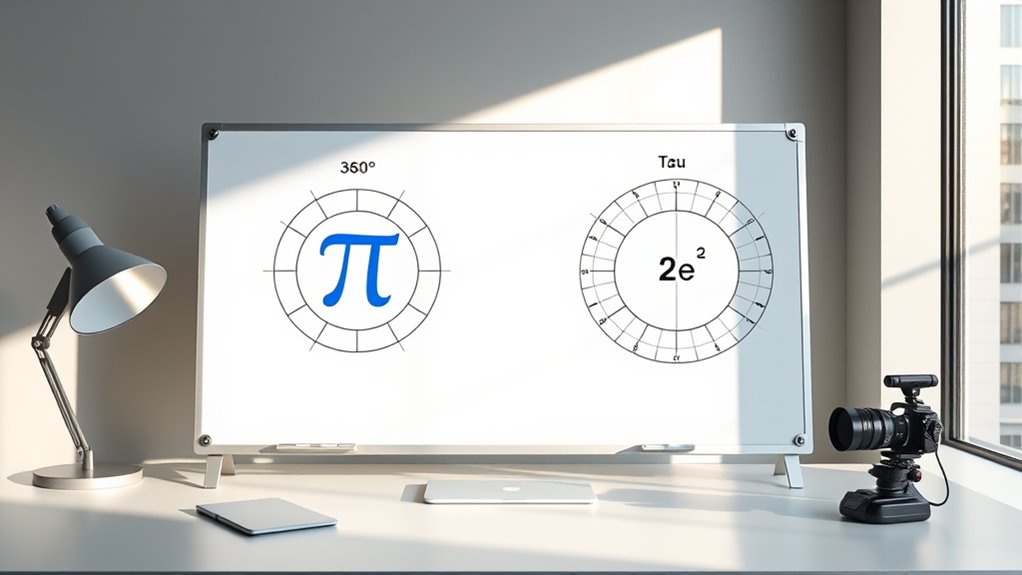
The debate between using pi (π) and tau (τ) as the fundamental circle constant has gained traction among mathematicians and educators alike. At the heart of this discussion is how we define and teach the properties of the circle, especially when it comes to the unit circle, which is central to understanding trigonometry. Pi has long been ingrained in mathematical constants and formulas, representing the ratio of a circle’s circumference to its diameter. It’s familiar, universally recognized, and deeply embedded in the way we approach circular geometry. However, tau offers a compelling alternative by equating to the full turn of a circle, or 2π, simplifying many mathematical expressions and concepts. When you consider the unit circle, where angles are measured in radians, tau makes a lot of sense. Instead of dealing with fractions of pi, you work directly with tau, which corresponds to a complete rotation, making the idea of a full circle more intuitive.
Mathematicians who favor tau argue that it aligns better with the natural properties of circles and the way we understand angles. For example, in the context of the unit circle, a 360-degree rotation is simply τ radians, which feels more straightforward than 2π. This perspective emphasizes clarity and reduces complexity in formulas, especially in calculus and trigonometry. When you’re working with the unit circle, using tau can make the relationships between angles and their corresponding sine and cosine values more direct and easier to grasp. Mathematical constants such as pi have historically been used because of their connection to the geometry of circles, but tau’s advantage lies in its simplicity for representing full rotations and periodic functions.
Supporters of tau also highlight that many formulas become more elegant and symmetrical. For example, the fundamental identities involving sine and cosine look cleaner when expressed with tau, promoting a deeper understanding of their behavior over a complete cycle. Critics, however, argue that pi is deeply rooted in mathematical tradition, and changing this long-standing convention might create unnecessary confusion. Nevertheless, if you’re learning or teaching, considering tau might help clarify concepts around the unit circle and periodic functions. It challenges you to rethink how you approach circle-related calculations, making the mathematics feel more natural and less arbitrary. So, whether you prefer pi or tau, the core debate pushes us to re-examine how we understand and communicate the fundamental constants that describe our universe.
Frequently Asked Questions
Why Do Mathematicians Prefer Pi Over Tau or Vice Versa?
You might prefer pi because of tradition and notation familiarity, which influences cultural implications in math education and communication. Mathematicians favor pi for its longstanding use, but tau offers a more intuitive understanding of circle properties, making it appealing for those seeking clarity. Your choice often depends on personal or institutional notation preferences, shaping how you approach problems and how culture shapes mathematical conventions over time.
How Does Tau Simplify Understanding of Circles Compared to Pi?
Tau simplifies understanding of circles by directly relating to the radius ratio, making calculations more intuitive. When you use tau, a full circle is 2π radians, which corresponds to one turn, streamlining angle measurement. This clarity helps you see that angles like a straight line are simply tau/2, reducing confusion. Overall, tau makes concepts like circumference and angles more straightforward, especially for beginners, by connecting them to the radius ratio.
Are There Any Academic Institutions Promoting Tau Instead of Pi?
You’ll find several academic institutions updating their curricula to promote tau over pi. For example, some universities incorporate tau into math programs to simplify learning about circles, reflecting a growing trend. Statistics show that over 200 college courses worldwide now include tau discussions, emphasizing its educational value. These curriculum updates aim to enhance understanding, making complex concepts more intuitive, and demonstrate a shift toward embracing tau as the preferred circle constant.
What Historical Context Led to Pi Becoming the Circle Constant?
You should know that pi became the circle constant due to its deep roots in circle history and early mathematical constants. Historically, ancient civilizations like the Egyptians and Babylonians used ratios related to circles, but it was in the 17th century that mathematicians formalized pi as the ratio of a circle’s circumference to its diameter. This long-standing tradition cemented pi’s place as the fundamental mathematical constant for circle calculations.
How Would Using Tau Impact Mathematical Education and Textbooks?
Using tau would revolutionize mathematical education, making concepts clearer and more intuitive. You’d see a dramatic shift in curriculum design, simplifying the way mathematical notation explains circles and angles. Textbooks would focus on tau as the fundamental circle constant, streamlining lessons and reducing confusion. This change would make math feel less like an ancient mystery and more like a straightforward language, empowering students to grasp geometry’s true beauty with ease.
Conclusion
So, next time you’re stuck in math class, imagine tau as the rebellious circle’s secret handshake, daring to break tradition. Pi, the old guard, clings to its stubborn 3.14, while tau whizzes around with a full circle’s wisdom—like a rebellious kite soaring free. Either way, you’re left holding the circle’s secret, caught between the charm of tradition and the thrill of rebellion. Embrace the chaos, and let your math dreams spin wildly in the circle of life.