Voronoi diagrams and Delaunay triangulations are dual algorithms used for dividing space efficiently. You can think of Voronoi diagrams as regions around points where any location is closest to one of those points. Delaunay triangulation connects points to form triangles with no inside circumcircle. These methods help analyze spatial relationships, optimize layouts, and solve complex problems. Continue exploring, and you’ll uncover how these algorithms work together to solve various spatial challenges.
Key Takeaways
- Voronoi diagrams partition space into regions closest to each point, while Delaunay triangulation connects points to form optimal triangles.
- These algorithms are dual; Delaunay triangulation can be derived from Voronoi diagrams and vice versa.
- Voronoi diagrams visualize influence zones, aiding in spatial analysis and resource allocation.
- Delaunay triangulation maximizes minimum angles, creating well-shaped triangles for surface reconstruction.
- Both algorithms are essential tools in computational geometry for space partitioning and spatial relationship analysis.
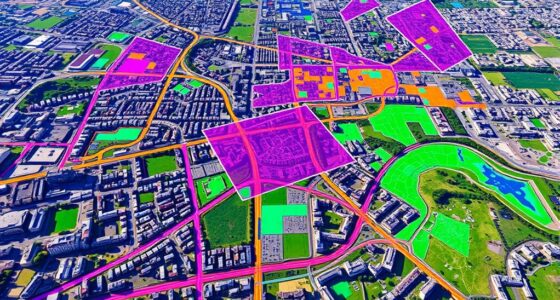
Voronoi and Delaunay algorithms are fundamental tools in computational geometry that help analyze and partition space based on a set of points. When working with spatial data, these algorithms allow you to understand relationships, optimize layouts, and solve complex problems efficiently. The core idea behind Voronoi diagrams is to divide space into regions, each surrounding a specific point, such that any location within a region is closest to that point compared to all others. This means that if you have a collection of points representing, say, cell towers or weather stations, the Voronoi diagram visually indicates the areas each station influences most. This visualization helps in tasks like resource allocation, coverage analysis, or spatial clustering. Additionally, Voronoi diagrams are often used in urban planning to optimize the placement of facilities and infrastructure.
Delaunay triangulation complements Voronoi diagrams as its dual graph. It connects points to form triangles in such a way that no point lies inside the circumcircle of any triangle. This property ensures that the triangulation maximizes the minimum angle across all triangles, avoiding skinny triangles that can cause computational issues. When you generate a Delaunay triangulation, you’re effectively creating a mesh that reflects the spatial relationships among points, which is useful for interpolation, pathfinding, and surface reconstruction. Because of their duality, constructing a Delaunay triangulation from a set of points directly gives you the Voronoi diagram, and vice versa. This interconnectedness simplifies many spatial analyses.
Implementing these algorithms involves understanding their geometric properties and choosing the right approach based on your data size and application. For example, algorithms like Fortune’s sweep line method efficiently generate Voronoi diagrams for large datasets. Once you have a Voronoi diagram, you can derive the Delaunay triangulation by connecting points whose regions share an edge. Conversely, starting from a Delaunay triangulation, you can produce the Voronoi diagram by drawing perpendicular bisectors of the edges. This dual process ensures consistency and provides multiple perspectives for spatial analysis.
Both Voronoi diagrams and Delaunay triangulation are widely used in fields ranging from computer graphics and geographic information systems to robotics and urban planning. They enable you to partition and analyze space in a way that reveals underlying patterns and relationships. By mastering these algorithms, you enhance your ability to solve real-world problems involving spatial data, optimize network layouts, and develop more efficient computational models. Their dual nature ensures that you can switch perspectives easily, leveraging the strengths of each method to gain deeper insights into complex spatial relationships.
Frequently Asked Questions
How Do Voronoi and Delaunay Algorithms Perform With High-Dimensional Data?
You’ll find that Voronoi and Delaunay algorithms struggle with high-dimensional data due to high dimensional challenges. As dimensions increase, their performance drops because of exponential growth in complexity, leading to scalability issues. This makes them less practical for large, high-dimensional datasets. To overcome this, you might consider alternative techniques like approximate algorithms or dimensionality reduction methods, which can better handle the curse of dimensionality and improve scalability.
What Are Common Real-World Applications of These Algorithms?
Imagine a city’s blueprint coming to life—you use Voronoi and Delaunay algorithms for urban planning, dividing neighborhoods with precision. They also power cellular networks, optimizing signal towers for seamless coverage. These algorithms help design efficient transportation systems, manage resource allocation, and even enhance environmental monitoring. By turning complex spaces into manageable regions, you harness their real-world magic to build smarter, more connected communities and infrastructure.
How Do These Algorithms Handle Dynamic or Changing Datasets?
You can handle dynamic datasets with these algorithms through adaptive updates and incremental construction. When data points change, you update the Voronoi diagram or Delaunay triangulation locally, avoiding a full rebuild. This approach allows you to efficiently adapt to additions, removals, or movements of points, ensuring your space partitioning stays accurate without significant computational costs. It’s an effective way to manage real-time changes in your data.
What Are the Computational Complexities of Voronoi and Delaunay Constructions?
You might worry about algorithm efficiency and data scalability, but Voronoi and Delaunay constructions are quite manageable. Typically, they run in O(n log n) time for 2D datasets, making them efficient for large data. As your dataset grows, their performance remains practical, and optimized algorithms help handle dynamic updates. So, you can confidently use these algorithms even as your data scales, knowing they stay computationally feasible.
Can These Algorithms Be Integrated With Machine Learning Models?
You can definitely integrate Voronoi and Delaunay algorithms with machine learning models. They serve as tools for hybrid optimization and feature augmentation, helping improve data representation and spatial analysis. By incorporating these algorithms, you can enhance models’ understanding of geometric relationships, leading to better clustering, classification, or regression results. This integration opens new avenues for spatial data analysis and more robust, accurate machine learning applications.
Conclusion
As you explore Voronoi and Delaunay algorithms, remember their timeless dance—like planets orbiting in harmony—each shaping space with purpose. These dual algorithms reveal nature’s elegance in structuring chaos, guiding you to see beyond mere computation. Embrace their beauty, for in understanding their connection, you discover a deeper harmony within the universe’s intricate design. Just as stars find balance, so too can your insights find clarity through these powerful tools.