
As a robotics engineer, you rely on geometric algorithms to help robots perceive, navigate, and manipulate their surroundings accurately. These algorithms enable you to calibrate sensors, plan best paths around obstacles, and represent complex environments mathematically. They transform real-world data into coordinate models, making tasks safer and more efficient. Exploring how these algorithms work in action reveals the core technology driving advanced robotic systems—continue exploring to understand how these concepts come alive in real-world applications.
Key Takeaways
- Robotics engineers utilize geometric algorithms for precise sensor calibration, ensuring accurate environmental data interpretation.
- They implement path planning algorithms like A* and Voronoi diagrams to optimize robot navigation and obstacle avoidance.
- Geometric modeling helps engineers represent complex environments, enabling safe and efficient robot movement.
- Algorithms support real-time adaptation to dynamic surroundings, critical for autonomous exploration and task execution.
- Engineers translate mathematical geometry into practical systems for improved perception, manipulation, and autonomous decision-making.
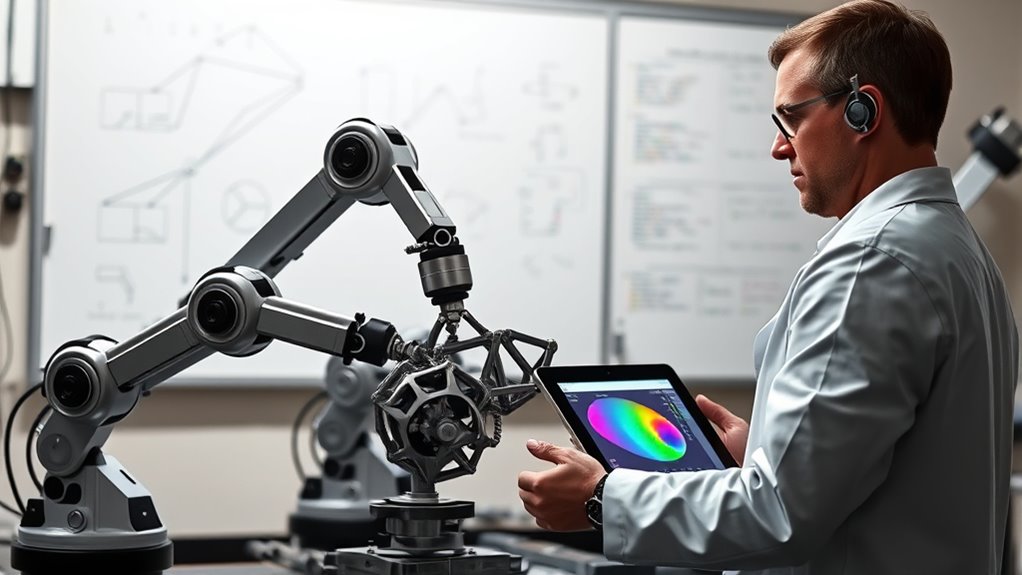
Have you ever wondered what it takes to design and build the robots that power industries, explore space, or assist in everyday tasks? As a robotics engineer, you dive into complex problems that require a deep understanding of geometric algorithms to guarantee robots operate efficiently and accurately. A critical aspect of this work involves sensor calibration. Think of sensors as the robot’s eyes and ears—they gather essential data about the environment. But these sensors aren’t perfect out of the box. You must calibrate them meticulously to confirm their readings are accurate, which directly impacts the robot’s ability to interpret its surroundings reliably. Proper sensor calibration involves geometric algorithms that compare sensor outputs against known reference points, adjusting for distortions or inaccuracies. This process ensures that the robot perceives its environment correctly, whether it’s avoiding obstacles or manipulating objects.
Once sensors are calibrated, your focus shifts to path planning. This is where geometric algorithms truly shine. Path planning involves calculating an ideal route for the robot to reach its destination while avoiding obstacles and minimizing energy consumption. You use geometric concepts like Voronoi diagrams, Delaunay triangulation, or A* algorithms to map the environment and plot safe, efficient paths. These algorithms analyze spatial data, taking into account the robot’s size, kinematic constraints, and dynamic obstacles. The challenge lies in creating algorithms that can adapt in real-time, recalculating routes as the environment changes. Your expertise in geometry helps you develop algorithms that are not only precise but also computationally efficient, enabling the robot to respond swiftly. Additionally, understanding the importance of accurate geometric models ensures that the translation of real-world scenarios into mathematical representations is as precise as possible.
Mastering geometric algorithms also means understanding how to translate real-world scenarios into mathematical models. You create representations of physical spaces, using coordinate systems and geometric shapes to simplify complex environments. This modeling is essential for accurate path planning and sensor calibration, as it provides a framework for analyzing spatial relationships. Whether you’re programming a robotic arm in a factory or guiding a rover across Martian terrain, these algorithms form the backbone of the robot’s decision-making process. Your skill in applying geometric principles ensures that robots can navigate unpredictable environments, perform tasks with precision, and operate safely alongside humans.
In essence, as a robotics engineer, your work with geometric algorithms—particularly in sensor calibration and path planning—translates complex mathematical concepts into practical solutions. These algorithms empower robots to perceive their environment accurately and navigate intelligently, making them indispensable tools in advancing automation and exploration. Your expertise guarantees that robots don’t just function—they excel in performing their tasks with reliability and efficiency.
Frequently Asked Questions
How Do Geometric Algorithms Improve Robot Navigation Accuracy?
Geometric algorithms improve your robot’s navigation accuracy by enhancing mapping precision and obstacle avoidance. They process spatial data quickly, allowing your robot to create detailed maps of its environment. This helps it identify obstacles more reliably and plan efficient paths. As a result, your robot can navigate complex spaces smoothly, avoid collisions, and reach destinations faster, making its movements safer and more dependable in dynamic or cluttered settings.
What Programming Languages Are Most Common for Geometric Algorithm Implementation?
You typically use languages like C++, Python, and MATLAB for implementing geometric algorithms, especially in path planning and collision detection. C++ is popular for its speed and efficiency, making it ideal for real-time applications. Python offers simplicity and a rich ecosystem of libraries, speeding up development. MATLAB is great for prototyping and testing algorithms. Together, these languages help you develop accurate, efficient navigation systems for robots.
How Do Geometric Algorithms Handle Dynamic Obstacles in Real-Time?
You handle dynamic obstacles in real-time by using obstacle avoidance techniques integrated into your path planning algorithms. These algorithms continuously update the robot’s route, detecting moving objects and adjusting the path proactively. You rely on sensors to gather real-time data, allowing the system to respond quickly and guarantee safe navigation. This dynamic obstacle handling ensures your robot can navigate complex environments smoothly, avoiding collisions while maintaining efficient movement.
What Are the Biggest Challenges in Designing Geometric Algorithms for Robotics?
Like trying to untangle a maze of glowing threads, designing geometric algorithms for robotics presents huge challenges. You must guarantee precise sensor calibration and data fusion to interpret the environment accurately. Balancing real-time responsiveness with complex calculations pushes system limits. Handling unpredictable obstacles, maintaining safety, and optimizing efficiency require innovative solutions, as every decision hinges on seamless integration of sensor data and geometric reasoning, making the task both intricate and rewarding.
How Does Sensor Data Integration Enhance Geometric Algorithm Performance?
Sensor data integration boosts geometric algorithm performance by enabling sensor fusion, which combines inputs from multiple sensors for more accurate, thorough data. Data synchronization ensures that this information aligns precisely in time, reducing errors and inconsistencies. By effectively integrating and synchronizing sensor data, you improve the robustness and reliability of your geometric algorithms, allowing your robot to navigate and interact with its environment more accurately and efficiently.
Conclusion
As you master geometric algorithms, you’re sculpting the future of robotics—like an artist shaping a masterpiece from raw data. Every line of code transforms into precise movements, turning complex challenges into elegant solutions. Picture your algorithms as the guiding stars in a dark sky, illuminating the path forward. With each innovation, you’re not just building robots—you’re forging the symphony of tomorrow’s technological world. Embrace this journey, and let your creativity shape the impossible into reality.