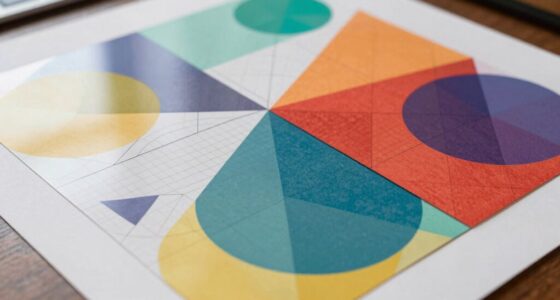
Origami merges geometric principles with artistic creativity to spark innovation in design. By understanding how folds follow specific angles and proportions, you can create structures that are both beautiful and functional. This approach influences architecture, product design, and technology, enabling lightweight, adaptable, and visually striking solutions. If you want to explore how these folding patterns can transform your ideas into innovative designs, there’s more to discover.
Prime for Young Adults — start your free trial
Fast free delivery, streaming and member deals for eligible 18–24 year olds.
As an affiliate, we earn on qualifying purchases.
Key Takeaways
- Origami applies geometric principles to create innovative, scalable, and predictable design patterns across various fields.
- Folding techniques enable the development of lightweight, deployable structures in architecture and technology.
- Mathematical understanding of folds informs the creation of aesthetically striking and structurally efficient designs.
- Modern computational tools simulate complex origami patterns, fostering new possibilities in sustainable and adaptable structures.
- Origami bridges tradition with innovation, inspiring creative exploration and storytelling through transformative forms.

Have you ever wondered how the ancient art of origami influences modern design? It’s a fascinating intersection where mathematical patterns meet artistic expression, creating a bridge between tradition and innovation. Origami isn’t just about folding paper into beautiful shapes; it’s a sophisticated language of geometry that reveals how simple folds can generate complex, functional forms. This blend of precision and creativity inspires designers across fields—architecture, product design, fashion, and even technology—who seek to incorporate origami’s principles into their work. When you understand the underlying mathematical patterns, you see how each fold corresponds to specific angles and proportions, allowing for predictable, repeatable results. These patterns aren’t random; they follow geometric rules that can be scaled, modified, and combined to produce new structures. This mathematical rigor provides a solid foundation for translating the traditional art into modern applications. At its core, origami fosters artistic expression by encouraging innovative thinking and visual exploration. You can experiment with folds to create dynamic, eye-catching shapes that challenge conventional design norms. For example, architects utilize origami-inspired structures to develop buildings that are not only aesthetically striking but also structurally efficient and adaptable. The ability to fold and unfold materials enables the creation of deployable structures, which are lightweight yet robust—ideal for temporary installations, emergency shelters, or space habitats. Designers leverage this versatility to craft products that are both functional and visually engaging. The process of folding also embodies a form of storytelling, where each crease contributes to a narrative of transformation and ingenuity. By embracing origami’s principles, you tap into a rich tradition that celebrates precision, patience, and creativity. Understanding the mathematical patterns behind these folds reveals how relationships between angles and proportions govern the design process, enabling more sophisticated and innovative outcomes. Modern technology further amplifies these ideas, as computational design tools help simulate complex folding patterns, pushing the boundaries of what’s possible. This fusion of ancient technique and cutting-edge innovation results in designs that are elegant, sustainable, and efficient. Ultimately, the influence of origami on modern design reveals how mathematical patterns can serve as a foundation for artistic expression, opening new avenues for innovation. You become part of a continuum that values both discipline and imagination, transforming simple sheets of paper into masterpieces of engineering and art. Whether in architecture or fashion, origami reminds us that the most remarkable designs often emerge from the simplest ideas, meticulously folded into extraordinary forms.
origami folding geometric design kit
As an affiliate, we earn on qualifying purchases.
As an affiliate, we earn on qualifying purchases.
Frequently Asked Questions
How Does Origami Influence Modern Architectural Design?
You see how paper folding inspires modern architectural design by encouraging innovative, lightweight structures. Creative origami techniques allow you to develop complex, flexible forms that adapt to different spaces and functions. By applying folding geometry, you can create energy-efficient buildings with unique aesthetics. This influence pushes architects to think outside traditional frameworks, making structures more sustainable and visually striking through the clever use of origami-inspired design principles.
What Are the Mathematical Principles Behind Origami Folds?
Think of origami folds like a complex dance, guided by mathematical principles. You use geometric transformations to manipulate paper, creating precise angles and shapes. Combinatorial mathematics helps you understand how folds can be combined in countless ways, ensuring structural stability and aesthetic appeal. These principles allow you to design intricate, functional models, blending art and science seamlessly, much like a master choreographer directing a perfect performance.
Can Origami Techniques Improve Sustainable Product Development?
Yes, origami techniques can enhance sustainable product development by encouraging the use of eco-friendly materials and creating reusable structures. You can design products that fold down for compact storage or transform for multiple functions, reducing waste. By applying origami principles, you promote innovation with minimal material use, making your designs more environmentally friendly and efficient. This approach helps you develop sustainable solutions that are both functional and eco-conscious.
How Is Origami Used in Biomedical Engineering?
You can see origami’s impact in biomedical engineering through its use in designing compact, deployable biomedical devices and surgical tools. By leveraging folding techniques, you can create devices that unfold inside the body, reducing invasiveness and improving precision. This approach allows for minimally invasive procedures, making surgeries safer and more efficient. Origami-inspired designs continue to revolutionize how you develop innovative, adaptable solutions for complex medical challenges.
What Are the Challenges in Scaling Origami-Based Designs?
Like trying to fit a square peg in a round hole, scaling origami-based designs presents challenges. You’ll face scaling complexity, as small models don’t always translate well to larger sizes, and fabrication challenges, especially when maintaining precise folds and material integrity. Achieving consistency and durability becomes tough, but with innovative materials and techniques, you can overcome these hurdles to bring intricate origami structures to life at any scale.
architectural origami paper models
As an affiliate, we earn on qualifying purchases.
As an affiliate, we earn on qualifying purchases.
Conclusion
You’ve seen how origami opens doors to dazzling designs and daring innovations. By blending bold bends with brilliant ideas, you can transform simple sheets into spectacular structures. Embrace this elegant art to ignite your imagination and inspire inventive insights. With every fold, you forge fresh futures, fueling your creative fire. So, step into the world of origami, where geometry guides your genius and innovation is just a fold away.
deployable origami structures for architecture
As an affiliate, we earn on qualifying purchases.
As an affiliate, we earn on qualifying purchases.
As an affiliate, we earn on qualifying purchases.
NFL season / tailgating Picks
team gear
As an affiliate, we earn on qualifying purchases.