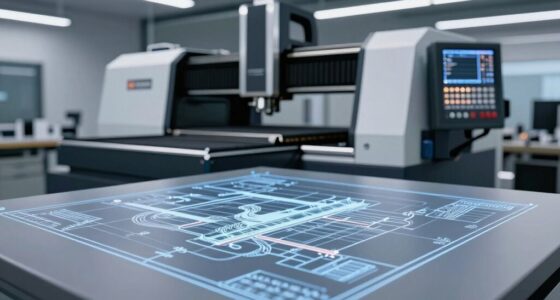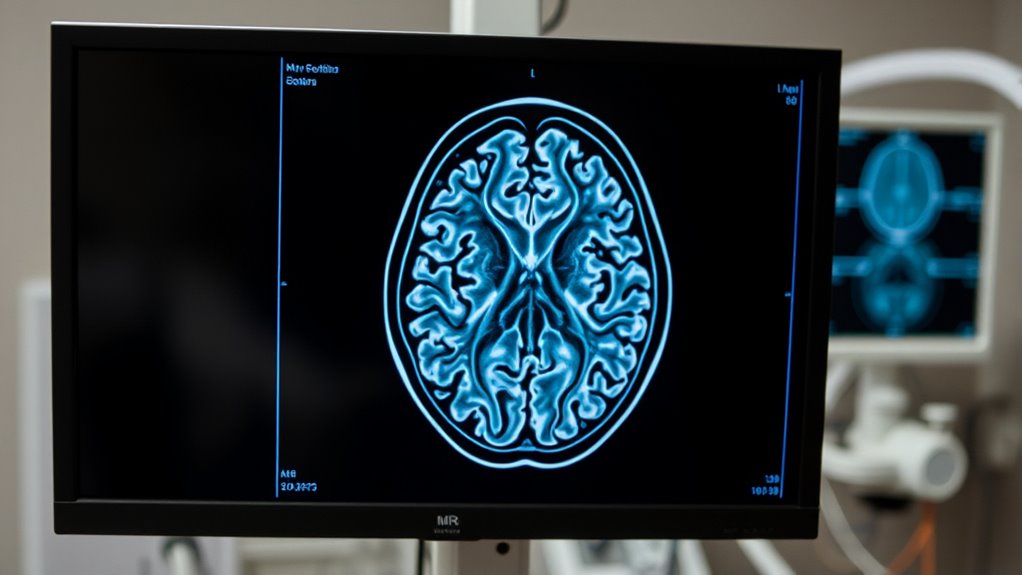

In medicine, imaging and diagnostics depend heavily on understanding shapes and geometry. Using technologies like MRI and CT scans, you can visualize detailed geometric data of internal structures, such as organs, bones, and tissues. This precise shape information helps you identify abnormalities and plan surgeries more safely. By analyzing the spatial relationships and forms of these structures, you optimize treatments and improve outcomes. If you keep exploring, you’ll discover how geometry truly enhances medical precision and innovation.
Key Takeaways
- Medical imaging produces detailed geometric models of internal structures for accurate diagnosis.
- Shapes and spatial relationships help identify abnormalities and guide treatment planning.
- 3D reconstructions enable precise visualization of organs and tissues for diagnostics.
- Geometric measurements assist in assessing size, shape, and positioning of biological features.
- Imaging data’s geometric accuracy improves diagnostic confidence and personalized medical interventions.

Have you ever wondered how geometry shapes the way doctors diagnose and treat the human body? It’s a fascinating intersection where mathematical shapes and spatial reasoning become essential tools in medicine. When your doctor orders imaging tests like MRI or CT scans, they’re working with detailed geometric data that reveals the internal structures of your body. These images aren’t just pictures; they’re precise maps that help clinicians understand the complex shapes and sizes of organs, bones, and tissues. By analyzing these shapes, doctors can identify abnormalities, plan treatments, and even predict how conditions might progress. Geometry provides the language for translating invisible biological structures into visual, measurable forms.
In surgical planning, geometry is absolutely indispensable. Surgeons rely on three-dimensional models generated from imaging data to map out procedures with pinpoint accuracy. Instead of relying solely on intuition, they use geometric calculations to determine the best approach, avoid critical structures, and minimize trauma. For example, when operating on a tumor near vital blood vessels, surgeons need to understand the spatial relationships precisely. They might use computer-aided design (CAD) tools that incorporate detailed geometric models to simulate the surgery beforehand. This guarantees they’re prepared for every twist and turn, reducing risks and improving outcomes. In this way, geometry doesn’t just assist in visualization; it actively guides the surgical process, making complex procedures safer and more predictable.
Additionally, geometry plays a fundamental role in implant design. Whether it’s joint replacements, dental implants, or bone scaffolds, the shapes of these devices must fit perfectly within the body’s natural contours. Engineers and medical professionals work together to create implants that replicate the geometry of the original anatomy. This ensures stability, comfort, and functionality. Advanced imaging techniques provide the geometric data needed to craft custom implants tailored to each patient’s unique anatomy. The goal is to design implants that integrate seamlessly with existing tissues, promoting better healing and longer-lasting results. Without a solid understanding of the shapes involved, achieving a perfect fit would be nearly impossible. Moreover, recent advancements in 3D printing have enhanced custom implant production, allowing for even more precise recreation of complex biological geometries.
Ultimately, geometry in medicine isn’t just about abstract shapes; it’s about applying mathematical principles to real-world problems that directly impact health. It helps turn complex biological forms into understandable models, guides precise surgical interventions, and ensures implants work harmoniously within the body. By embracing the power of shapes and spatial reasoning, medicine continues to become more accurate, personalized, and effective. So the next time you see a detailed medical image or hear about a groundbreaking implant, remember that behind it all lies the fundamental language of geometry working to improve your health.

Atlas of Diagnostic Imaging in Dermatology: A Practical Approach
As an affiliate, we earn on qualifying purchases.
As an affiliate, we earn on qualifying purchases.
Frequently Asked Questions
How Do Different Shapes Influence the Accuracy of Medical Imaging?
Different shapes notably influence the accuracy of medical imaging because they affect how well the system can perform circle approximation and angular measurements. You’ll find that irregular or complex shapes make it harder to get precise readings, leading to potential errors. By understanding these shape influences, you can improve image interpretation, ensuring more accurate diagnostics. Properly accounting for shape variations helps your imaging tools provide clearer, more reliable results.
What Role Does Geometry Play in Developing New Diagnostic Tools?
Geometry acts as the blueprint guiding your innovations, like a master architect sketching the future of diagnostics. By understanding fracture patterns and tissue elasticity, you can design tools that precisely navigate the body’s intricate landscape. This mathematical language unlocks new ways to detect subtle changes, turning complex structures into understandable maps. Your mastery of geometry transforms raw data into accurate, life-saving diagnostic tools, shaping medicine’s future with every calculated curve.
Can Geometric Principles Improve Personalized Treatment Plans?
Yes, geometric algorithms and shape analysis can profoundly improve personalized treatment plans. By analyzing the unique shapes and structures of a patient’s anatomy, you can tailor interventions more precisely. These principles help identify subtle differences, optimize surgical approaches, and enhance imaging accuracy. Incorporating geometric methods allows you to develop treatments that better fit individual needs, leading to improved outcomes and more effective, personalized healthcare solutions.
How Is 3D Modeling Changing Surgical Procedures?
Think of 3D modeling as your surgical compass, guiding you through complex anatomy. It transforms your approach by integrating virtual reality and biomechanical analysis, giving you a detailed, realistic view before stepping into the operating room. This technology allows you to plan procedures precisely, reducing risks and improving outcomes. With 3D models, you gain a clearer understanding of patient-specific structures, making surgeries safer and more effective.
What Challenges Exist in Applying Geometry to Complex Biological Structures?
You face challenges when applying geometry to complex biological structures due to biological complexity and imaging limitations. The intricate shapes and variability of tissues make precise modeling difficult, and imaging techniques might not capture every detail accurately. These issues can lead to incomplete or distorted models, affecting diagnostics and treatment plans. Overcoming these challenges requires advancements in imaging technology and more sophisticated geometric algorithms to better represent biological diversity.

TIME&TRAVE 3D Printed Spine Pen Holder, Anatomical Vertebrae Pencil Cup Based on Real CT Scan, Gothic Desk Organizer for 8-10 Pens, Medical Student & Doctor Gift
Anatomically Accurate Spine Design: Faithfully reproduced from real human CT scan data, this pen holder showcases intricate vertebral…
As an affiliate, we earn on qualifying purchases.
As an affiliate, we earn on qualifying purchases.
Conclusion
So, next time you think about medicine, remember it’s not just about pills and procedures. It’s about shapes—circles, lines, and curves—that reveal health secrets. Just like a puzzle, geometry helps doctors piece together your body’s story, turning complex forms into clear diagnoses. In this way, medicine isn’t only science; it’s an art of understanding shapes, making the invisible visible, and ultimately, saving lives through the power of geometry.

Additive Manufacturing of Metals: From Fundamental Technology to Rocket Nozzles, Medical Implants, and Custom Jewelry (Springer Series in Materials Science, 258)
As an affiliate, we earn on qualifying purchases.
As an affiliate, we earn on qualifying purchases.

Handbook of Surgical Planning and 3D Printing: Applications, Integration, and New Directions
As an affiliate, we earn on qualifying purchases.
As an affiliate, we earn on qualifying purchases.