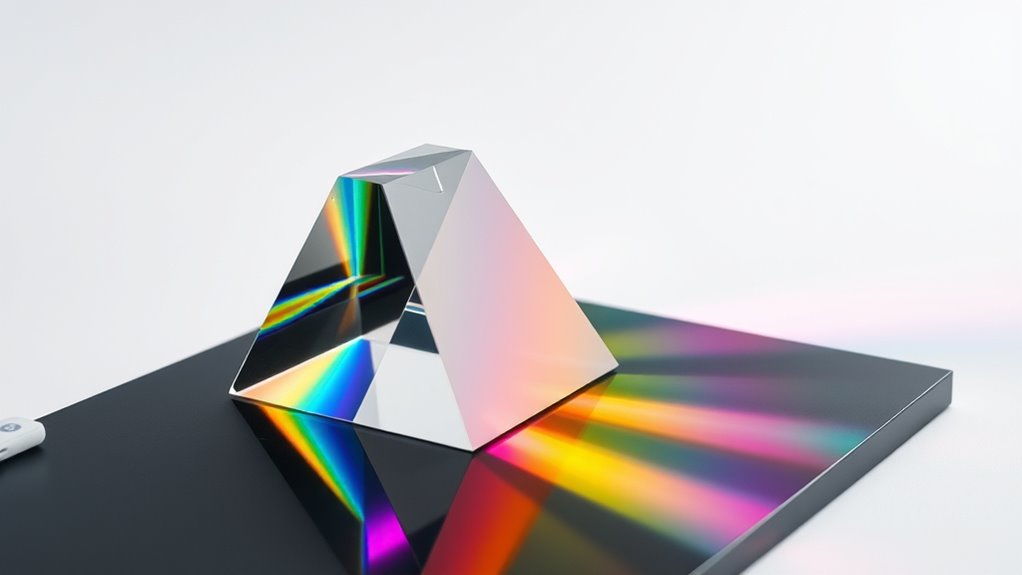

Bending light in geometric optics means understanding how light rays travel straight and change direction when passing through lenses or reflecting off mirrors. Simple experiments, like shining a flashlight through a convex lens or using a spoon to distort images, show how light bends. Ray tracing helps you visualize this process by drawing light paths to see where images form or distort. If you continue exploring, you’ll discover how these principles shape the way we see and design optical devices.
Key Takeaways
- Light travels in straight lines and bends when passing through lenses or around objects, enabling image formation and distortion.
- Simple experiments, like shining a flashlight through a convex lens, demonstrate how light bends and creates focused or distorted images.
- Ray tracing visually predicts how light rays bend and converge or diverge, helping understand optical effects and distortions.
- Lens shape and refractive index influence how light bends, affecting the clarity and accuracy of the resulting image.
- Understanding light bending through experiments and ray tracing aids in designing better optical devices with minimal distortions.
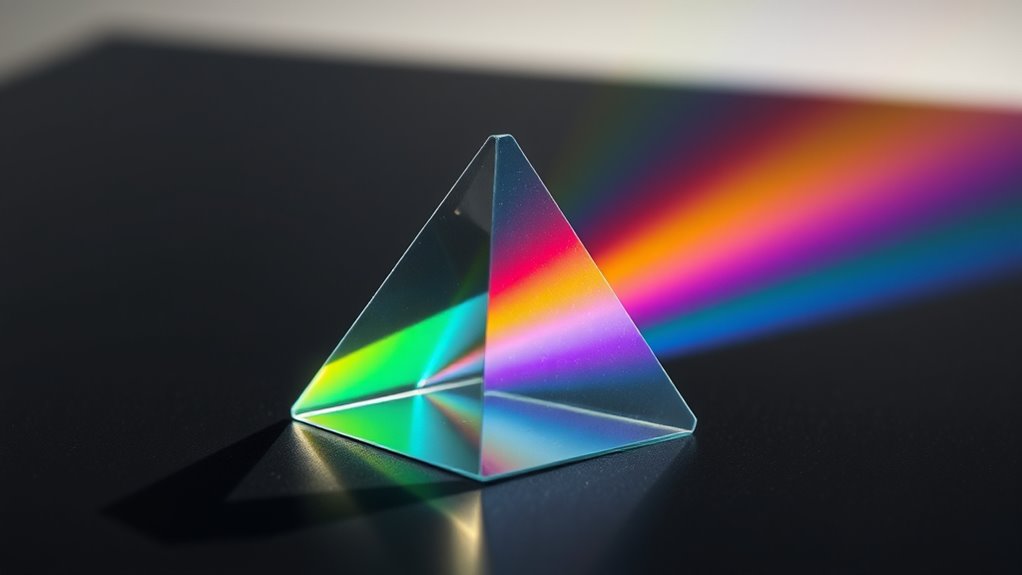
Have you ever wondered how light travels in straight lines to form images? It’s a fundamental question in understanding how we see the world around us. In the domain of geometric optics, light is often treated as rays that travel in straight lines, which makes it easier to analyze how images form through lenses and mirrors. When you look through a simple magnifying glass or camera lens, you’re witnessing this principle in action. But sometimes, the way light interacts with these lenses isn’t perfect, leading to phenomena like lens distortion. This distortion occurs because real lenses aren’t ideal; slight imperfections and design limitations cause images to appear warped or distorted. To predict and understand these effects, scientists and engineers use a technique called ray tracing. Ray tracing involves drawing multiple rays from an object through the lens, tracing their paths to see where they converge or diverge. This method helps visualize how the lens bends light rays, showing why images may seem stretched, compressed, or skewed.
When you perform simple experiments with lenses, you’re effectively engaging in basic ray tracing. For instance, by shining a flashlight through a convex lens onto a piece of paper, you can observe how the light rays bend and focus at a point, forming a clear image. If the lens is imperfect or if you look at the image from an angle, distortion can occur. This is because different parts of the lens bend light differently, a phenomenon known as lens distortion. It’s especially noticeable with wide-angle lenses or cheap optics, where straight lines may appear curved or warped. Understanding ray tracing helps you grasp why these distortions happen and how lens design can minimize them. Engineers use computer simulations that employ ray tracing to optimize lens shapes, reducing unwanted distortions and improving image quality.
In everyday life, your knowledge of ray tracing and lens distortion can help you choose better optics or understand why certain images seem off. Whether you’re taking photographs or using a microscope, recognizing how light bends and where distortions originate enhances your appreciation of optical devices. When light passes through a lens, it’s bent according to the shape and refractive index of the material, which is what causes the focusing or spreading of rays. This bending is predictable through ray tracing, giving you a clear picture of how images are formed. So next time you look through a camera or a magnifying glass, remember that you’re witnessing the fascinating interplay of light rays bending, converging, and sometimes distorting—an elegant dance explained by the principles of geometric optics.
Frequently Asked Questions
How Does Light Behave in Different Mediums Besides Air and Glass?
When light travels through different mediums, it behaves uniquely. In liquids, refraction causes light to bend, similar to glass, but at varying degrees depending on the liquid’s density. You’ll also notice light absorption, where some colors fade as light passes through certain materials. This means that in different mediums, light can bend unpredictably and lose intensity, affecting how you see objects submerged or covered by various substances.
Can Geometric Optics Explain Phenomena Like Diffraction and Interference?
Geometric optics can’t fully explain phenomena like wave interference and light diffraction because they involve wave behavior beyond simple ray paths. When you observe light bending around obstacles or creating patterns, you’re seeing wave interference and diffraction effects, which require wave optics. Although geometric optics helps understand reflection and refraction, it doesn’t capture these wave phenomena, so you need wave theory to explain them accurately.
How Do Lenses Correct Vision Problems in Everyday Life?
Imagine peering through a clear, curved lens that transforms a blurry world into sharp, vibrant details. Lens correction works by bending light precisely so it focuses correctly on your retina. Whether you wear glasses or contact lenses, this simple device improves your vision by adjusting how light enters your eye, helping you see clearly and sharply every day. It’s a clever way to turn everyday vision problems into visual clarity.
What Are the Limitations of Geometric Optics in Real-World Applications?
You might find geometric optics helpful, but it has limitations in real-world applications. It assumes light travels in straight lines and ignores wave particle duality and quantum effects, which become significant at very small scales. These factors cause phenomena like diffraction and interference that geometric optics can’t explain. So, for precise applications like quantum computing or nanotechnology, you need to contemplate wave behavior and quantum effects rather than relying solely on simple geometric optics principles.
How Does the Curvature of a Mirror Affect Image Formation?
You see, mirror curvature directly impacts image formation. A concave mirror can produce real or virtual images depending on the object’s position, while a convex mirror always forms virtual, upright images. The curvature causes image distortion if the mirror isn’t shaped correctly, making objects appear stretched or compressed. So, understanding mirror curvature helps you predict how the image will look, which is essential for applications like telescopes, headlights, or security mirrors.
Conclusion
Think of geometric optics as a clear, straightforward map guiding your journey of light. With simple experiments, you can see how light bends and reflects like a skilled dancer following a choreography. By understanding these basic principles, you reveal the secrets behind lenses, mirrors, and even how our eyes work. So, next time you see a rainbow or a shimmering mirror, remember—you’re witnessing the elegant dance of light, beautifully explained with just a few simple steps.