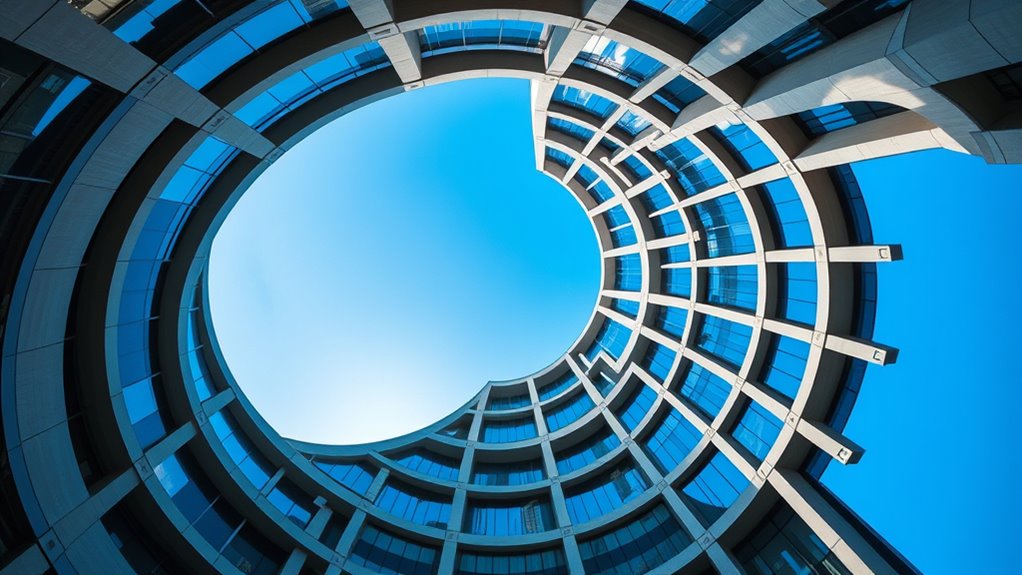

Architectural wonders built on geometry showcase how precise shapes and patterns create structures of both beauty and strength. From the ancient Parthenon and pyramids to modern masterpieces like Gaudí’s designs, geometry guides every aspect—from stability to artistic detail. These structures use arches, domes, and symmetry to push engineering boundaries and craft harmony. By exploring these geometric principles, you’ll uncover how imagination and technical skill shape the most enduring landmarks. Keep exploring to understand how geometry transforms architecture worldwide.

Prime made for students and young adults
- Fast, free delivery for dorm and study essentials
- Prime Video and Amazon Music included
- Member-only deals
Key Takeaways
- Iconic structures like the Parthenon and Great Pyramid exemplify the use of precise geometric principles for stability and harmony.
- Architectural innovations such as arches, domes, and vaults are driven by geometric designs that enhance strength and scale.
- Artists like Gaudí incorporate complex geometries into organic forms, blending art and engineering through geometric patterns.
- Geometric planning ensures structural integrity, aesthetic appeal, and efficient construction through symmetry and tessellations.
- Architectural forms communicate cultural and spiritual ideas, with geometry playing a key role in their symbolic and emotional impact.
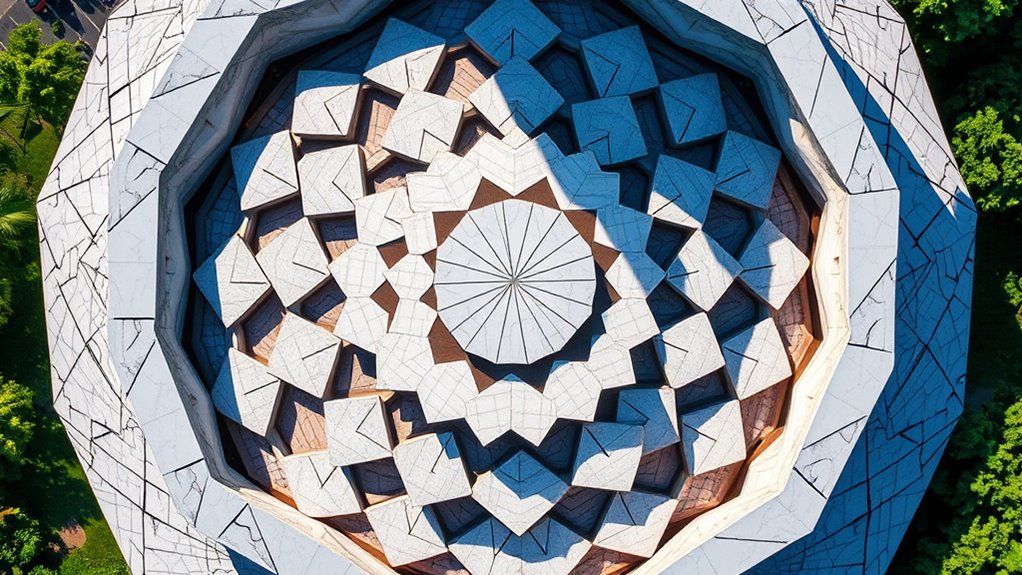
Throughout history, architects have harnessed the power of geometry to create some of the most awe-inspiring structures in the world. This mastery of shapes, proportions, and spatial relationships has driven both structural innovations and artistic expressions, shaping the way we experience built environments. When you look at iconic landmarks like the Parthenon or the Great Pyramid, you’re witnessing how precise geometric principles laid the foundation for stability and grandeur. These structures weren’t just artistic statements—they represented groundbreaking advancements in engineering, allowing builders to push the limits of what was possible with available technology. You can see how geometric patterns, such as the use of the golden ratio, foster harmony and balance, making structures both resilient and visually enthralling.
As you explore architectural marvels, you’ll notice that geometric concepts serve as the blueprint for innovation. For instance, the development of arches, domes, and vaults revolutionized construction by distributing weight more efficiently, enabling larger and more complex spaces. These structural innovations didn’t just improve durability—they opened new artistic avenues. Architects began experimenting with intricate designs, tessellations, and symmetry that became defining features of their work. The Hagia Sophia, with its massive dome, exemplifies how geometry can be used to create a sense of awe and spiritual transcendence. Every curve and angle was meticulously calculated to achieve both aesthetic beauty and structural integrity, proving that geometry isn’t just a technical tool but a creative force. Additionally, the integration of geometric precision in planning and construction has resulted in more harmonious and enduring structures.
Your appreciation deepens when you realize how geometry influences artistic expressions within architecture. The repeating patterns and precise proportions evoke a sense of order and harmony, guiding your eye through the space. Ornamental details, such as mosaic tiles or decorative facades, often rely on geometric principles to achieve their mesmerizing effects. Architects like Gaudí took these ideas further, integrating complex geometries into organic forms that challenge traditional boundaries. These artistic expressions showcase how geometry enables architects to communicate ideas, evoke emotions, and craft environments that inspire both wonder and reflection. In essence, the marriage of structural innovations and artistic expressions through geometry has allowed architecture to evolve from mere shelter into a form of cultural storytelling.
geometric architectural model kits
As an affiliate, we earn on qualifying purchases.
As an affiliate, we earn on qualifying purchases.
Frequently Asked Questions
How Does Geometry Influence Modern Architectural Design?
You see, geometry shapes modern architectural design by guiding structural integrity and aesthetic appeal. It allows you to create innovative forms that enhance architectural aesthetics while ensuring stability. By applying geometric principles, you can experiment with new structures and materials, pushing design boundaries. Geometry acts as a foundation for design innovation, helping you craft buildings that are both visually striking and functionally sound, transforming your ideas into extraordinary architectural achievements.
What Are the Most Complex Geometric Shapes Used in Architecture?
You explore the most complex geometric shapes in architecture, like those created through parametric design and fractal patterns. Parametric design uses algorithms to craft intricate, adaptive forms that respond to specific constraints, while fractal patterns generate repeating, self-similar shapes that create mesmerizing visual effects. These advanced techniques allow you to push architectural boundaries, producing structures with remarkable complexity and beauty that challenge traditional design principles.
Can Geometry Improve the Sustainability of Buildings?
You can see that geometry plays a key role in enhancing building sustainability. By applying sustainable design principles and choosing eco-friendly materials, you optimize natural light, airflow, and insulation. Geometric shapes can reduce material waste and improve energy efficiency, making buildings more environmentally friendly. Embracing precise geometric planning allows you to create structures that are not only visually appealing but also contribute markedly to reducing your ecological footprint.
How Do Architects Ensure Structural Stability With Intricate Geometries?
Imagine delicate, complex shapes defying gravity — you wonder how they stand firm. You guarantee structural stability by combining materials innovation with rigorous structural analysis. You select advanced materials that flex and support intricate geometries, while detailed analysis predicts stress points and load distribution. This careful balance allows your designs to be both visually stunning and structurally sound, transforming bold visions into resilient realities.
What Role Does Geometry Play in Cultural Symbolism of Architecture?
You see, geometry plays a essential role in conveying cultural symbolism in architecture. It helps you incorporate cultural motifs and create spaces that resonate with a community’s identity. When you interpret symbolism through geometric forms, you connect people to their heritage and beliefs. This visual language allows you to express deeper meanings, making architecture not just functional but also a powerful symbol of cultural values and traditions.
architectural design software for geometry
As an affiliate, we earn on qualifying purchases.
As an affiliate, we earn on qualifying purchases.
Conclusion
You’ve seen how geometry shapes breathtaking structures, turning simple lines into masterpieces that touch the sky. These architectural wonders are like puzzles brought to life, each angle and curve whispering secrets of mathematical magic. As you walk through these marvels, remember—they’re more than buildings; they’re symphonies of geometry, dancing in perfect harmony. So next time you gaze up, let the beauty of math remind you that even the most complex designs start with a simple idea.
architectural scale ruler for precise measurements
As an affiliate, we earn on qualifying purchases.
As an affiliate, we earn on qualifying purchases.
geometric pattern tiles for home decor
As an affiliate, we earn on qualifying purchases.
As an affiliate, we earn on qualifying purchases.
Fall Picks
fall essentials
As an affiliate, we earn on qualifying purchases.