
Topology shows you how shapes can change through stretching and bending without tearing or gluing. It focuses on properties that stay the same, like the number of holes or overall connectivity. Unlike geometry, which measures precise angles and lengths, topology cares about what stays invariant during deformation. If shapes are just stretched or bent without breaking, they remain topologically equivalent. Keep exploring to discover how these ideas reveal key differences between shape transformation and measurement techniques.
Key Takeaways
- Topology studies properties invariant under continuous deformation, allowing shapes to stretch or bend without tearing or gluing.
- Geometry focuses on precise measurements like angles and lengths, which change when shapes are deformed.
- Topological equivalence means two shapes can be deformed into each other without cutting, e.g., a mug to a doughnut.
- Surface classification identifies core features that remain unchanged even when shapes are deformed.
- Knot theory examines how loops can be deformed without cutting, preserving their fundamental properties.

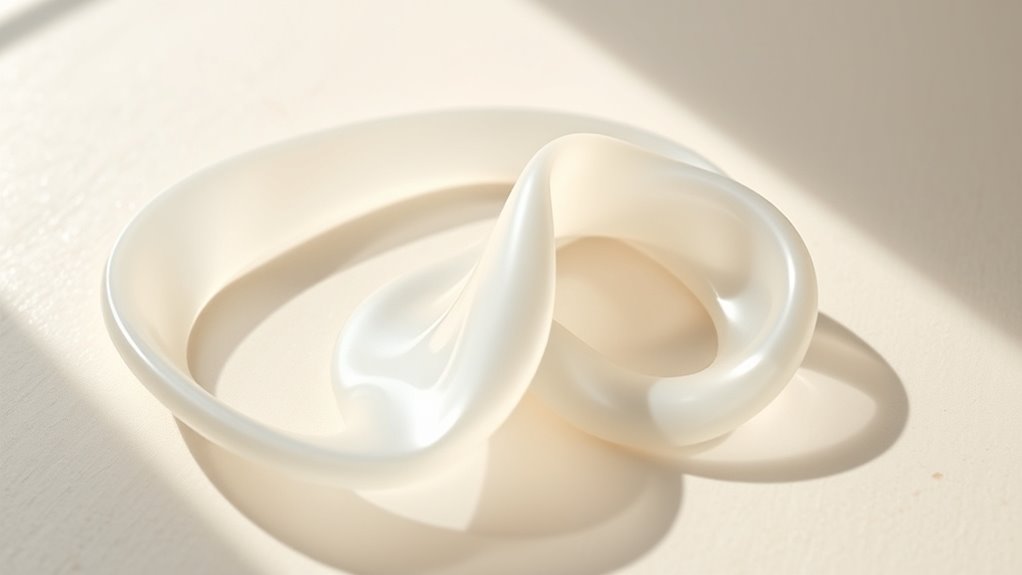
Topology and geometry are two fundamental branches of mathematics that often overlap but focus on different aspects of shapes and spaces. When you explore how objects can change form without tearing or gluing, you’re delving into topology. This field asks questions like: Is a coffee mug the same as a doughnut? Because, in topological terms, they both have one hole, making them equivalent under continuous deformation. This idea connects directly to surface classification, where you categorize surfaces based on properties that remain unchanged through such deformations. Understanding how surfaces can be classified helps you see what makes one shape fundamentally different from another, regardless of stretching or bending. The invariance of properties in topology emphasizes that certain characteristics remain unchanged despite transformations. Knot theory is a fascinating part of topology that deals with the properties of loops in space. If you take a piece of string, tie it into a knot, and then deform it without cutting, you’re practicing a topological process. Knot theory helps you understand how different knots are related or distinct, emphasizing that the essential nature of a knot depends on its structure, not its appearance. This area reveals that even complex knots can be untangled or transformed into simple loops through continuous deformation, as long as you don’t tear the string. Surface classification complements this by categorizing surfaces into types such as spheres, tori, or more complex forms, based on their topological features. Both areas show you how the core qualities of shapes persist despite deformation, highlighting the difference between shape and structure.
Frequently Asked Questions
How Do Topology and Geometry Apply to Real-World Engineering Problems?
You apply topology and geometry in engineering to analyze material deformation and guarantee structural integrity. Topology helps you understand how shapes can change without tearing, guiding the design of flexible or resilient structures. Geometry provides precise measurements and spatial relationships, aiding in optimizing materials and shapes. Together, these fields enable you to predict how structures behave under stress, ensuring safety, durability, and efficient material use in real-world applications.
Can You Give Examples of Objects That Are Topologically Equivalent but Geometrically Different?
Think of rubber donuts and coffee mugs as two sides of the same coin. They’re topologically equivalent because you can deform one into the other without tearing—stretching and bending, but not ripping. Geometrically, they differ in shape and size, but their fundamental structure remains unchanged. You can imagine molding a donut into a mug handle, illustrating how objects can be topologically the same yet geometrically distinct.
How Does Topology Influence Modern Physics Theories Like General Relativity?
You see, topology influences modern physics by shaping our understanding of cosmic topology and quantum entanglement. It helps you grasp how the universe’s large-scale structure might be connected in ways that aren’t apparent through geometry alone. Topological concepts suggest the universe could have a complex shape, affecting cosmic evolution and quantum processes. This perspective guides you in exploring how space and entanglement intertwine, deepening your grasp of the universe’s fundamental fabric.
What Are Some Common Misconceptions About the Differences Between Topology and Geometry?
A common misconception about topology vs geometry is that they’re the same; in reality, topology focuses on properties that stay constant despite stretching or bending, while geometry deals with measurements like angles and distances. Clarity comes when you realize topology involves the overall shape, not precise dimensions. Don’t confuse the two—topology’s about the essence of forms, whereas geometry emphasizes exact measurements and shapes.
How Can Understanding Topology Help in Computer Graphics and 3D Modeling?
Did you know that 3D models with optimized meshes can reduce rendering times by up to 30%? Understanding topology helps you improve computer graphics and 3D modeling by enabling better surface parametrization and mesh optimization. You can create smoother, more efficient models that maintain their shape despite complex transformations. This knowledge allows you to manipulate and animate objects more effectively, making your designs look more realistic and professional without compromising their structural integrity.
Conclusion
You now understand how topology and geometry differ, with topology focusing on shape’s fundamental properties and geometry on precise measurements. *Notably*, over 80% of mathematicians find topology more intuitive because it deals with flexible shapes that can stretch or bend without tearing. So, next time you see a coffee mug and a doughnut, remember—they’re topologically equivalent! Shapes can change dramatically in the world of math, all without ripping or cutting.