

To visualize the fourth dimension beyond familiar 3D space, you can use projections and analogies that build on what you already know. Think of how 3D objects cast 2D shadows, and how 4D shapes like the tesseract are projected into 3D space. Manipulating these projections through rotation and stretching helps reveal their properties. Developing these mental models opens new ways to understand higher dimensions—keep exploring, and you’ll uncover even more fascinating insights.
Key Takeaways
- Higher-dimensional objects, like the tesseract, are visualized through 3D projections and analogies, translating complex concepts into familiar forms.
- Visualization techniques include rotating and morphing projections to understand how 4D shapes relate to 3D space.
- Mental exercises and analogies, such as extending a cube into the fourth dimension, help develop intuition for beyond-3D concepts.
- Recognizing patterns in projections reveals properties and behaviors of 4D structures, aiding comprehension.
- These visualization methods make abstract 4D ideas more accessible, fostering deeper understanding across mathematics and physics.

Understanding the fourth dimension can seem intimidating, but visualizing it becomes easier when you break it down into relatable concepts. When you think about higher dimensional geometry, you’re stepping beyond the familiar three dimensions of length, width, and height, into a domain that challenges your everyday perception. To grasp this, you can use 4D visualization techniques that help you imagine what’s happening beyond your usual spatial experience. These methods often involve analogies, projections, and rotations that translate complex ideas into visual forms you can comprehend.
One effective way to start is by considering how a three-dimensional object appears when projected onto a two-dimensional surface, like a shadow or drawing. Similarly, a four-dimensional object can be projected into three dimensions, giving you a glimpse of its structure without fully experiencing the higher dimension. For example, a tesseract, or 4D hypercube, can be visualized by studying its 3D projections. These projections show how the shape’s faces and edges relate, helping you understand its higher-dimensional properties. Using 4D visualization techniques, you can manipulate these projections—rotating, stretching, or morphing them—to see how the structure changes, offering insight into the nature of four-dimensional space.
Visualize a tesseract’s 3D projections to understand its higher-dimensional structure.
Another approach involves analogy: just as a 2D surface cannot fully represent a 3D object, your 3D intuition falls short of fully capturing a 4D object. But by imagining how a 3D object, like a cube, can be extended into the fourth dimension, you begin to develop an intuition for higher dimensional geometry. This mental exercise, combined with visual aids, helps bridge the gap between abstract theory and visual understanding. It’s about creating mental models that allow you to see the relationships and transformations that happen in four dimensions.
Using these techniques, you’ll start recognizing patterns and behaviors that are impossible to visualize directly but can be understood through projections and analogies. Over time, you’ll see that higher dimensional geometry isn’t just an abstract concept; it’s a logical extension of familiar shapes and transformations. With practice, your ability to visualize the fourth dimension improves, enabling you to better grasp its implications in physics, mathematics, and computer graphics. Ultimately, embracing 4D visualization techniques transforms what initially seems unfathomable into a fascinating realm of spatial exploration, expanding your understanding well beyond the limitations of three-dimensional space.
Additionally, understanding dimensional projections can deepen your appreciation for how higher-dimensional objects relate to the physical world we perceive.

Mapping with Altitude: Designing 3D Maps
As an affiliate, we earn on qualifying purchases.
As an affiliate, we earn on qualifying purchases.
Frequently Asked Questions
Can We Perceive the Fourth Dimension With Our Senses?
You can’t directly perceive the fourth dimension with your senses because of perceptual limitations. Your sensory experiences are confined to three-dimensional space, making it impossible to see or feel the fourth dimension naturally. However, you can understand and visualize it through mathematical models and visualizations, which help you grasp concepts beyond your sensory capabilities. These tools expand your perception, even though your senses remain limited to 3D.
How Do Mathematicians Represent Four-Dimensional Objects Visually?
Mathematicians represent four-dimensional objects visually through higher-dimensional projections and topological representations. You can imagine these as shadows or slices of 4D shapes projected into 3D space, making them easier to analyze. Topological models help you understand the properties that remain unchanged despite deformation. By studying these projections and representations, you gain insights into 4D structures that your senses can’t directly perceive, bridging the gap between abstract math and visual understanding.
Are There Real-World Applications of Understanding the Fourth Dimension?
Understanding the fourth dimension helps you work with higher dimensional data and multi-dimensional modeling in fields like data science and computer graphics. You can optimize complex systems, improve image processing, and analyze large datasets more effectively. This knowledge also aids in developing advanced simulations and algorithms, making it invaluable for innovations in artificial intelligence, virtual reality, and robotics. Embracing higher dimensions enhances your ability to solve real-world problems creatively and efficiently.
What Are Common Misconceptions About the Fourth Dimension?
Think of the fourth dimension as a hidden layer behind your perceptions, not just a strange concept. Many believe it’s like a sci-fi portal or a mystical domain, but it’s really about understanding spatial illusions and dimensional illusions. People often mistake it for time or think it’s something supernatural. In reality, it’s a mathematical extension of our universe, helping us grasp complexities beyond what our eyes can see.
How Does the Fourth Dimension Relate to Theories in Physics?
In physics, the fourth dimension often relates to higher-dimensional space, which helps explain complex phenomena like gravity and time. You’ll find it integral to string theory, where the universe exists in multiple dimensions beyond our familiar three. This higher-dimensional space allows physicists to unify forces and particles, offering a more complete understanding of the universe’s fundamental nature. So, the fourth dimension isn’t just a concept; it’s a key part of modern physics.
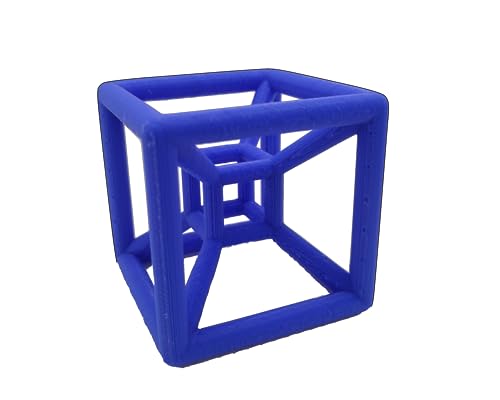
Hypercube – 3D Printed Tesseract (Blue)
- Dimensional Rendering: 3D visualization of 4D geometry
- Material: Made from bio plastic
- Size: Approximately 2x2x2x2 inches
As an affiliate, we earn on qualifying purchases.
As an affiliate, we earn on qualifying purchases.
Conclusion
As you explore the mysteries of the fourth dimension, remember that understanding this domain is like unfastening the universe’s greatest secret—an adventure that could redefine reality itself. With every mental leap, you push the boundaries of what you thought was possible, opening your mind to worlds beyond your wildest dreams. Embrace this journey, for imagining the fourth dimension isn’t just a feat of thought—it’s a gateway to infinite cosmic wonders waiting to be discovered.

Zonon 24 Sets Math Geometry Kit Student 10 Pcs Shatterproof Storage Box Includes Compass, Rulers, Protractor, Eraser, Pencil Sharpener, Lead Refills, Pencil for Back to School Students Class Teacher
- Complete 24-Set Geometry Kit: Includes tools in shatterproof storage box
- Variety of Colors: Six colors with four sets each
- Includes Essential Tools: Rulers, compasses, protractor, pencils, refills
As an affiliate, we earn on qualifying purchases.
As an affiliate, we earn on qualifying purchases.
As an affiliate, we earn on qualifying purchases.