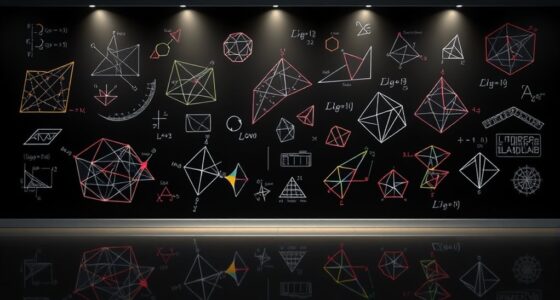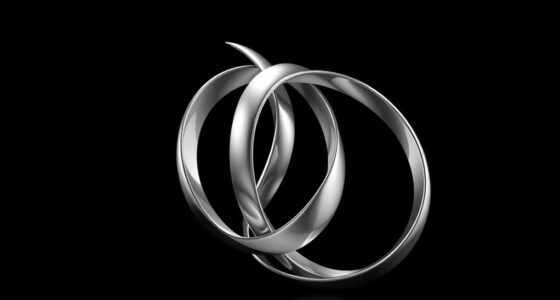

Topology is the study of shapes that can be stretched, bent, or twisted without tearing. You’ll discover fascinating objects like Möbius strips, which have only one side, and other bizarre surfaces that challenge everyday intuition. These shapes reveal how surfaces can be fundamentally different based on properties like holes and orientability. Keep exploring, and you’ll uncover the surprising ways topologists classify and understand these weird surfaces and their hidden properties.
Key Takeaways
- Möbius strips are non-orientable surfaces with only one side, illustrating properties that challenge common notions of surfaces.
- Topology studies how shapes can be deformed without tearing, revealing the fundamental nature of weird surfaces like Möbius strips.
- Surface classification categorizes shapes based on holes and orientability, helping beginners understand complex surfaces easily.
- Non-orientable surfaces, such as Möbius strips, demonstrate how traveling around can flip orientation, highlighting unique topological properties.
- Knot theory explores how loops and links can be embedded in surfaces, offering insights into the structure of unusual and complex surfaces.

Have you ever wondered how mathematicians study shapes and spaces that stretch, bend, or twist without tearing? It’s a fascinating area called topology, which focuses on properties that remain unchanged under continuous deformations. When exploring this world, you’ll encounter intriguing objects like Möbius strips and other weird surfaces that challenge your intuition. One way to understand these objects is through surface classification, which helps categorize surfaces based on their fundamental properties. Surface classification tells you that every surface can be classified by its number of holes and whether it’s orientable or not. For example, a sphere has no holes and is orientable, meaning it has a consistent “inside” and “outside.” A doughnut, or torus, has one hole, but it’s still orientable. But when you look at a Möbius strip, things get more interesting. It’s a non-orientable surface, meaning it has only one side, and traveling around it flips your orientation. This unique property makes it a perfect example of how topology explores shapes that defy everyday intuition. Understanding these properties can be deepened by studying surface classification, which reveals how different surfaces are fundamentally related.
Knot theory also plays a crucial role in understanding the complexity of these surfaces. It’s a branch of topology that studies how loops can be knotted or linked without cutting them. Imagine taking a piece of rope, tying it into a knot, and then gluing the ends together to form a closed loop. Knot theory investigates whether you can untie the knot without cutting, and how different knots relate to each other. These ideas connect to surfaces because knots can be embedded in three-dimensional space, and their properties reveal much about the space itself. In fact, knot theory helps classify and distinguish between different types of surfaces and their embeddings. It’s like a code that describes how loops and surfaces are tangled or linked, providing insights into the structure of the space they inhabit.
Frequently Asked Questions
How Does Topology Relate to Everyday Objects?
Topology relates to everyday objects through concepts like edge continuity and surface classification. You notice how a coffee mug’s handle and a donut are similar because they both have one edge and a continuous surface. These ideas help you understand that many objects share underlying structures, making topology a useful way to see the world differently. It reveals how shapes can be deformed without tearing or gluing, showing the hidden connections in daily items.
Can Topology Explain the Universe’s Shape?
Imagine peering into a cosmic mystery—topology offers a fascinating way to explore the universe’s topology and cosmic shape. It suggests our universe might be more complex than a simple ball, possibly looping or bending in ways we can’t see. By studying these properties, you can understand whether the universe is finite or infinite, flat or curved. Topology helps you grasp the universe’s true structure, revealing its hidden, elegant design.
What Are Real-World Applications of Topological Concepts?
You’ll find topological concepts like knot theory and rubber surfaces everywhere in the real world. Engineers use knot theory to design strong, flexible materials and secure cables. Architects incorporate rubber surfaces for durability and comfort. In medicine, topology helps understand the structure of DNA and brain networks. These applications show how topology isn’t just abstract; it plays a crucial role in creating innovative solutions across industries.
How Do Mathematicians Visualize Higher-Dimensional Surfaces?
When you explore higher dimensions, visualization techniques become essential. Mathematicians often use projections, like shadowing a 4D object onto 3D space, to make sense of complex shapes. They also create computer models and animations to simulate higher-dimensional surfaces. These tools help you understand how these surfaces behave, revealing properties that are impossible to imagine directly. So, visualization techniques bridge the gap between abstract math and intuitive understanding of higher dimensions.
Are There Practical Uses for Möbius Strips Today?
Imagine a twist in materials that challenges your sense of normalcy—Möbius strips have practical uses today. You might use them in conveyor belts that need a continuous surface, reducing wear and tear. Engineers also explore their properties in creating efficient electrical circuits or in designing unique optical devices. Their ability to act as continuous surfaces makes them invaluable for innovations that require a seamless, one-sided structure.
Conclusion
Now that you’ve explored Möbius strips and strange surfaces, it’s clear topology challenges how we see shapes and space. Did you know that mathematicians have identified over 1,000 different types of surfaces? This field is full of surprises, blending geometry and imagination. Keep exploring, and you’ll discover even more mind-bending concepts that stretch your understanding of the world around you. The more you learn, the more incredible these weird surfaces become!