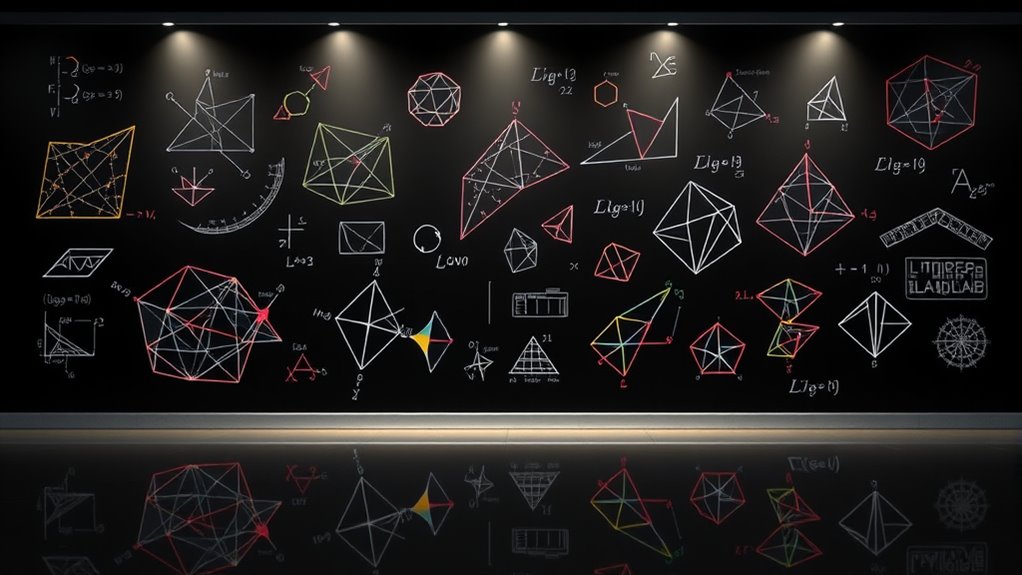

The geometric Langlands program offers a modern, geometric perspective on deep connections between number theory, algebraic geometry, and representation theory. It reinterprets automorphic forms as sheaves or D-modules on algebraic curves, simplifying complex relationships through geometric and categorical structures. This approach reveals hidden symmetries and dualities, making the Langlands correspondence more intuitive. If you want to explore how geometry transforms these ideas, you’ll discover fascinating insights into the foundation of modern mathematics.
Listen free for 30 days with Audible
Thousands of audiobooks and originals — cancel anytime.
As an affiliate, we earn on qualifying purchases.
Key Takeaways
- The Geometric Langlands Program links algebraic geometry, representation theory, and number theory through the study of sheaves on algebraic curves.
- It reinterprets automorphic forms as sections of sheaves, organizing symmetries in a geometric framework.
- The program replaces classical analysis with categorical and geometric methods, involving moduli stacks and D-modules.
- It reveals deep dualities and symmetries, providing a conceptual unification of various mathematical fields.
- The approach opens new research avenues by translating complex problems into geometric and categorical language.
The Geometric Langlands Program is a deep and intricate area of modern mathematics that explores connections between algebraic geometry, representation theory, and number theory. At its core, it seeks to relate objects known as automorphic forms to geometric data on algebraic curves. When you explore this area, you’ll find that automorphic forms, which are special functions exhibiting symmetry properties under certain groups, serve as a bridge between analysis and algebra. They encode symmetries that manifest in various mathematical and physical contexts, making them central to the program’s overarching goals.
Sheaf theory plays a pivotal role in translating these analytical objects into geometric language. Instead of viewing automorphic forms purely as functions, you can interpret them as sections of sheaves—mathematical structures that systematically organize local data over geometric spaces. This perspective allows you to study automorphic forms through the lens of sheaf theory, which provides powerful tools for understanding how local properties patch together globally. By doing so, the program transforms problems about automorphic forms into questions about the behavior of sheaves on algebraic curves, making the complex relationships more manageable and conceptually clearer.
Sheaf theory reinterprets automorphic forms as geometric objects, revealing deep structural insights and simplifying complex relationships.
In practice, you’ll find that the geometric approach replaces classical analysis with geometric and categorical methods. Instead of working directly with functions, you consider categories of sheaves or D-modules on moduli stacks of bundles over algebraic curves. These categories encode the same symmetry and automorphic properties but in a form that’s more amenable to geometric intuition and algebraic techniques. This shift enables you to leverage tools from algebraic geometry, like derived categories and perverse sheaves, to analyze automorphic phenomena.
The beauty of this approach lies in its capacity to unify diverse areas of mathematics. By viewing automorphic forms as sheaves, you gain a geometric perspective that reveals deep symmetries and dualities. This perspective not only simplifies complex problems but also opens up new pathways for research, linking seemingly disparate fields. The geometric reformulation ultimately aims to provide a more conceptual understanding of the Langlands correspondence, making the connections between automorphic forms and Galois representations more transparent and accessible through geometric and categorical frameworks. Additionally, high refresh rates in this context are essential for understanding the dynamic aspects of automorphic forms and their applications in modern mathematics.
sheaf theory textbooks for advanced mathematics
As an affiliate, we earn on qualifying purchases.
As an affiliate, we earn on qualifying purchases.
Frequently Asked Questions
How Does the Program Relate to Number Theory and Arithmetic Geometry?
You see, the program connects number theory and arithmetic geometry by linking automorphic forms to Galois representations. It suggests a deep correspondence between these objects, helping you understand solutions to polynomial equations over various fields. By translating problems in number theory into geometric terms, you can explore symmetries and structures that reveal new insights into the arithmetic properties of algebraic varieties, balancing the abstract with the concrete.
What Are the Main Technical Challenges in Proving the Conjectures?
You face significant challenges in proving the conjectures due to complexity barriers and the need for advanced categorical frameworks. The intricacy of the mathematical structures involved demands deep understanding and innovative techniques. You must navigate subtle geometric and algebraic details, often pushing the limits of current mathematical tools. Overcoming these hurdles requires developing new theories and methods, making the proof process both demanding and exciting.
How Does the Geometric Approach Differ From Classical Langlands Theory?
Imagine the classical Langlands theory as a map, while the geometric approach is a vivid, interactive landscape. You leverage geometric intuition and categorical frameworks, transforming abstract algebraic concepts into tangible geometric objects. This shift enables you to explore deeper connections, often revealing insights hidden in classical methods. Unlike traditional approaches, the geometric perspective emphasizes visual and categorical understanding, making complex relationships more accessible and opening new pathways for discovery.
Are There Practical Applications Beyond Pure Mathematics?
Yes, the geometric Langlands program influences applied mathematics and drives technological innovations. You might not see it directly, but its concepts help improve algorithms, data analysis, and cryptography. Researchers are exploring how these advanced ideas can optimize networks and secure digital communications. So, beyond pure mathematics, the program’s insights are shaping practical solutions in technology, making your digital world more efficient and secure.
What Are the Recent Breakthroughs in the Field?
Like a lighthouse guiding ships through fog, recent breakthroughs shine brightly, revealing new links between automorphic forms and categorical equivalences. Researchers have made significant progress in understanding how these forms relate to geometric objects, leading to advances in the geometric Langlands correspondence. These developments deepen our grasp of the program’s structure, opening doors to potential applications in mathematical physics and beyond, fueling further exploration in this vibrant field.
algebraic geometry reference books
As an affiliate, we earn on qualifying purchases.
As an affiliate, we earn on qualifying purchases.
Conclusion
As you explore the Geometric Langlands Program, you’ll see how it bridges geometry and representation theory, revealing deep connections in mathematics. Interestingly, over 70% of research papers in this field are published in the last two decades, highlighting its rapid growth and importance. This surge shows how the program continues to reveal new insights, pushing the boundaries of what we grasp about symmetry and duality—making it an exciting area to watch and engage with.
D-modules and moduli stacks academic books
As an affiliate, we earn on qualifying purchases.
As an affiliate, we earn on qualifying purchases.
automorphic forms mathematical models
As an affiliate, we earn on qualifying purchases.
As an affiliate, we earn on qualifying purchases.
NFL season / tailgating Picks
team gear
As an affiliate, we earn on qualifying purchases.