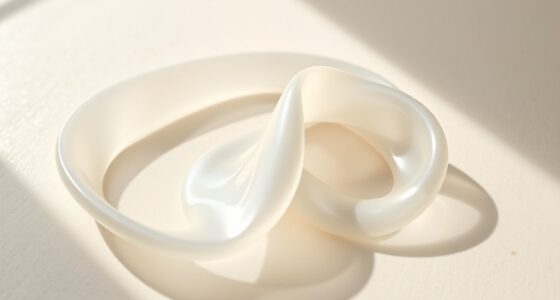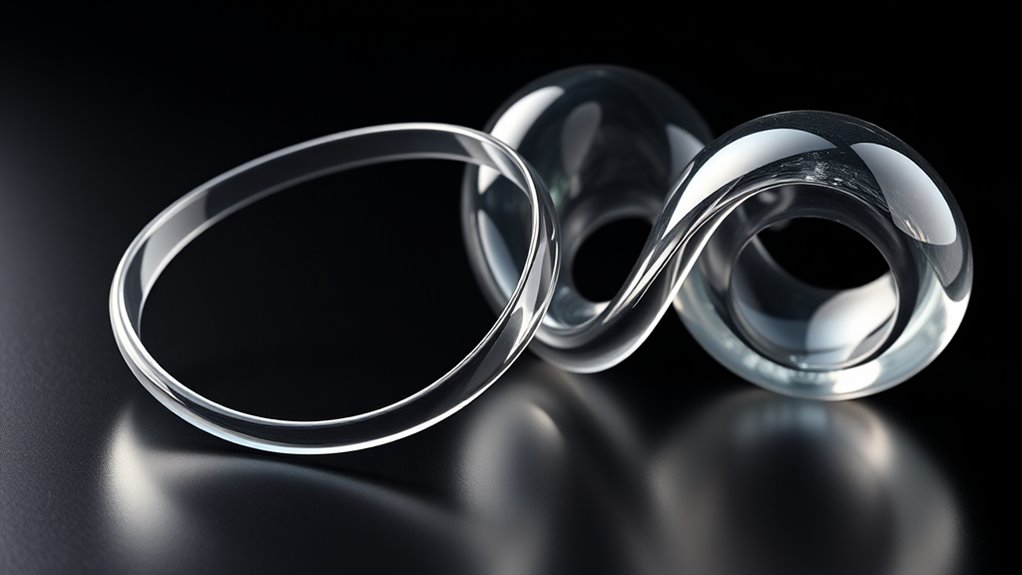

Topology studies strange surfaces like Möbius strips and Klein bottles, which challenge your intuition about sides and edges. A Möbius strip has only one surface and one edge thanks to a half-twist, while a Klein bottle is a non-orientable surface with no inside or outside, created by connecting edges with twists. These concepts show how topology explores shapes that defy ordinary perceptions. Exploring further reveals how these unique shapes are constructed and their fascinating properties.

Prime made for students and young adults
- Fast, free delivery for dorm and study essentials
- Prime Video and Amazon Music included
- Member-only deals
Key Takeaways
- The Möbius strip exemplifies a non-orientable surface with a single side and boundary, illustrating basic topological concepts.
- The Klein bottle extends non-orientability, representing a one-sided surface with no boundary, requiring higher-dimensional embedding.
- Both surfaces are constructed by identifying edges with twists, highlighting how topology studies shape properties beyond geometry.
- Topological equivalence involves deforming surfaces like the Möbius strip into complex forms without tearing, preserving features like holes.
- These structures demonstrate how topology explores counterintuitive and complex surfaces with applications across science and mathematics.
As an affiliate, we earn on qualifying purchases.
The Möbius Strip: A One-Sided Wonder
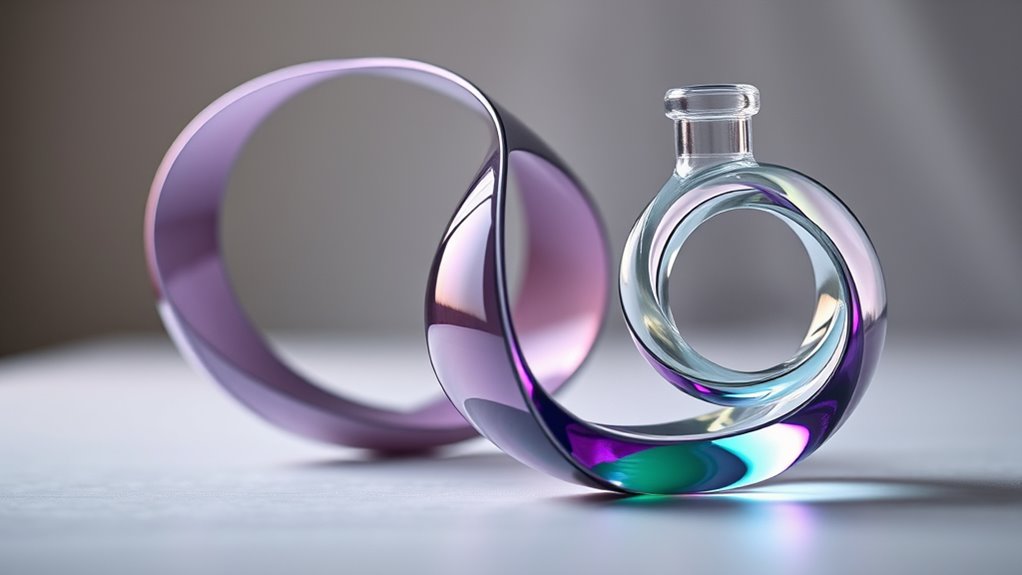
The Möbius strip is a fascinating object because it has only one side and one edge, challenging our intuition about surfaces. When you create a twisted loop by giving a strip of paper a half-turn before connecting the ends, you form this unique shape. It defies the boundary paradoxes you might expect from a simple loop, revealing that what seems like two sides is actually one continuous surface. As you trace along the strip, your finger will eventually return to the starting point on the same side, despite the initial impression of two. This twist creates a surface with intriguing properties, making you question the usual distinctions between inside and outside. The Möbius strip exemplifies how simple twists can produce complex, boundary-defying geometries. Additionally, it shares interesting features with topological objects like the Klein bottle, where the concepts of inside and outside become even more blurred.
As an affiliate, we earn on qualifying purchases.
The Klein Bottle: A Non-Orientable Surface

You’ll see that a Klein bottle is non-orientable, meaning it has no distinct “inside” or “outside.” To understand this, consider how it twists and connects in a way that defies traditional surfaces. Its construction involves identifying edges in a way that creates a seamless, one-sided surface. Embracing the concept of limits on creativity can help us appreciate how constraints influence and inspire such innovative topologies.
Non-Orientability Explained
Non-orientability is a fascinating property that challenges our intuitive understanding of surfaces, and the Klein bottle exemplifies this concept perfectly. It means that you can’t consistently define a “left” or “right” side across the surface. When you move around a non-orientable surface like the Klein bottle, you experience an orientation reversal, flipping your handedness symmetry. This property means the surface has no distinct “inside” or “outside.” Instead, your perspective continually changes as you traverse it. To understand this better, consider these key points:
- Handedness symmetry and its loss in non-orientable surfaces
- How orientation reversal occurs during traversal
- The difference between orientable and non-orientable surfaces
- The significance of the Klein bottle’s non-orientability in topology
Klein Bottle Construction
Have you ever wondered how a surface can be non-orientable and yet still be constructed? The Klein bottle is a perfect example, created by identifying edges of a square in a specific way. Unlike orientable surfaces, it can’t be embedded in three-dimensional space without intersections, making it fascinating in knot theory and surface embedding. To visualize it, imagine taking a rectangle, then gluing the top edge to the bottom with a twist, and the sides similarly, but with a twist as well. Here’s a simplified process:
| Step | Description | Result |
|---|---|---|
| 1 | Start with a rectangle | Basic shape |
| 2 | Attach edges with a twist | Creates non-orientability |
| 3 | Complete surface | Klein bottle shape |
This construction reveals how topology explores complex surfaces beyond our usual three dimensions, and understanding these surfaces can deepen our grasp of topological concepts.
As an affiliate, we earn on qualifying purchases.
Topological Equivalence and Deformation
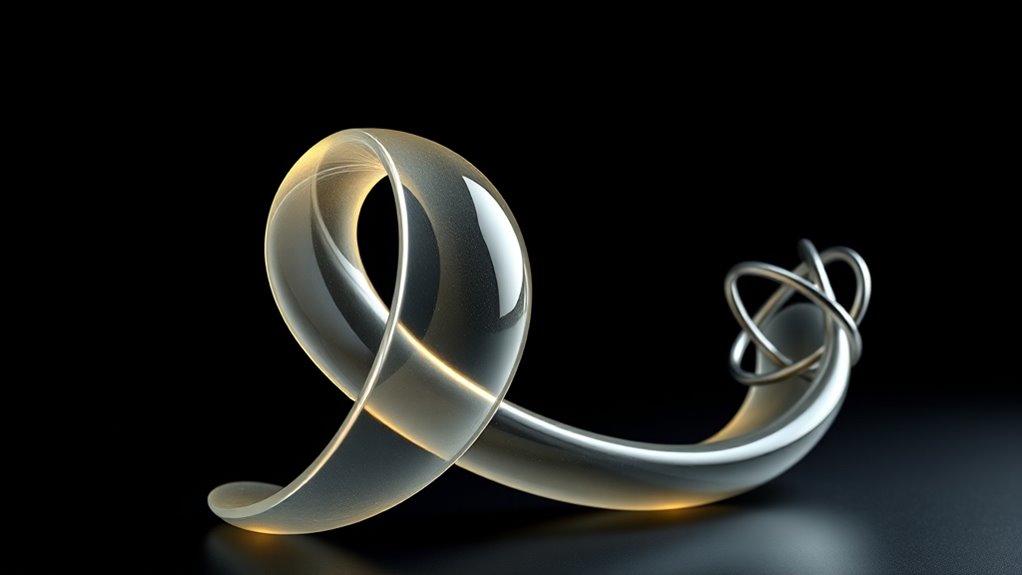
Topological equivalence is a fundamental concept that helps us understand when two shapes are fundamentally the same, despite differences in their appearance. You can think of it as stretching or bending an object without tearing or gluing it, known as continuous deformation. If one shape can be transformed into another through such deformation, they are topologically equivalent. This idea relies on topological invariance, meaning certain properties stay unchanged during deformation. These invariants include the number of holes or connected components. Recognizing topological equivalence helps classify complex shapes and understand their essential features. By focusing on deformation rather than precise measurements, topology reveals the true essence of shapes beyond their superficial form.
- Continuous deformation preserves topological invariants
- Shapes are equivalent if one can be deformed into the other
- Topological invariants include holes and connectedness
- Deformation avoids tearing or gluing
As an affiliate, we earn on qualifying purchases.
Surfaces With Unusual Properties

Some surfaces defy our usual intuition by exhibiting unusual properties that challenge conventional understanding. You might find twisted loops, like those in a Möbius strip, where a single surface has only one side and one edge. These surfaces reveal how surface embeddings can produce remarkable effects, such as orientability or non-orientability. For example, embedding a twisted loop into three-dimensional space creates a surface with properties that seem counterintuitive, like the Klein bottle, which has no edges and cannot exist without intersecting itself in our universe. These complex surfaces showcase how topology allows for diverse forms that challenge our perceptions of shape and space, pushing the boundaries of what we consider possible in the geometry of surfaces. Understanding surface properties enhances our appreciation of these fascinating mathematical phenomena.
Applications of Topological Concepts

Topological concepts have many practical applications across various fields, influencing how you understand and solve real-world problems. In mathematical modeling, topology helps you analyze complex data structures and optimize networks. In material engineering, it guides the design of innovative materials with unique properties, like flexible or self-healing substances. Topology also informs robotics, enabling you to develop motion planning algorithms that navigate cluttered environments. Additionally, in computer science, topological data analysis reveals hidden patterns in large datasets, improving machine learning algorithms. These applications demonstrate the power of topology to transform technology and industry. By leveraging topological ideas, you can approach challenges creatively and develop solutions rooted in a deep understanding of shape, space, and connectivity, including topological invariants that characterize complex structures.
Visualizing and Creating Topological Models
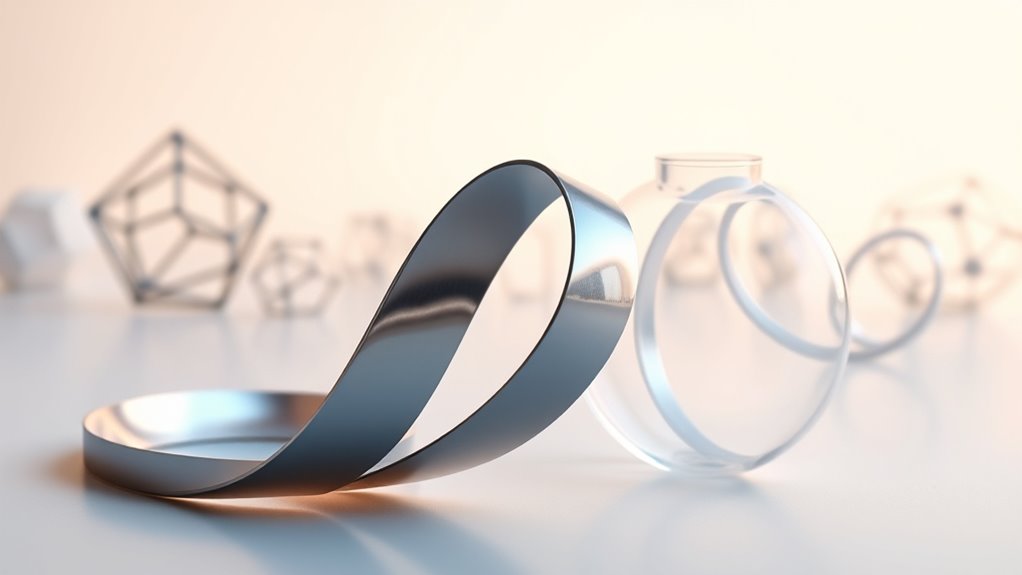
To effectively work with topological models, you need to learn how to visualize complex shapes and structures. Visualization techniques help you understand properties like connectedness and continuity, making abstract concepts more concrete. Start by sketching or manipulating physical models, such as Möbius strips and Klein bottles, to gain insight into their unique features. Building physical models allows you to explore their properties firsthand, revealing how they differ from ordinary shapes. Using simple materials like paper, string, or 3D-printed objects, you can create tangible representations that clarify their topology. These methods make abstract ideas accessible, helping you develop intuition and deepen your understanding of complex topological structures through direct experience. Additionally, understanding cost and budgeting considerations can assist in planning and constructing physical models effectively.
Frequently Asked Questions
How Do Higher-Dimensional Analogs of Möbius Strips and Klein Bottles Exist?
You wonder how higher-dimensional analogs of Möbius strips and Klein bottles exist. In higher-dimensional topology, non-orientable manifolds extend these concepts, creating complex shapes that can’t be oriented consistently. These manifolds, like higher-dimensional Möbius strips, involve twisting and identification patterns in more than three dimensions. You can visualize them as generalized twists, which challenge your intuition but reveal fascinating properties of shapes that defy simple orientation.
Can Topological Concepts Be Applied to Quantum Physics or Cosmology?
You might wonder if topological ideas apply to quantum physics or cosmology. They do! For instance, cosmological topology explores how the universe’s shape affects its structure, while quantum entanglement reveals how particles remain connected across space. Topology helps explain these phenomena by describing space’s properties that stay unchanged despite deformation, offering insights into the universe’s fabric and quantum behaviors that seem to transcend classical notions of space and time.
Are There Real-World Materials That Mimic Non-Orientable Surfaces?
You might wonder if real materials mimic non-orientable surfaces. Material analogs and physical models, like Möbius strips made from paper or metal, show how these surfaces work in the real world. Scientists create small-scale models to explore properties of non-orientable geometries, but perfect physical mimics are rare. While some innovative materials approximate these surfaces, true non-orientable materials remain mostly theoretical, offering exciting opportunities for future research.
How Do Topology and Geometry Differ in Understanding Surfaces?
You might wonder how topology and geometry differ when studying surfaces. Topology focuses on properties preserved through continuous deformations, emphasizing topological invariants like genus. Geometry, on the other hand, examines the shape’s geometric curvature, dictating how surfaces bend and stretch. While topology classifies surfaces by their fundamental structure regardless of shape, geometry describes their specific form and size, offering a detailed view of their physical properties.
What Are the Challenges in Visualizing Higher-Genus Non-Orientable Surfaces?
Did you know that visualizing higher-genus non-orientable surfaces is incredibly challenging, with most models limited to three dimensions? You struggle because traditional visualization techniques fall short, and computational modeling often simplifies these complex shapes. To truly grasp their structure, you need innovative approaches that can represent their twists and holes accurately, pushing the boundaries of current visualization techniques and helping you better understand these fascinating, mind-bending surfaces.
Conclusion
You now see how these mind-bending surfaces, like Möbius strips and Klein bottles, challenge your perception of space. Did you know that topologists have constructed Klein bottles with only 10 pieces? This shows how complex, yet fascinating, topology truly is. Keep exploring these strange shapes—they reveal that our world is full of surprises waiting to be understood, proving that even the most unusual surfaces can have real-world applications and endless wonder.
Evergreen bestsellers Picks
bestsellers
As an affiliate, we earn on qualifying purchases.