
Hyperbolic geometry shows up in both art and nature through intricate, endlessly repeating patterns that stretch beyond normal space. You might see these shapes in artworks that evoke infinity or in natural forms like coral reefs and leaf structures that maximize efficiency. Artists use hyperbolic tilings and models to create mesmerizing visuals, while nature adapts hyperbolic principles for growth and strength. If you explore further, you’ll discover how these strange, beautiful structures reflect fundamental aspects of our universe.
Key Takeaways
- Hyperbolic geometry creates intricate, repeating patterns used in art to evoke infinity and complex visual effects.
- Artists employ hyperbolic tilings, such as regular polygons meeting at each vertex, to craft mesmerizing, expansive designs.
- Natural structures like coral reefs and leaf surfaces exhibit hyperbolic patterns that optimize surface area and resource distribution.
- Hyperbolic forms in biology demonstrate how nature leverages non-Euclidean geometry for growth efficiency and structural stability.
- Understanding hyperbolic geometry enhances insights into natural phenomena and cosmological models, linking geometry with the universe’s structure.

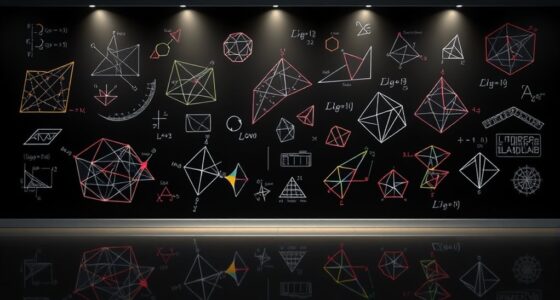
Have you ever wondered what geometry looks like in a universe where the usual rules don’t apply? In hyperbolic geometry, space curves away from itself, creating a landscape that defies our everyday intuition. Unlike flat Euclidean planes, hyperbolic spaces expand exponentially, allowing for fascinating visual and structural phenomena. This unique geometry can be represented through models like the Klein model, which projects the infinite hyperbolic plane into a finite disk. The Klein model preserves straight lines as straight within the disk, making it a powerful tool for visualizing hyperbolic concepts. When exploring hyperbolic tilings, you quickly realize that patterns can cover surfaces infinitely without repeating exactly, showcasing the extraordinary diversity of hyperbolic space. These tilings, often called tessellations, use regular polygons arranged in ways impossible in Euclidean settings, such as heptagons meeting at each vertex. They reveal how hyperbolic geometry allows for an endless variety of symmetrical, intricate patterns that seem to extend beyond the limits of normal space. Additionally, the properties of hyperbolic space enable the creation of complex, self-similar structures that mimic natural forms and fractals.
In art, hyperbolic geometry has inspired designs that evoke a sense of infinity and complexity. Artists use hyperbolic tilings to craft mesmerizing visuals that challenge perceptions of space and form. These patterns can be seen in works inspired by the mathematical beauty of hyperbolic space, where repeating motifs seem to grow and morph endlessly, creating an illusion of boundless depth. The use of Klein models in these artworks helps artists visualize and manipulate hyperbolic patterns with precision, translating complex mathematical ideas into stunning visual compositions. Such art celebrates the strange, yet harmonious, structures possible within hyperbolic space, pushing the boundaries of traditional aesthetics.
Nature also hints at hyperbolic geometry in surprising ways. Some biological forms, like certain coral reefs and leaf structures, exhibit hyperbolic patterns that maximize surface area and efficiency. These natural hyperbolic forms demonstrate how evolution harnesses geometric principles to solve problems related to growth and resource distribution. In the domain of physics, the fabric of space itself may incorporate hyperbolic aspects, especially in models of the universe with negative curvature. This connection suggests that hyperbolic geometry isn’t just a mathematical curiosity but a fundamental aspect of the cosmos, shaping everything from microscopic biological structures to the large-scale structure of space-time. Furthermore, understanding hyperbolic geometry can deepen insights into space-time and the universe’s overall shape and structure.
Frequently Asked Questions
How Can Hyperbolic Geometry Be Applied in Modern Architecture?
You can apply hyperbolic geometry in modern architecture through parametric design, allowing you to create complex, organic forms that stand out. It enables structural innovation by optimizing strength and material use, resulting in lightweight yet durable structures. Using these techniques, you can craft eye-catching facades and innovative interiors that blend aesthetic appeal with functional efficiency, pushing the boundaries of contemporary architecture and inspiring new ways to think about space and form.
What Are Some Examples of Hyperbolic Patterns in Marine Life?
You’ll notice hyperbolic patterns in marine life through intricate marine tessellations and coral structures. These patterns feature repeating, saddle-shaped forms that efficiently maximize space and strength. In coral reefs, hyperbolic geometry creates complex, stable frameworks, while in marine tessellations, you see repeating motifs that adapt to water currents and environmental pressures. These natural hyperbolic patterns showcase nature’s remarkable use of geometry for survival and beauty.
Can Hyperbolic Geometry Influence Digital Art Design?
Yes, hyperbolic geometry can influence digital art design by inspiring fractal aesthetics and enhancing algorithmic creativity. You can incorporate hyperbolic patterns to create visually striking, complex visuals that challenge traditional perspectives. By leveraging algorithms that mimic hyperbolic structures, you access new possibilities for dynamic, intricate artworks. This approach pushes your creativity, allowing you to craft innovative designs that captivate viewers with their depth and mathematical elegance.
How Does Hyperbolic Geometry Relate to the Structure of the Universe?
You might picture the universe as a vast, curved saddle, shaped by hyperbolic geometry. In cosmological models, this geometry helps you understand the universe’s topology, suggesting it could be infinite or have a complex shape. Rather than a flat space, hyperbolic geometry reveals a universe that expands and curves uniquely, influencing how you interpret cosmic structures and the overall fabric of space.
What Tools Are Used to Visualize Hyperbolic Geometric Forms?
You can visualize hyperbolic geometric forms using software simulations like Geogebra or Hyperbolic Tessellations, which help you explore their intricate structures digitally. Physical models, such as crochet or paper constructions, give you a tangible sense of hyperbolic space. Both tools allow you to better understand the unique properties and beauty of hyperbolic geometry, making it easier to grasp complex concepts through hands-on experience or detailed visualizations.
Conclusion
As you explore hyperbolic geometry, it’s like stepping into a world where shapes dance beyond normal bounds, stretching your imagination like a rubber band caught in a breeze. This fascinating geometry reveals patterns in art and nature, showing you that beauty often hides in the most unexpected, curved corners. Embrace these wild, warped spaces—they remind you that the universe’s creativity flows in every twist and turn, waiting for you to discover its infinite wonder.