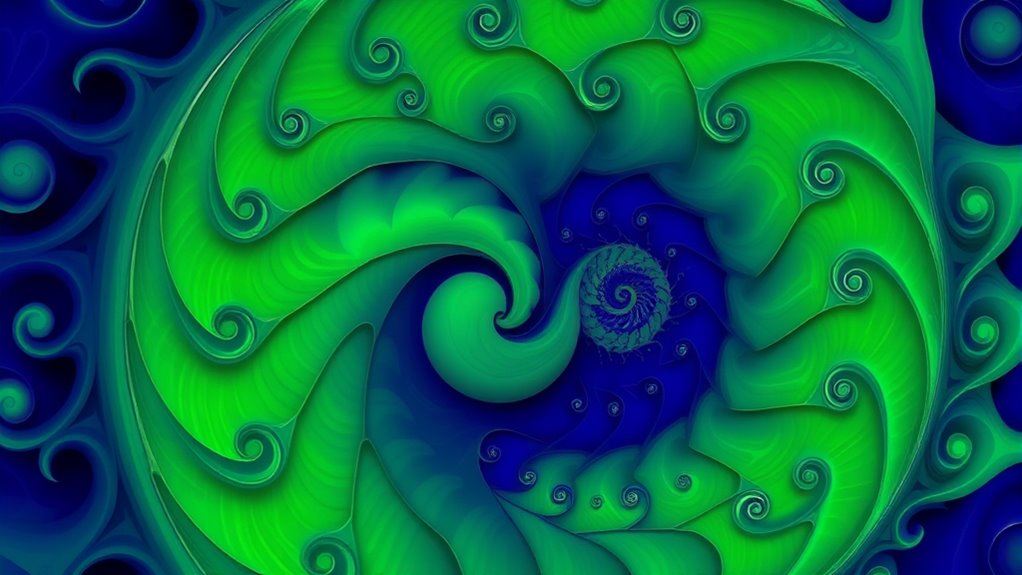

Fractals show how simple rules can create endlessly complex and beautiful patterns, both in math and nature. When you apply basic formulas repeatedly, they produce intricate designs like coastlines, trees, and snowflakes. These patterns are self-similar, meaning small parts resemble the whole. By exploring fractals, you’ll see how nature and the universe use simple math to generate stunning, infinite designs. Keep exploring, and you’ll discover even more fascinating secrets behind these remarkable structures.
Key Takeaways
- Fractals are complex patterns created by simple, repeating mathematical rules at different scales.
- Their self-similar structure means small parts resemble the entire shape infinitely.
- Natural examples like coastlines and trees demonstrate how fractal geometry appears in nature.
- Simple equations iterated repeatedly produce intricate and beautiful fractal designs.
- Fractals reveal that stunning patterns in the universe arise from fundamental, straightforward rules.
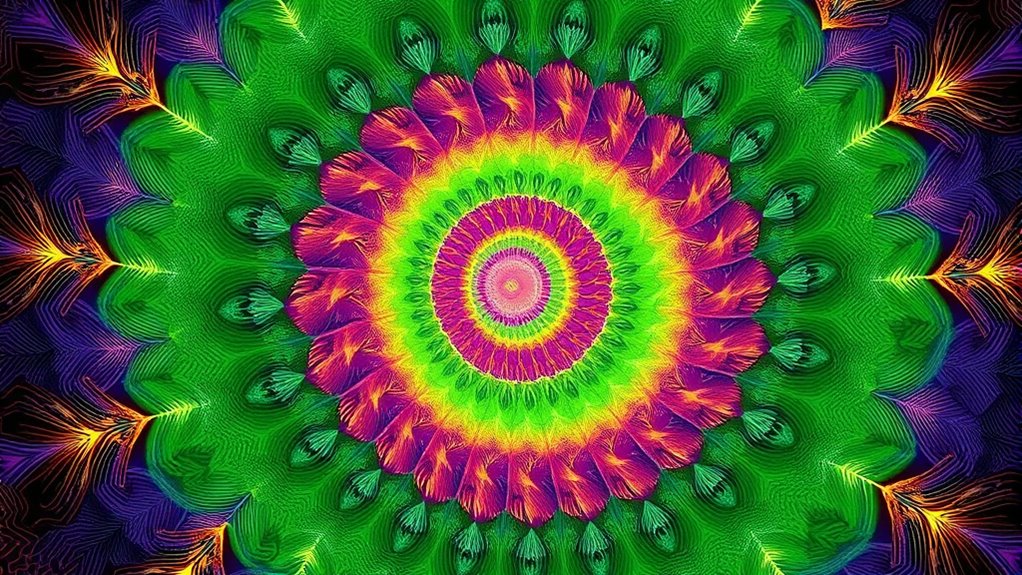
Have you ever noticed complex patterns repeating at different scales in nature or math? Those mesmerizing designs are often fractals—geometric shapes that reveal fascinating mathematical beauty through simple rules. Fractals are everywhere, from the jagged coastlines you see on maps to the branching of trees and blood vessels. They demonstrate how nature’s repetition creates intricate, self-similar structures that can be infinitely detailed. This repetition isn’t random; it’s governed by straightforward mathematical formulas that produce astonishing complexity. When you understand fractals, you start to see these patterns everywhere, revealing how simple rules can generate extraordinary designs.
Fractals reveal nature’s repeating, self-similar patterns created by simple mathematical rules.
At their core, fractals are about self-similarity, meaning that a small piece looks similar to the whole. Imagine zooming into a fern leaf or a snowflake—no matter how close you get, the pattern repeats itself. This infinite scaling is what makes fractals so mesmerizing. They challenge your intuition about shape and space, showing that complexity doesn’t require complicated rules. Instead, a few simple mathematical instructions, when iterated repeatedly, produce endlessly fascinating patterns. This concept is what makes fractals a perfect example of mathematical beauty—simple equations giving rise to complexity that’s both elegant and awe-inspiring.
Nature’s repetition is a perfect illustration of fractal principles. Think of a coastline’s jagged outline, which looks rough and irregular at a large scale but reveals similarly complex patterns when examined more closely. The branching of trees, blood vessels, and lightning bolts all follow fractal-like structures, optimizing space and resource distribution. These natural fractals are not just random; they’re the result of evolutionary processes that favor efficient, scalable designs. As you observe them, you realize that nature often employs fractal geometry to solve real-world problems, creating structures that are both strong and flexible. The concept of self-similarity helps you understand how simple, repeated rules generate forms that seem infinitely complex, illustrating the idea that beauty arises from simplicity. Whether it’s the spiral of galaxies or the pattern of a Romanesco broccoli, fractals remind you that nature’s repetition is a fundamental principle of the universe’s design. They’re a tribute to how the universe’s underlying math creates breathtaking, endlessly fascinating patterns. When you grasp this, you start to see the world through a new lens—one where simplicity and complexity are intertwined, revealing the profound mathematical beauty hidden in everyday phenomena.
Frequently Asked Questions
How Do Fractals Relate to Natural Phenomena Like Weather Patterns?
You see, weather patterns like cloud formation often display fractal-like structures, with self-similar details at different scales. This helps in weather modeling because recognizing these patterns allows scientists to better predict how storms or clouds develop over time. By understanding the fractal nature of these phenomena, you can appreciate how simple rules produce complex, natural structures, making weather forecasts more accurate and revealing the beauty of nature’s mathematical harmony.
Can Fractals Be Used to Improve Computer Graphics and Image Compression?
You won’t believe how fractal algorithms can revolutionize computer graphics and image encoding, making them more detailed and efficient than ever before. By harnessing fractals, you can generate stunning visuals with less data, markedly improving compression. Fractal algorithms analyze patterns to recreate complex textures, saving space and enhancing realism. So, yes, fractals are transforming digital imagery, allowing for breathtaking graphics and smarter image encoding that feels almost magical in its capabilities.
What Are the Applications of Fractals in Medicine and Biology?
In medicine and biology, fractals help you analyze complex cell structures and tissue patterns, revealing their self-similar nature. You can use fractal analysis to study the branching of blood vessels or lung airways, improving diagnosis. Additionally, fractals assist in DNA analysis by identifying repetitive patterns and mutations, aiding genetic research. These applications enhance your understanding of biological systems and support advancements in medical imaging and disease detection.
Are Fractals Only Mathematical Constructs or Do They Exist in Reality?
Think of fractals as nature’s secret code, not just mathematical abstractions. They do exist in reality, popping up in coastlines, clouds, and plants. While mathematicians often use fractals as theoretical models to understand complexity, these patterns are visible in the world around you. So, they’re more than just abstract concepts—they’re the blueprint behind many natural forms, proving that math and reality are more connected than you might think.
How Do Fractals Influence Modern Art and Design?
You see how fractals influence modern art and design by inspiring fractal in fashion, where intricate patterns create visual interest, and fractal inspired architecture, which incorporates complex, repeating structures for aesthetic appeal. These designs often mimic natural fractal patterns, making them feel organic and dynamic. By embracing fractals, artists and architects craft innovative, mesmerizing works that captivate viewers and push creative boundaries.
Conclusion
Now that you’ve explored fractals, you see how simple rules create endless, intricate patterns—like a snowflake’s delicate branches or a fern’s repeating leaves. These patterns are nature’s secrets, hiding complexity in simplicity. Just as a tiny seed grows into a vast tree, your understanding of fractals opens a world of infinite beauty within the ordinary. Keep looking for these patterns everywhere—they’re the universe’s way of showing you its hidden artistry.