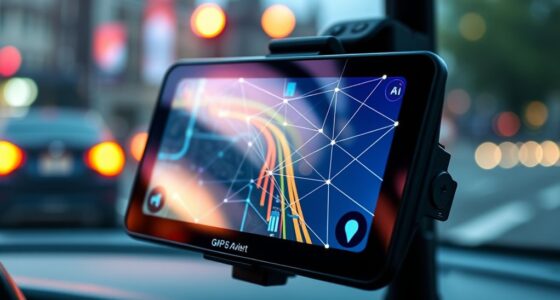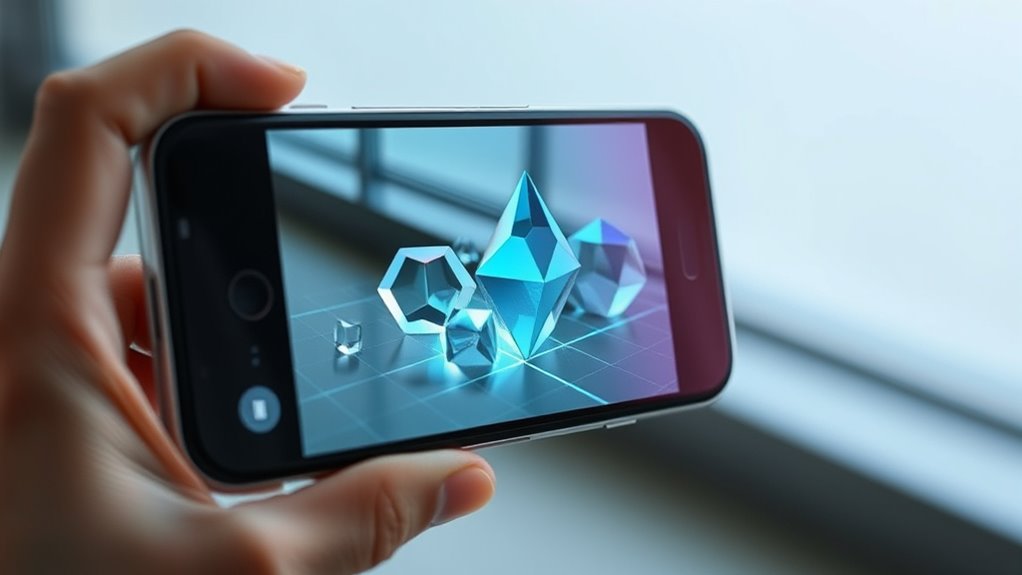

In mobile tech, geometry plays a key role in how your device detects gestures, maps your environment, and creates immersive augmented reality experiences. It allows sensors and cameras to measure distances, recognize surfaces, and build 3D models of your surroundings. This understanding helps virtual objects align accurately with real-world spaces, making interactions more natural. Exploring this further reveals how geometric principles continuously improve your device’s ability to blend digital and physical worlds seamlessly.
Key Takeaways
- Geometry enables precise virtual object placement by understanding environmental surfaces and spatial relationships.
- Depth sensing technologies use geometric principles to create accurate 3D maps of surroundings.
- Spatial mapping constructs detailed models of environments, enhancing AR interactions and device localization.
- Geometry supports gesture recognition and movement tracking for natural user interactions.
- Accurate device positioning and orientation are achieved through geometric techniques, improving AR realism and functionality.
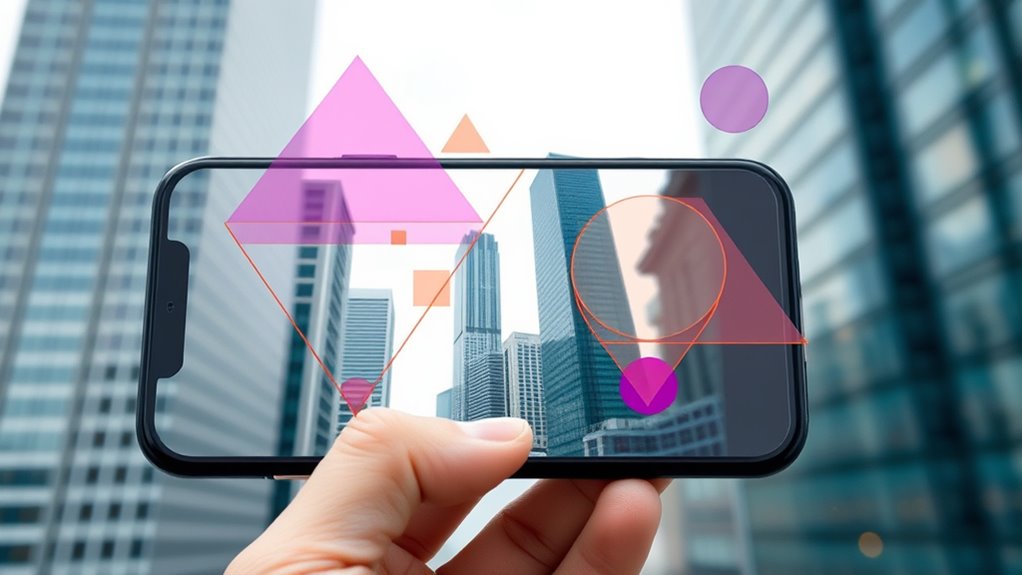
Have you ever wondered how your smartphone accurately detects gestures, tracks your movement, or enhances your augmented reality experience? It all comes down to the sophisticated use of geometry, especially through techniques like depth sensing and spatial mapping. These technologies work together to create a seamless interaction between you and your device, making virtual objects feel real and integrated into your environment. When you point your phone at a room or a scene, sensors gather geometric data that helps your device understand the space around you, allowing for precise overlay of digital content.
Depth sensing is a key component here. It involves measuring the distance from your phone to objects in the environment, often using infrared sensors, time-of-flight cameras, or structured light techniques. This data creates a three-dimensional map of the surroundings, enabling your phone to distinguish between foreground and background, recognize surfaces, and understand spatial relationships. When you’re playing an AR game or trying to measure a piece of furniture, depth sensing ensures the digital elements are correctly scaled and anchored to real-world objects. Without it, augmented reality would feel floaty or disconnected, but with accurate depth information, your device can place virtual objects convincingly within physical space.
Spatial mapping deepens this understanding further. It’s a process where your phone constructs a detailed 3D model of your environment by analyzing the depth data over time. As you move your device around a room, the system continuously updates this map, capturing the contours of walls, furniture, and other features. This dynamic mapping allows your smartphone to recognize surfaces, detect edges, and identify navigable spaces. For example, when you use AR to visualize how a new couch might look in your living room, spatial mapping ensures the virtual furniture aligns perfectly with the floor and walls, respecting the room’s geometry. The combination of depth sensing and spatial mapping creates a robust framework that makes augmented reality feel natural and intuitive.
Thanks to these geometric techniques, your smartphone isn’t just passively recording data; it’s actively interpreting and understanding the space around you. This understanding powers gesture recognition, allowing you to interact with virtual objects through hand movements, and enables precise tracking of your position and orientation in real time. Additionally, localizing the device within a space relies heavily on geometric principles to improve accuracy and user experience. Ultimately, these advancements in geometry aren’t just technical feats—they’re what make your mobile AR experiences immersive, accurate, and effortlessly integrated into your physical world.
depth sensing camera for smartphones
As an affiliate, we earn on qualifying purchases.
As an affiliate, we earn on qualifying purchases.
Frequently Asked Questions
How Does Geometry Improve AR Object Placement Accuracy?
Geometry improves AR object placement accuracy by using depth estimation to understand distances in your environment, ensuring objects stay properly anchored. Perspective correction adjusts for your device’s viewpoint changes, making virtual objects appear seamless as you move. By combining these geometric principles, you get more precise placement, reducing errors and creating a realistic augmented reality experience. This way, your virtual objects blend naturally with the real world around you.
What Geometric Principles Are Used in Mobile Camera Calibration?
You rely on geometric principles like lens distortion correction and calibration patterns to calibrate your mobile camera. By analyzing how the lens warps images, you adjust for distortion, ensuring accuracy. Calibration patterns, such as checkerboards, help map the camera’s internal parameters. These principles work together to refine your camera’s measurements and improve AR object placement, making virtual elements align seamlessly with the real world.
How Does Geometry Assist in Real-Time Motion Tracking?
Geometry helps you with real-time motion tracking by enabling depth estimation and feature matching. As you move, your device analyzes geometric relationships between features in successive images, estimating distances and tracking changes. This allows your camera system to understand your motion accurately, adjusting overlays or AR elements smoothly. By leveraging geometric principles, your device maintains precise spatial awareness, making augmented reality experiences seamless and responsive during movement.
Can Geometric Algorithms Optimize AR Experience in Low-Light Conditions?
Yes, geometric algorithms can enhance your AR experience in low-light conditions. They use sensor fusion to combine data from cameras and other sensors, improving depth estimation even when visibility is poor. This allows your device to better interpret spatial information, creating more stable and accurate virtual overlays. By refining depth and structure detection, these algorithms ensure your AR visuals remain seamless and immersive, despite challenging lighting.
What ARe the Limitations of Geometric Models in Mobile AR Applications?
You’ll find that geometric models in mobile AR face limitations like sensor noise, which can cause inaccuracies in tracking and mapping. Additionally, their computational complexity demands significant processing power, potentially slowing down your device or draining the battery. These issues can reduce the precision and responsiveness of your AR experience, especially in challenging conditions or on devices with limited hardware capabilities.
AR spatial mapping device
As an affiliate, we earn on qualifying purchases.
As an affiliate, we earn on qualifying purchases.
Conclusion
As you explore mobile tech, you’ll see how geometry acts like a secret code revealing augmented reality and camera magic. It’s the backbone that helps your devices understand the world around you, blending digital and real seamlessly. Just like a map guides a traveler, geometry guides your phone’s every move, making your experience smooth and immersive. Embrace it, and you’ll see how this unseen math shapes the future of your mobile adventures.
3D environment scanner for mobile
As an affiliate, we earn on qualifying purchases.
As an affiliate, we earn on qualifying purchases.
augmented reality gesture controller
As an affiliate, we earn on qualifying purchases.
As an affiliate, we earn on qualifying purchases.