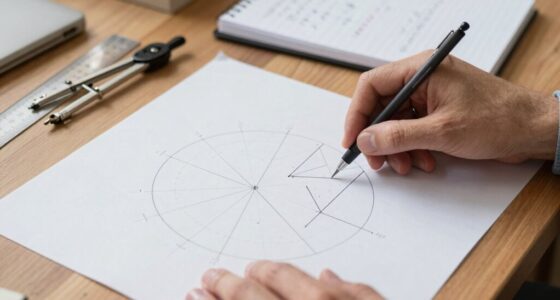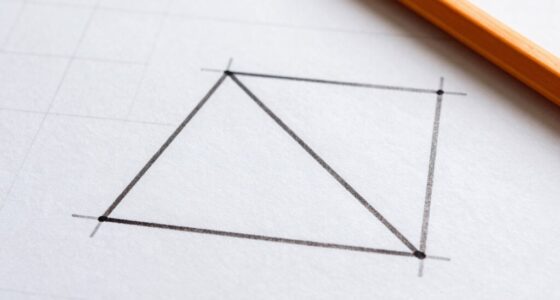

In geometry, proof techniques like contradiction and contraposition help you establish properties rigorously. With contradiction, you assume the opposite of what you want to prove and show this leads to an impossible situation, often using angle chasing or algebra. Contraposition involves proving that if the conclusion is false, then the hypothesis must be false, linking geometric concepts logically. Mastering these methods enhances your reasoning skills and problem-solving ability; exploring further reveals how to apply them effectively in various proofs.

Prime made for students and young adults
- Fast, free delivery for dorm and study essentials
- Prime Video and Amazon Music included
- Member-only deals
Key Takeaways
- Proof by contradiction assumes the negation of the statement to find a logical inconsistency.
- Contradiction often involves angle chasing to identify impossible angle relationships.
- Contraposition proves “if not Q, then not P” by showing the negation leads to a contradiction.
- Coordinate proof can demonstrate algebraic inconsistencies when applying contradiction or contraposition.
- Both techniques deepen understanding by linking geometric properties through logical reasoning.

Understanding proof techniques in geometry is essential for building a strong foundation in the subject. When you explore methods like contradiction and contraposition, you’ll find that they often intertwine with practical strategies such as angle chasing and coordinate proof, making complex concepts more approachable. Angle chasing involves carefully following the relationships between angles in a figure to uncover hidden properties or prove something about the shape. For example, by analyzing how angles relate in a triangle or a cyclic quadrilateral, you can establish equalities or congruencies that serve as stepping stones in your proof. Coordinate proof, on the other hand, allows you to translate geometric problems into algebraic ones by assigning coordinates to points, then using equations to demonstrate the truth of a statement. This method simplifies many proofs, especially when dealing with complex figures or when direct geometric reasoning becomes cumbersome. Additionally, understanding the role of logical reasoning in proof techniques enhances your ability to construct rigorous arguments. When applying proof by contradiction, you begin by assuming the opposite of what you want to prove. Then, through logical deduction, you show that this assumption leads to an inconsistency or an impossible situation. For instance, if you’re trying to prove that two lines are parallel, you might assume they’re not. Using angle chasing, you can analyze angles formed by these lines and other elements in the figure to find a contradiction—perhaps an angle that must be both less than 90 degrees and equal to or greater than 90 degrees simultaneously. This contradiction confirms that your original statement—that the lines are parallel—is true. Coordinate proof can also aid this process by setting coordinates that satisfy the assumptions, then demonstrating that the resulting algebraic expressions violate known properties or lead to impossible conditions. Furthermore, mastery of these proof techniques also involves developing geometric intuition, which can be strengthened through visualization tools and practice. Similarly, in proofs by contraposition, you prove that if the conclusion is false, then the hypothesis must also be false. This often involves logical equivalences and careful angle chasing to connect assumptions with the resulting geometric configurations. For example, if you want to prove that if two angles are supplementary, then certain segments are congruent, you might instead prove the contrapositive: if the segments are not congruent, then the angles are not supplementary. Using coordinate proof, you can assign coordinates to the points involved, then show that the failure of the segment congruence leads to a contradiction with the angle measures obtained algebraically. This approach is powerful because it often simplifies the proof process, especially when combined with geometric intuition and algebraic calculations. In essence, mastering contradiction and contraposition in geometry involves a mix of strategic thinking, angle chasing to analyze relationships, and coordinate proof to handle complex algebraic aspects. These techniques sharpen your reasoning skills and deepen your understanding of geometric properties, enabling you to tackle a wide array of problems with confidence.
As an affiliate, we earn on qualifying purchases.
Frequently Asked Questions
How Do I Choose Between Contradiction and Contraposition in Proofs?
You should choose between contradiction and contraposition based on the logical clarity and proof complexity. If the statement’s negation is easier to assume and disprove, go with contradiction. If the contrapositive simplifies the argument and aligns better with your intuition, use contraposition. Consider which approach feels more straightforward and less convoluted, balancing logical rigor with your intuitive understanding to make the proof process smoother.
Can These Techniques Be Applied to Non-Euclidean Geometries?
Yes, you can apply contradiction and contraposition techniques to non-Euclidean geometries. These proof adaptations work because they rely on logical reasoning rather than specific geometric postulates. When working in non-Euclidean geometries, you just need to carefully consider the unique axioms and properties, then adapt your proofs accordingly. This flexibility makes contradiction and contraposition valuable tools across different geometric frameworks.
Are There Limitations to Using Contradiction and Contraposition?
Did you know that about 85% of mathematicians find contradiction and contraposition highly effective? These techniques have logical limitations; they may not work well when premises are uncertain or incomplete. Cultural considerations also matter, as some reasoning styles differ across cultures, affecting their applicability. While powerful, you should recognize these boundaries to avoid errors, especially in complex or diverse contexts where assumptions might not hold universally.
How Do These Methods Compare to Direct Proof Techniques?
You find that contradiction and contraposition often offer more efficient proofs through their logical equivalence, making complex statements easier to handle. Unlike direct proof techniques, which can sometimes be lengthy, these methods can streamline the process by focusing on the negation or inverse of a statement. They’re especially useful when direct approaches are complicated, helping you quickly establish truth or falsehood with clear logical steps.
When Is It Better to Use Proof by Contradiction Versus Contraposition?
You should use proof by contradiction when the statement’s negation leads to an impossible situation, making the proof more straightforward and efficient. For example, proving that a number isn’t rational is easier via contradiction. This method leverages logical equivalence, simplifying complex proofs. Contraposition is better when the contrapositive is easier to prove than the original statement, ensuring proof efficiency without assuming the statement directly.
As an affiliate, we earn on qualifying purchases.
Conclusion
Just like navigating a maze, mastering proof techniques in geometry guides you through complex problems. Contradiction and contraposition are your trusty compass and map, helping you find clarity amidst confusion. With these strategies, you’ll confidently uncover truths hidden within shapes and angles. Keep practicing, and you’ll soon see that proving a statement is like opening a secret door—revealing the elegant logic that holds geometry together. Trust these tools, and you’ll navigate any proof with ease.
As an affiliate, we earn on qualifying purchases.
As an affiliate, we earn on qualifying purchases.
Fall Picks
fall essentials
As an affiliate, we earn on qualifying purchases.