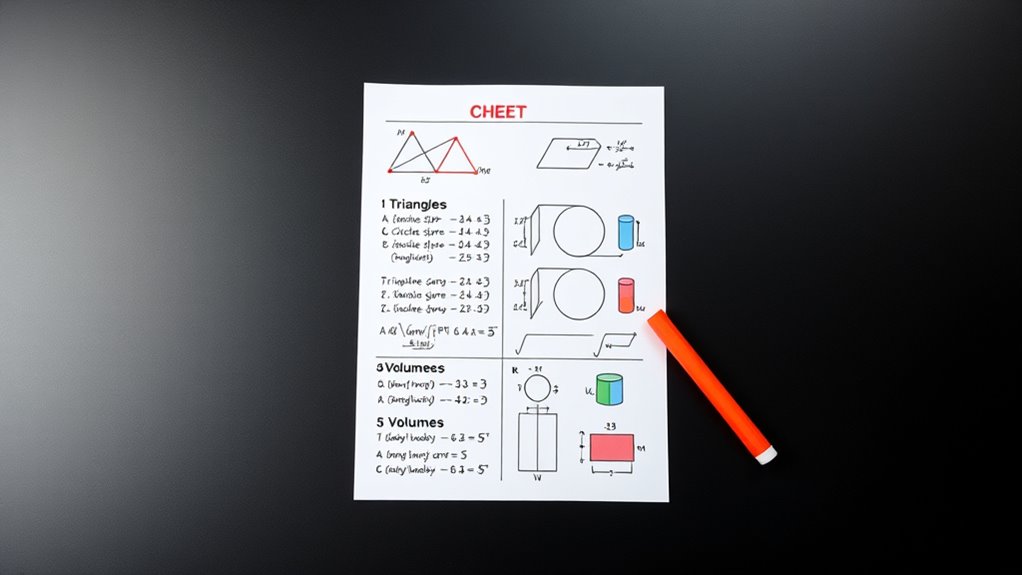

This cheat sheet covers essential geometry formulas for finding areas, volumes, and other key measurements. You’ll learn how to calculate the area of circles using A = πr² and find the volume of cones with V = (1/3)πr²h. These formulas help you solve problems quickly, whether for homework, tests, or projects. Keep exploring to discover more, and you’ll gain confidence in applying these formulas to various shapes and scenarios.
Key Takeaways
- Essential formulas include area, volume, surface area, and perimeter for various geometric shapes.
- Circle area formula: A = πr², where r is the radius; key for circular measurements.
- Cone volume formula: V = (1/3)πr²h, useful for capacity and material calculations.
- Understanding shape properties and relationships enhances problem-solving efficiency.
- Visualizing shapes and practicing formulas build geometric intuition and accuracy.
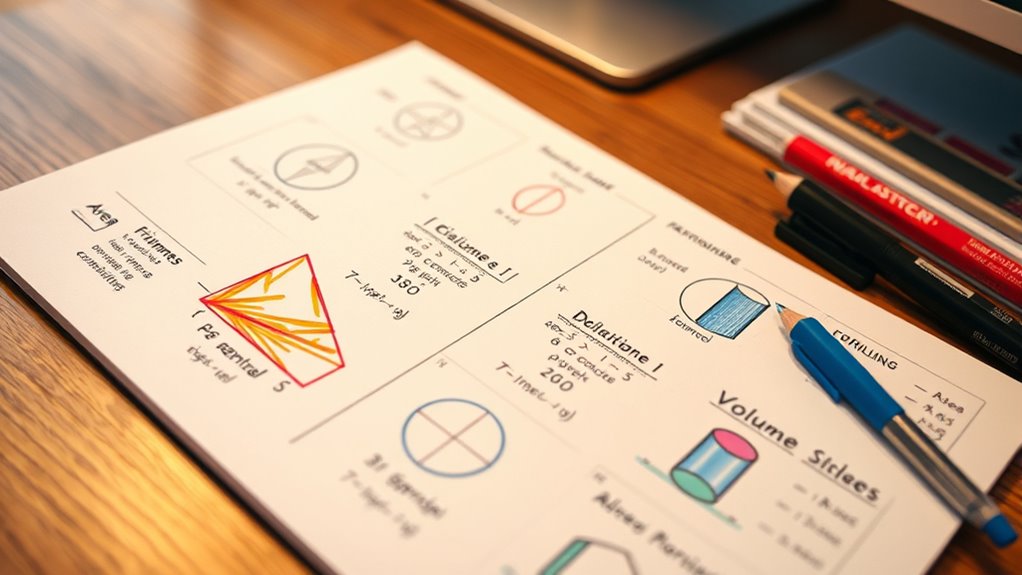
Understanding geometry formulas is essential for solving problems efficiently and accurately. When you’re working with shapes, knowing how to find the circle area or the cone volume can make all the difference in completing your calculations correctly and quickly. These formulas are fundamental tools that help you understand the properties of different geometric figures and apply them in real-world situations, whether you’re tackling homework, exams, or practical projects.
Let’s start with the circle area. If you’re given the radius of a circle, calculating its area becomes straightforward once you remember the formula: A = πr². Here, π (pi) is approximately 3.1416, and r is the radius of the circle. This formula tells you how much space the circle covers, which is essentially important in fields like architecture, engineering, and design. For instance, if you need to determine how much material you’ll need to cover a circular table or a circular garden, knowing the circle area helps you estimate the quantity accurately. It’s important to note that the radius is the distance from the center of the circle to any point on its edge, and squaring this value emphasizes how the area grows rapidly as the radius increases.
Moving on to the cone volume, understanding this formula is equally crucial when dealing with three-dimensional objects. The cone volume is given by V = (1/3)πr²h, where r is the radius of the base and h is the height of the cone. By plugging in the measurements for the radius and height, you can determine how much space the cone occupies. This comes in handy in various applications, such as calculating the amount of material needed to make a conical container or understanding the capacity of a funnel. Remember, the volume formula includes the factor of 1/3 because a cone is essentially a third of a cylinder with the same base and height, which explains the proportional difference. Additionally, knowing the horsepower of electric dirt bikes can help in understanding their performance capabilities and how they compare to traditional models.
Knowing these formulas allows you to approach problems with confidence. When you understand the relationship between the radius and the area, or the height and the volume, you can manipulate the formulas to find missing values or verify your answers. It’s also helpful to visualize the shapes and relate the formulas to real-life objects. Practice makes perfect: as you become more familiar with the circle area and cone volume formulas, you’ll develop an intuitive sense for solving complex problems efficiently. Mastering these basics builds a solid foundation for exploring more advanced geometric concepts, ensuring you’re prepared for anything that comes your way in math or practical applications.

Professor Nano High School Geometry Concept Cards || 4×7.11 inches, Set of 11 || Cheat Sheet, Quickstudy
Expertly developed and created by a dedicated university professor and educator who understands the challenges students face when…
As an affiliate, we earn on qualifying purchases.
As an affiliate, we earn on qualifying purchases.
Frequently Asked Questions
How Do I Convert Between Different Units of Measurement in Geometry Formulas?
To convert between different units of measurement in geometry formulas, you need to understand unit conversion and measurement systems. First, identify the units you’re working with and find the conversion factor between them. Multiply or divide your measurement by this factor to switch units. This guarantees your formulas stay accurate across different measurement systems, making your calculations consistent whether you’re working with inches, centimeters, or other units.
Are There Formulas for Irregular or Composite Shapes?
Yes, there are formulas for irregular shapes and composite figures. You break down complex shapes into regular ones, find their areas or volumes separately, then add or subtract these measurements to get the total. For irregular shapes, you might use methods like the coordinate plane or grid approximation. For composite figures, identify each part’s shape, calculate individually, and combine the results for an accurate measurement.
How Can I Estimate Volume and Area for Complex 3D Objects?
You can estimate the volume and area of complex 3D objects through 3D shape approximation and digital modeling techniques. By breaking the shape into simpler components or using software, you can analyze and calculate their dimensions more accurately. Digital modeling tools, like CAD programs, allow you to create detailed representations, making it easier to measure and estimate the area and volume of intricate and irregular 3D shapes efficiently.
What Are the Common Mistakes to Avoid When Using These Formulas?
You should avoid miscalculations in formulas and ignoring units, as these are common mistakes. Double-check your calculations to guarantee accuracy, and always pay attention to units to maintain consistency. Rushing through problems or assuming formulas fit all shapes can lead to errors. Confirm your shape matches the formula, and convert units if necessary. Being precise helps prevent mistakes and ensures your results are reliable.
How Do I Apply Formulas in Real-World Engineering or Architecture Scenarios?
You apply formulas in real-world engineering or architecture by analyzing practical applications like calculating the volume of a storage tank or the area needed for a floor plan. Use geometry formulas to determine material quantities, structural stability, or space optimization. For example, you might calculate the surface area for painting or the volume for water storage. These real-world examples help guarantee your designs are accurate and efficient, saving time and resources.

Calculated Industries 4065 Construction Master Pro Advanced Construction Math Feet-inch-Fraction Calculator for Contractors, Estimators, Builders, Framers, Remodelers, Renovators and Carpenters
SOLVE ALL YOUR DIMENSIONAL MATH quickly and accurately with the award-winning CM Pro construction calculator’s powerful built-in solutions…
As an affiliate, we earn on qualifying purchases.
As an affiliate, we earn on qualifying purchases.
Conclusion
With this handy heap of helpful hints, you’ll happily harness homework and highlight your horizon of harmonious shapes. Remember, mastering measurements makes mathematics manageable and memorable. Keep practicing these precise formulas to power up your progress and push past problems. Whether it’s area or volume, your newfound knowledge will be a valuable victory. So, stay sharp, stay savvy, and succeed with confidence—your core competencies in calculations are your key to conquering any challenge!

Plastic Graduated Measuring Cup, 100mL Round Base Cone Shape Graduated Beaker Clear Capacity Beaker for Kitchen Lab(2Pack)
【Practical Cone Shaped Cups Set】This value set includes two essential cone shaped cups designed for precise liquid measurement….
As an affiliate, we earn on qualifying purchases.
As an affiliate, we earn on qualifying purchases.
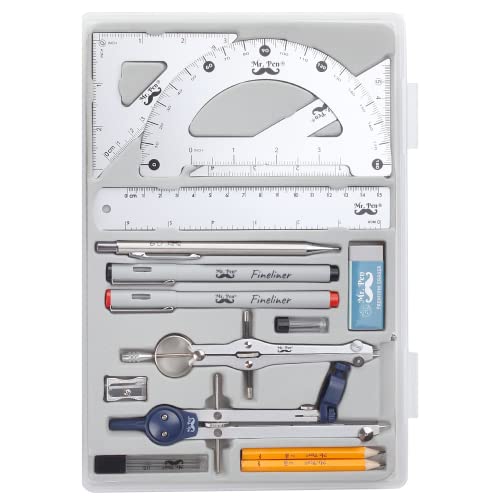
Mr. Pen- Professional Geometry Set, 15 pcs, Drafting Tools with Protractor, Compass, Metal Ruler, Triangles, Pens & Pencils, Complete Geometry & Drafting Kit for Architects, Engineers & Students
Package includes 2 Compasses, 2 triangles, 1 6-inch ruler, 1 protractor, 2 pencils for compass, 2 fineliners, 1…
As an affiliate, we earn on qualifying purchases.
As an affiliate, we earn on qualifying purchases.