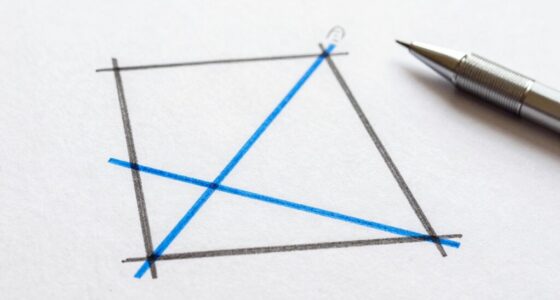

Using symmetry is a powerful way to simplify complex problems by revealing hidden patterns and invariants. When you recognize symmetrical features, you can reduce the problem’s complexity and focus on essential, unchanging elements. Applying transformations like flipping or rotating shapes helps you see different perspectives and uncover solutions. This strategy sharpens your visual recognition and encourages experimentation. Keep exploring, and you’ll discover even more ways symmetry can enhance your problem-solving skills.
Key Takeaways
- Recognize invariant features under transformations to simplify complex problems and focus on essential elements.
- Use geometric transformations like rotation and reflection to explore different perspectives and uncover hidden patterns.
- Identify symmetrical patterns to facilitate visual recognition and reveal connections within the problem.
- Break down problems into manageable parts through symmetry, making solutions more accessible and systematic.
- Apply symmetry to test properties and invariants, guiding logical deductions and creative problem-solving approaches.

Have you ever noticed how symmetry appears in nature, art, and design? It’s everywhere—leaf veins, snowflakes, architectural marvels, and even in complex artworks. This natural occurrence isn’t just eye-catching; it’s a powerful tool for problem-solving. When you recognize symmetry, you engage your ability for visual pattern recognition, which helps you see connections and structures that might otherwise go unnoticed. Symmetry simplifies complex problems by revealing underlying patterns, making them easier to analyze and solve. One effective way to leverage symmetry is through geometric transformations, which involve flipping, rotating, or translating shapes while preserving their structure. These transformations allow you to explore different perspectives of a problem, often uncovering solutions hidden in the pattern.
Symmetry reveals hidden patterns, making complex problems easier to analyze and solve through visual recognition and geometric transformations.
In practice, understanding geometric transformations helps you identify symmetrical properties in a problem, whether it’s a puzzle, a design, or a real-world scenario. For example, if a problem involves a shape or a pattern, you can test how it behaves under reflection or rotation. Doing so often reveals invariants—features that stay the same despite the transformation—which can be key clues to solving the problem. Recognizing these invariants helps you reduce the complexity of the problem, focusing only on the essential elements that remain unchanged. This approach is especially useful in geometric problems, where symmetry can guide you toward the right solution faster. Additionally, some problems can be approached by considering natural symmetries, which often reflect fundamental principles in mathematics and science.
Moreover, symmetry isn’t limited to visual aesthetics; it’s a strategic framework that enhances critical thinking. When you analyze a problem through the lens of symmetry, you’re essentially breaking it down into more manageable parts. You can mirror or rotate sections of the problem to see if patterns repeat or if certain configurations lead to solutions. This process sharpens your visual pattern recognition skills, enabling you to spot symmetrical relationships that aren’t immediately obvious. It’s like holding up a mirror or turning an object to see it from a different angle—suddenly, the solution becomes clearer because you’ve illuminated the hidden structure.
Using symmetry as a problem-solving strategy also fosters creativity. It encourages you to experiment with geometric transformations, testing different configurations until you find one that works. This iterative process often sparks new insights and innovative approaches, transforming a formidable challenge into an achievable task. By harnessing the power of symmetry, you’re not just solving a problem—you’re developing a deeper understanding of the underlying patterns and relationships that govern it. In doing so, you strengthen your analytical skills, making future problems easier to tackle with confidence and clarity.
As an affiliate, we earn on qualifying purchases.
Frequently Asked Questions
How Can Symmetry Be Applied in Real-World Problem Solving?
You can apply symmetry in real-world problem solving by recognizing visual patterns and using structural analysis. When faced with complex designs or systems, look for symmetrical elements to simplify your understanding. This helps you identify balance and predict how parts fit together, making solutions more straightforward. Whether designing architecture or solving mechanical puzzles, symmetry guides you to efficient, elegant solutions by revealing underlying patterns you might otherwise overlook.
What Are Common Mistakes When Using Symmetry in Puzzles?
You might mistake visual symmetry for actual symmetry, falling for illusions that seem balanced but aren’t. Don’t overlook the details—assuming all symmetrical patterns are identical can lead you astray. Common mistakes include overreliance on symmetry illusions and ignoring subtle asymmetries. Remember, symmetry isn’t always perfect; a keen eye helps you spot genuine symmetry versus deceptive illusions, keeping your problem-solving sharp and accurate.
Does Symmetry Always Simplify Complex Problems Effectively?
Symmetry doesn’t always simplify complex problems effectively. If you rely solely on visual symmetry, you might overlook asymmetry recognition, which can be vital for solving certain puzzles. You should evaluate whether the problem’s structure benefits from symmetry or if asymmetrical details hold the key. Sometimes, focusing too much on symmetry can lead you astray, so stay flexible and consider all aspects before deciding if symmetry is a helpful strategy.
How Do I Recognize Symmetrical Patterns Quickly?
Spotting symmetrical patterns is like catching a glimpse of a familiar face in a crowd. You can quickly recognize symmetry through visual pattern recognition by training your eyes to notice balanced shapes, repeated elements, and mirror images. Practice intuitive symmetry detection by analyzing parts of a problem and comparing them mentally. Over time, your mind will instinctively pick out these patterns, making problem-solving feel like a natural flow rather than a puzzle.
Can Symmetry Be Combined With Other Problem-Solving Strategies?
Yes, you can definitely combine symmetry with other problem-solving strategies like analyzing visual patterns or applying algebraic techniques. When you spot symmetry, it helps simplify complex problems, making patterns clearer. You might use symmetry to reduce a visual problem before translating it into algebra, or vice versa. Combining these strategies allows you to approach problems from different angles, increasing your chances of finding efficient solutions quickly and effectively.
symmetry pattern recognition puzzles
As an affiliate, we earn on qualifying purchases.
As an affiliate, we earn on qualifying purchases.
Conclusion
By mastering symmetry, you unseal a secret weapon that can solve even the most impossible problems. It’s like having a magic key that opens every lock in your mind, turning chaos into clarity in the blink of an eye. When you see symmetry, you’re not just solving a problem—you’re wielding a superpower capable of transforming your entire approach to challenges. Embrace symmetry and watch your problem-solving skills skyrocket to levels you never thought possible!
visual pattern recognition training kit
As an affiliate, we earn on qualifying purchases.
As an affiliate, we earn on qualifying purchases.
geometric shape rotation and reflection set
As an affiliate, we earn on qualifying purchases.
As an affiliate, we earn on qualifying purchases.