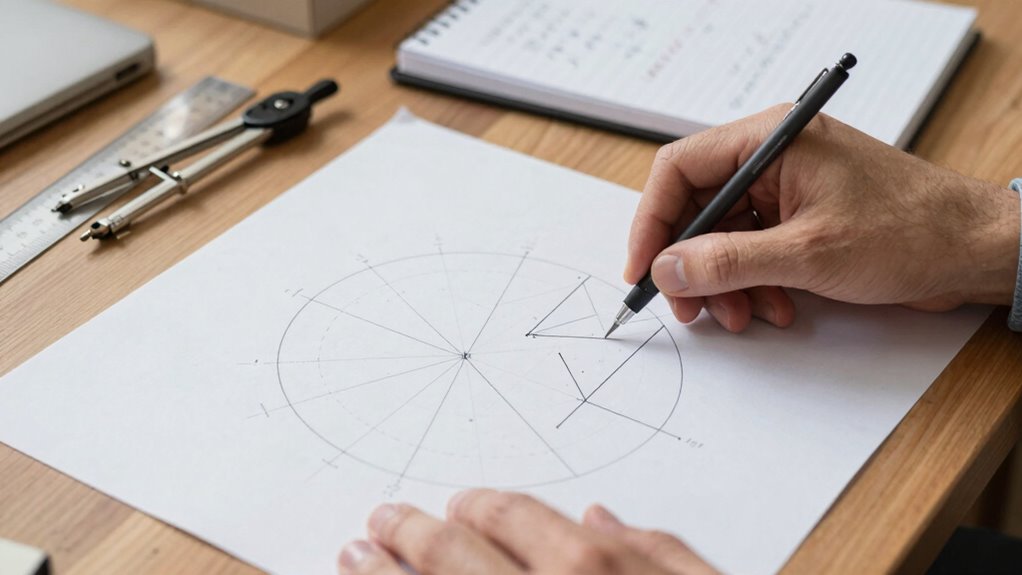

When tackling a geometry problem, you immediately focus on angle relationships and symmetry patterns. You look for equal or supplementary angles, vertically opposite pairs, and linear pairs. Recognizing symmetry lines helps you identify equal segments and angles, simplifying the figure. These insights guide your reasoning, allowing you to avoid unnecessary steps. If you keep exploring, you’ll discover even more effective ways to analyze the structure and solve the problem with confidence.

Prime made for students and young adults
- Fast, free delivery for dorm and study essentials
- Prime Video and Amazon Music included
- Member-only deals
Key Takeaways
- Recognize key angle relationships such as supplementary, complementary, or equal angles early in the figure.
- Identify lines of symmetry and their implications for equal segments or angles.
- Detect vertically opposite angles and linear pairs to understand the figure’s structure.
- Focus on fundamental properties like congruence, angle sums, and straight lines to simplify the problem.
- Use mental visualization to manipulate the figure and confirm conjectures efficiently.
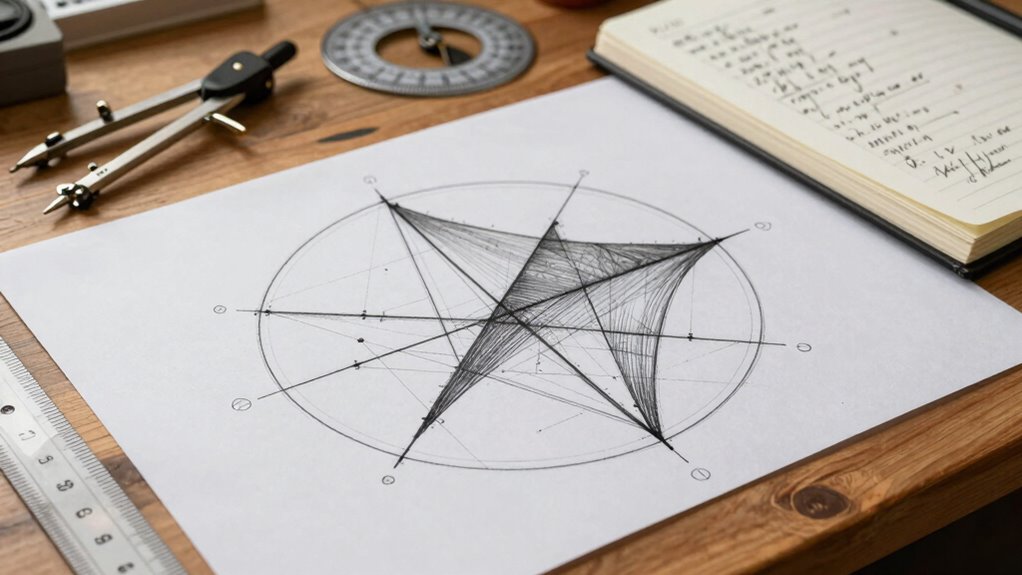
When tackling challenging geometry problems, the most skilled solvers often notice key details before anyone else. You might see them scanning the figure quickly, picking up on subtle clues that others overlook. One of the first things they focus on are angle relationships—those fundamental connections between angles that reveal much about the figure’s structure. They look for pairs of angles that are supplementary, complementary, or equal, understanding how these relationships can unlock the entire problem. For instance, recognizing when two angles are vertically opposite or when angles form a linear pair gives them a foothold to move forward. These angle relationships help them identify congruent angles or those that sum to specific values, narrowing down the possibilities rapidly. Developing an intuitive sense for how these relationships interact is key to mastering geometry problem-solving.
Skilled solvers quickly spot key angle relationships to unravel complex geometry problems efficiently.
Alongside understanding angle relationships, these problem-solvers immediately notice symmetry patterns in the figure. Symmetry isn’t just about visual appeal; it’s a powerful tool in geometry. They scan for lines of symmetry, rotational symmetry, or reflective symmetry, knowing that these patterns often imply equal segments, congruent angles, or proportional relationships. Spotting symmetry allows them to deduce properties without laborious calculations. For example, if a figure appears symmetric across a certain line, they recognize that corresponding angles or segments are equal, which can simplify complex proofs or calculations. Symmetry patterns often serve as a shortcut, pointing directly to key equalities or congruences that might otherwise take longer to establish through algebra or more detailed reasoning. Recognizing these geometric patterns helps in quickly forming conjectures and guiding the solution process. They also develop an inner visualization that enables them to mentally manipulate the figure, making deductions more intuitive.
These skilled problem-solvers also develop an intuitive sense for how angle relationships and symmetry patterns interact within a figure. They quickly see how certain angles, when combined with symmetrical properties, lead to important conclusions—like the fact that two angles are supplementary because they form a straight line, or that two segments are congruent due to symmetry. This mental synergy enables them to piece together different parts of a problem efficiently. They’re not just looking at isolated angles or segments; they’re synthesizing how these elements connect through the underlying geometric principles.
In essence, the hallmark of strong geometry problem-solving lies in your ability to notice these key details first—angle relationships and symmetry patterns. By honing this awareness, you can streamline your approach, avoid unnecessary steps, and arrive at solutions more swiftly. Recognizing these foundational elements early on transforms complex visuals into manageable puzzles, making you a more confident and effective solver.
As an affiliate, we earn on qualifying purchases.
Frequently Asked Questions
How Can I Improve My Initial Observation Skills in Geometry?
You can improve your initial observation skills in geometry by practicing visual strategies like sketching diagrams and mentally rotating figures. Focus on pattern recognition by regularly analyzing shapes, angles, and relationships, noting recurring themes or properties. Challenge yourself with varied problems to strengthen these skills. Over time, you’ll develop sharper intuition, enabling you to spot key features quickly and approach problems more confidently and efficiently.
What Common Mistakes Do Weak Problem-Solvers Make Initially?
Did you know that over 60% of students struggle with initial geometry problems? Weak problem-solvers often make mistakes by trusting misleading diagrams or overlooking vital details. They jump to conclusions too quickly, missing key angles, lines, or relationships. To improve, double-check diagrams and slow down to verify every element. Recognizing these common pitfalls helps you avoid errors and builds a solid foundation for tackling complex geometry challenges effectively.
Are There Specific Visual Cues That Indicate Key Properties?
You notice visual clues like marked angles, marked congruences, or parallel lines that indicate key properties. Property indicators such as symmetry, equal segments, or perpendicular bisectors catch your eye quickly. These visual cues help you identify congruent angles, similar triangles, or other relationships. By focusing on these clues, you can efficiently determine the relevant properties needed to solve the problem and avoid unnecessary steps.
How Important Is Understanding Problem Context Before Analyzing Figures?
Think of understanding problem context like zooming out with a camera lens—you see the full scene before focusing on details. It’s essential because context clues guide your diagram interpretation, revealing key properties and relationships. Without grasping the overall picture, you risk misinterpreting figures or missing hidden clues. So, always take a moment to understand the problem’s background first; it sharpens your focus and makes solving geometry puzzles more effective.
Do Successful Problem-Solvers Use Any Specific Mental Routines?
Successful problem-solvers use specific mental routines, like visualizing the figure, breaking down the problem, and checking for symmetry. They adopt problem-solving strategies such as drawing auxiliary lines or considering special cases. These routines help clarify complex diagrams and keep their thinking organized. By consistently applying these mental routines, they develop intuition, identify key properties quickly, and increase their chances of finding elegant solutions efficiently.
As an affiliate, we earn on qualifying purchases.
Conclusion
Just like Sherlock Holmes notices the smallest details others overlook, strong geometry problem-solvers train their eyes to spot key clues first. They understand that every line, angle, and circle whispers a secret waiting to be uncovered. By cultivating this keen awareness, you sharpen your intuition and reveal hidden patterns. Remember, the greatest discoveries often begin with noticing what everyone else misses—turning simple shapes into extraordinary solutions, just like a detective unraveling a complex mystery.
As an affiliate, we earn on qualifying purchases.
As an affiliate, we earn on qualifying purchases.
Evergreen bestsellers Picks
bestsellers
As an affiliate, we earn on qualifying purchases.