

Topology transformed how you see shapes by focusing on their core qualities rather than exact measurements. Imagine stretching, bending, or twisting objects like a rubber sheet without tearing or gluing. This approach reveals true connectedness, holes, and fundamental structure. It’s essential in understanding complex forms, from knots to surfaces. If you keep exploring, you’ll discover how this flexible viewpoint opens new horizons in mathematics and science, reshaping our understanding of space and form.

Prime made for students and young adults
- Fast, free delivery for dorm and study essentials
- Prime Video and Amazon Music included
- Member-only deals
Key Takeaways
- Topology emerged as a flexible branch of mathematics focusing on properties preserved under continuous deformation, akin to stretching a rubber sheet.
- It shifted from rigid geometric measurements to studying intrinsic shape features like holes and connectedness.
- Concepts like the “rubber sheet” analogy illustrate how shapes can be deformed without tearing, emphasizing their core structure.
- The development of knot theory and surface classification exemplifies topology’s focus on understanding complex shapes through deformation.
- This “rubber sheet” perspective revolutionized geometry, enabling analysis of shapes’ fundamental qualities beyond traditional rigid measurements.
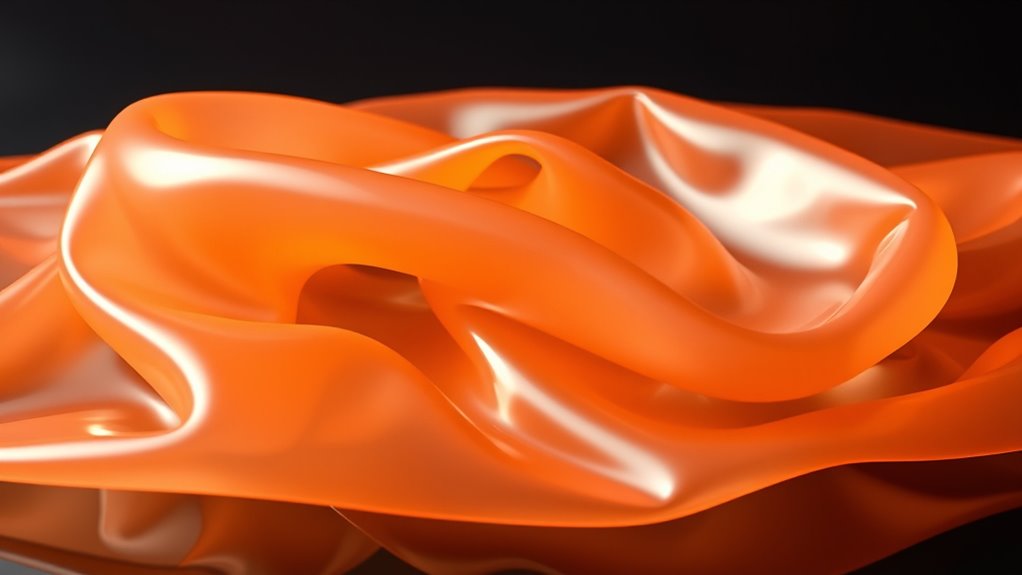
Imagine a universe where shapes can stretch, twist, and bend without tearing or gluing—welcome to topology, the branch of mathematics that explores properties preserved under continuous deformations. Unlike traditional geometry, which deals with fixed measurements and rigid shapes, topology focuses on the essence of a shape’s structure, regardless of how it’s deformed. You can think of a coffee mug and a doughnut as topologically equivalent because each has one hole, despite their different appearances. This flexibility allows you to understand the fundamental qualities of shapes when they’re stretched, compressed, or bent—without breaking or gluing parts together.
In topology, shapes can be stretched and bent without tearing, revealing their true connectedness and holes.
One of the most fascinating areas within topology is knot theory. Here, you explore how strings can be knotted or unknotted, and whether one knot can be transformed into another through continuous deformation without cutting. Imagine tying a knot in a rope and then twisting or stretching it; the question is whether you can untie it without undoing the knot or cutting the rope. Knot theory isn’t just about ropes—it has applications in understanding DNA strands, molecular structures, and even the behavior of certain fields in physics. You’re essentially studying the different ways a loop can be knotted and how those knots can be classified based on their properties.
Surface classification is another cornerstone of topology. It involves categorizing surfaces based on their fundamental features, such as the number of holes or handles they have. For example, a sphere has no holes, while a torus (a doughnut shape) has one. By continuously deforming a surface, you can identify its topological class. If you imagine molding a sphere into a shape with a handle, you’re performing a surface classification. This process helps mathematicians understand complex shapes by reducing them to simpler, more manageable forms, revealing their underlying structure. It’s like sorting different types of fabric based on their weave and texture, but in the realm of shapes and spaces.
In essence, topology allows you to see beyond rigid measurements and focus on what truly defines a shape’s identity. Through knot theory and surface classification, you gain tools to analyze and categorize shapes based on their intrinsic properties. This perspective has revolutionized how mathematicians approach problems involving complex structures and has opened pathways to numerous scientific and technological advancements. It’s a field where the only limit is your imagination, as you manipulate shapes in a flexible, rubber-like universe of continuous deformations.
As an affiliate, we earn on qualifying purchases.
Frequently Asked Questions
How Does Topology Differ From Traditional Geometry?
Topology differs from traditional geometry because it focuses on properties that stay the same under continuous deformation, like stretching or bending, without tearing or gluing. You learn that boundary properties matter less, and the shape’s essence remains intact despite changes. While geometry emphasizes exact measurements and angles, topology deals with the fundamental nature of shapes, highlighting how objects can transform through flexible, boundary-preserving deformations.
What Are Practical Applications of Topology Today?
You can use topology today in topological data analysis to identify patterns and features in complex datasets, which helps in fields like machine learning and image processing. Additionally, you apply it in material deformation modeling to understand how materials change shape under stress, ensuring better design and safety. These practical applications showcase topology’s power in solving real-world problems by analyzing shapes, structures, and data relationships effectively.
Who Are the Pioneers of Modern Topology?
You should know that pioneers like Henri Poincaré and Kurt Gödel profoundly shaped modern topology. They explored concepts like knot theory and topological invariants, which help you understand the properties of shapes that don’t change even when you stretch or bend them. Their work laid the foundation for today’s advances, influencing fields like data analysis and quantum physics. So, these mathematicians truly are the trailblazers of modern topology.
How Does Topology Influence Computer Science and Data Analysis?
You see, topology influences computer science and data analysis by helping you understand structures through continuous deformation, meaning shapes can change without tearing or gluing. Topological invariants, like holes or connectedness, stay constant despite these deformations, allowing you to identify essential features of data. This approach helps you analyze complex datasets, detect patterns, and develop algorithms that are robust to distortions, making your insights more accurate and meaningful.
Can Topology Be Visualized Easily for Beginners?
You might find topology’s visualization a bit tricky at first, but don’t worry—you can use beginner-friendly tools to make it easier. While visualization challenges exist, simple diagrams and interactive software help you grasp concepts like continuous deformation without complex math. These tools act as gentle guides, allowing you to explore shapes and spaces intuitively. With patience and the right resources, topology becomes a fascinating world you can see and understand.
As an affiliate, we earn on qualifying purchases.
Conclusion
As you explore topology, remember that it’s like a rubber sheet—flexible and full of surprises. Just as a drop of ink can stretch and twist without breaking, your understanding of shapes transforms beyond rigid boundaries. Embrace the idea that “what goes around, comes around,” for in topology, boundaries blur and connections deepen. Now, with a curious mind and an open heart, you’re ready to see the world’s shapes in a whole new light.
As an affiliate, we earn on qualifying purchases.
As an affiliate, we earn on qualifying purchases.
Fall Picks
fall essentials
As an affiliate, we earn on qualifying purchases.