Virtual reality in geometry education immerses you in interactive 3D environments, making complex shapes and spatial relationships easier to understand. You can manipulate models in real time, rotate objects, and explore their properties hands-on, which boosts your engagement and comprehension. VR also helps visualize geometric principles vividly, improving your spatial awareness and problem-solving skills. If you keep exploring, you’ll discover how VR can transform your approach to learning geometry in exciting ways.
Key Takeaways
- VR offers immersive 3D environments that enhance spatial understanding of geometric concepts beyond traditional 2D methods.
- Interactive VR models allow students to manipulate shapes, fostering active exploration of surface area, volume, and shape properties.
- Visualization of geometric relationships in VR clarifies complex ideas like plane intersections and angles between lines.
- VR promotes experimentation and hypothesis testing, leading to deeper comprehension through immediate feedback.
- Using VR bridges virtual and real-world understanding, improving skills crucial for fields like engineering and architecture.
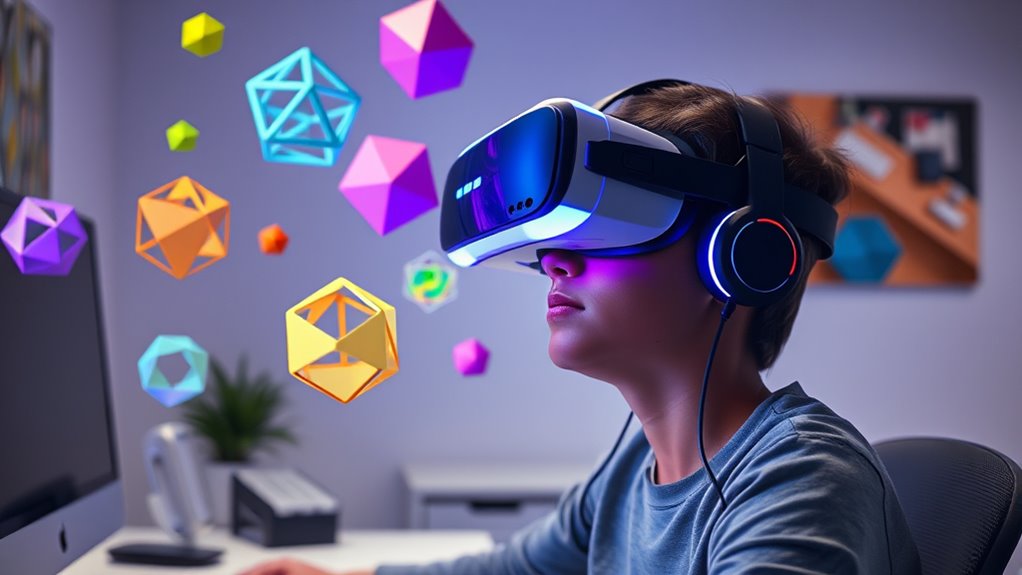
Virtual reality (VR) is transforming how geometry is taught by providing immersive, interactive experiences that bring complex concepts to life. Instead of relying solely on two-dimensional diagrams or static models, you can explore geometric shapes and relationships in a 3D environment that feels real and tangible. This shift to augmented visualization allows you to see and manipulate three-dimensional objects from multiple angles, making abstract ideas much easier to understand. With VR, you’re not just observing; you’re actively engaging with the material, which deepens comprehension and retention.
One of the key advantages of VR in geometry education is the ability to work with interactive models. These models respond to your movements and inputs, enabling you to rotate, resize, and dissect shapes effortlessly. When you’re able to interact directly with the models, you gain insights into their properties that static images simply can’t provide. For example, you can explore the surface area and volume of complex polyhedra by manipulating the models in real-time, observing how changes affect their measurements. This hands-on approach makes learning more dynamic and intuitive, helping you grasp concepts that might otherwise seem abstract or confusing.
Augmented visualization in VR also allows you to see geometric principles in context. You can visualize how shapes relate to each other in space, such as understanding the intersection of planes or the angles formed between lines. This spatial awareness is essential for mastering higher-level geometry topics and can be challenging to develop using traditional methods. With VR, you’re immersed in a 3D space where you can see the relationships unfold before your eyes, making complex ideas more accessible and less intimidating.
Furthermore, VR’s immersive environment encourages exploration and experimentation. You can test hypotheses by modifying models and instantly observing the outcomes. This trial-and-error process fosters a deeper understanding of geometric principles, as you learn through discovery rather than rote memorization. The interactivity makes learning more engaging and enjoyable, motivating you to spend more time exploring concepts and solving problems.
Additionally, understanding 3D visualization enhances your ability to comprehend and work with physical objects, which is especially important in fields like engineering and architecture.
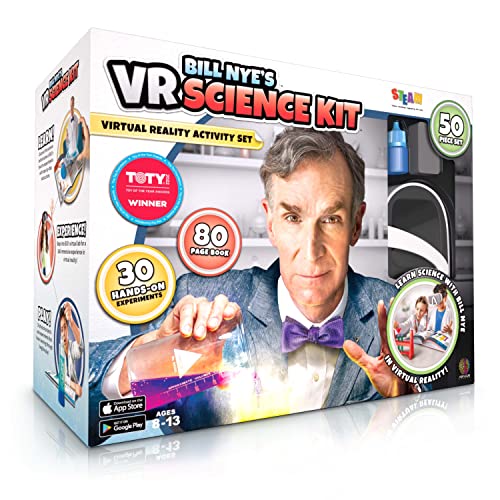
Abacus Brands Bill Nye's VR Science Kit – Kids STEM Set Ages 8-12
- Award-Winning STEAM Toy: Winner of the TOTY STEAM Toy of the Year
- Immersive Virtual Reality Lab: Join Bill Nye in a virtual science lab
- Educational & Fun: Learn chemistry, physics, and more
As an affiliate, we earn on qualifying purchases.
As an affiliate, we earn on qualifying purchases.
Frequently Asked Questions
How Does VR Impact Long-Term Retention of Geometric Concepts?
VR enhances your long-term retention of geometric concepts by strengthening your spatial memory through immersive 3D experiences. It reduces cognitive load, making complex ideas easier to grasp and remember. When you actively engage with geometric shapes in virtual environments, you’re more likely to retain information over time. This interactive approach helps solidify your understanding, leading to better recall and application of concepts long after your VR session ends.
Are There Specific Age Groups That Benefit Most From VR in Geometry?
Younger students, especially those in elementary and middle school, benefit most from VR in geometry because they’re at a stage where developmental readiness makes them more receptive to immersive learning. As the saying goes, “You’re never too old to learn,” but their engagement levels soar when VR sparks curiosity. This hands-on experience helps solidify concepts early, setting a strong foundation for future learning.
What Are the Cost Implications of Implementing VR in Classrooms?
Implementing VR in classrooms involves significant costs, including hardware costs for headsets and compatible devices, which can be pricey upfront. You’ll also face ongoing maintenance expenses to keep equipment functional and up-to-date. While the initial investment might seem high, long-term benefits like enhanced engagement and improved understanding can justify the costs. Planning for these expenses guarantees smooth integration and sustained use of VR technology in your educational environment.
How Do Teachers Need to Adapt Their Instruction for Vr-Based Learning?
You need to hit the ground running with VR by undergoing specialized teacher training and adapting your curriculum to include immersive 3D experiences. This means learning how to navigate new tech and designing lessons that leverage VR’s interactive potential. You’ll also want to stay flexible, as integrating VR requires fresh strategies. Ultimately, embracing these changes helps students grasp complex geometric concepts more intuitively, making your teaching more engaging and effective.
What Challenges Exist in Integrating VR Technology Across Curricula?
You face challenges like ensuring solid technical infrastructure, such as reliable hardware and internet, to support VR integration. Curriculum integration can be tricky, as you need to adapt lesson plans to include VR experiences without disrupting learning flow. Budget constraints and staff training also pose hurdles, making it essential for you to carefully plan and allocate resources to effectively incorporate VR technology across different subjects.

Pull String 3D Geometry Learning Book, 3D Geometry Learning Book with Braided Rope Design, Interactive Math Teaching Tool for Geometric Beginners, Teach Volume & Surface Area Formulas (15 Models)
- Enhances Geometry Understanding: Master points, lines, planes, volume, surface area
- Instant 3D Models: Pull to transform 2D shapes into 3D models
- Rich Content: Includes 15 geometric models and 16 hidden animals
As an affiliate, we earn on qualifying purchases.
As an affiliate, we earn on qualifying purchases.
Conclusion
As you step into the world of virtual reality, geometry transforms from flat diagrams to vibrant, three-dimensional landscapes. You don’t just learn; you explore, manipulate, and truly grasp complex shapes in an immersive dance of discovery. VR turns classroom walls into boundless horizons, making abstract concepts come alive like a symphony of shapes and colors. Embrace this new dimension—where learning becomes an adventure, and understanding, a vivid journey through space itself.

HeroMask VR Headset + Math Games — Gift for Kids 5–12 — Multiplication, Times Tables, Addition, Mental Math & More | Award-Winning Virtual Reality Educational Toy for Birthday or Christmas
- Engaging Math Games: Enhances mental math and problem-solving skills
- Includes VR Headset: Sturdy, comfortable headset for immersive learning
- Teacher-Designed Brain Games: Builds fluency, speed, and confidence in math
As an affiliate, we earn on qualifying purchases.
As an affiliate, we earn on qualifying purchases.

Geometric Solids 3D Shapes & 2D Folding Nets (1.96") 12+12 -Clear Math Manipulatives for Classroom & Homeschool -Thickened Durable Shapes with Smooth Edges,Teacher Supplies for Geometry, Volume & Nets
- Includes 12 3D Shapes: Visualize surface area and volume
- Includes 12 Nets: Transform 2D to 3D shapes
- Durable Thickened Material: Withstands frequent drops and use
As an affiliate, we earn on qualifying purchases.
As an affiliate, we earn on qualifying purchases.