
The history of geometry takes you from ancient civilizations, like Egyptians and Babylonians, who used early measurements for practical tasks, to Euclid, who formalized geometry as a rigorous mathematical system. You’ll see how Renaissance artists and architects incorporated geometry’s principles, and how non-Euclidean geometries expanded our understanding of space. The development of algebraic and fractal methods then revolutionized the field further. Keep exploring, and you’ll discover how these ideas continue to shape science and art today.

Prime made for students and young adults
- Fast, free delivery for dorm and study essentials
- Prime Video and Amazon Music included
- Member-only deals
Key Takeaways
- Ancient civilizations like Egyptians and Babylonians used early geometric measurements for construction and land division.
- Euclid formalized geometry into a rigorous deductive system, establishing foundational axioms and proofs.
- The Renaissance revived classical principles, integrating geometry into art, architecture, and perspective techniques.
- Non-Euclidean geometries, such as hyperbolic and spherical, challenged Euclid’s postulates, expanding understanding of space.
- Fractals introduced self-similar, complex patterns, bridging mathematics with natural phenomena and modern scientific applications.
As an affiliate, we earn on qualifying purchases.
Early Foundations and Ancient Civilizations
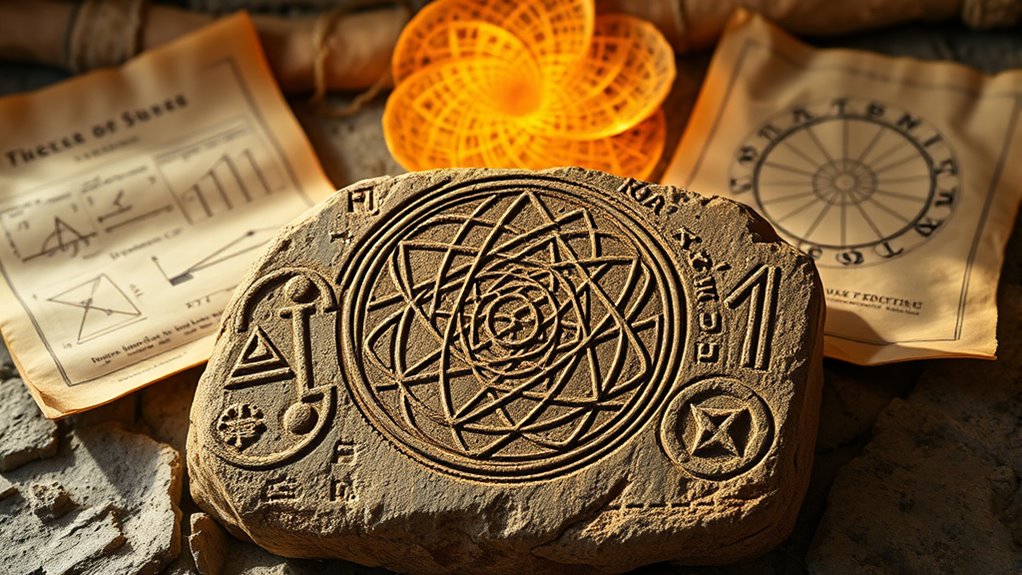
Have you ever wondered how the study of shapes and spaces began? It all started with ancient artifacts that reveal early measurements used for construction, land division, and daily tasks. Civilizations like the Egyptians and Babylonians carved marks on bones, stones, and clay tablets, demonstrating their understanding of geometry’s practical applications. They used these early measurements to build impressive structures like pyramids and ziggurats. These artifacts show that even without formal theories, humans recognized patterns, proportions, and spatial relationships. Their focus was mainly functional, driven by needs like irrigation, astronomy, and architecture. The concept of spatial relationships was fundamental to their understanding of geometry. This practical approach laid the groundwork for future mathematical developments, providing the basic concepts of measurement and shape that later evolved into more sophisticated geometric ideas.
As an affiliate, we earn on qualifying purchases.
Euclid and the Birth of Formal Geometry

Euclid, often called the “Father of Geometry,” transformed practical knowledge of shapes and spaces into a formal mathematical system. He introduced the concept of Euclidean axioms—fundamental, self-evident statements that serve as the foundation for all geometric reasoning. These axioms provide the basis for building logical arguments, ensuring consistency and rigor. Euclid’s work emphasized formal proofs, where each statement is logically derived from previous axioms and propositions. This approach allowed geometry to evolve from intuition and observation into a precise, deductive science. His method not only clarified geometric principles but also set a standard for mathematical rigor that influences the field to this day. Through Euclid, geometry became a structured, logical discipline grounded in evidence and reasoning.
As an affiliate, we earn on qualifying purchases.
The Renaissance and the Revival of Geometric Study
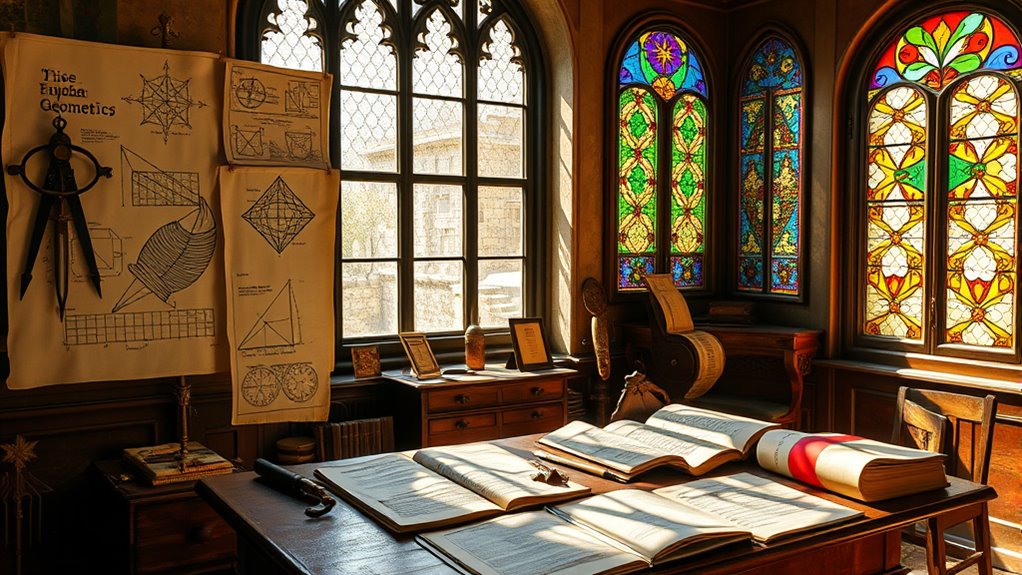
During the Renaissance, scholars rediscovered and expanded upon the geometric principles of ancient Greece, fueling a renewed interest in understanding space and form. Artistic representations became more precise, incorporating geometric shapes and perspective techniques to create realistic images. Architects drew inspiration from classical proportions and symmetry, influencing iconic structures like domes and columns. This revival led to a deeper exploration of geometric concepts beyond basic shapes, integrating them into art and architecture. The focus on harmony and proportion improved visual accuracy and aesthetic appeal. As a result, geometry’s role expanded from pure mathematics to practical applications in design and construction, shaping the visual language of the period. This era marked a significant shift, blending scientific inquiry with artistic innovation driven by geometric understanding. Additionally, the development of projector technology during this time benefited from geometric principles, enabling more precise and innovative visual projections in various applications beyond art and architecture.
As an affiliate, we earn on qualifying purchases.
The Development of Non-Euclidean Geometries
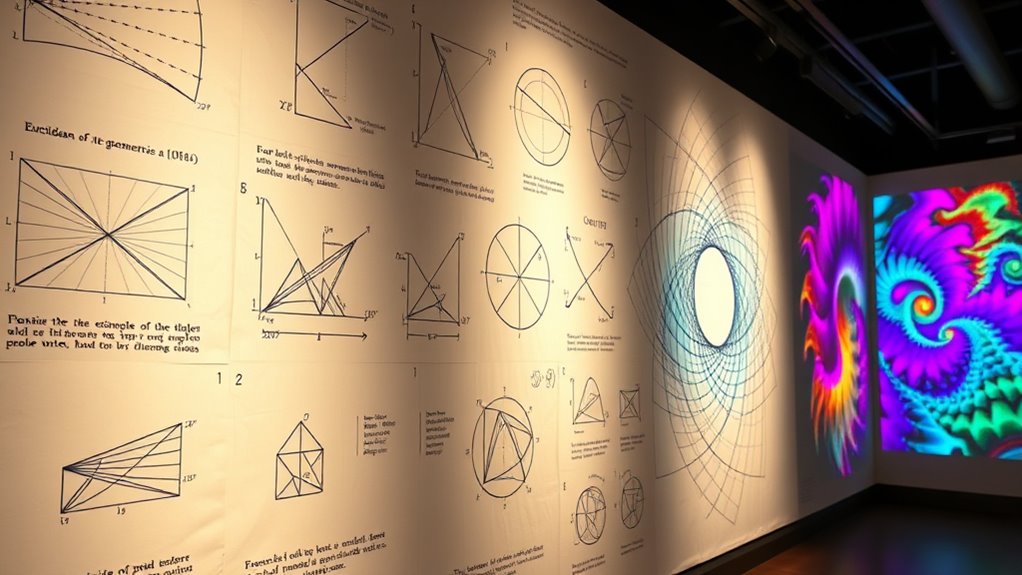
You’ll see how challenging Euclidean assumptions led to groundbreaking ideas in geometry. The birth of hyperbolic geometry opened new ways to understand space beyond traditional concepts. These developments notably impact modern mathematics today. Embracing creative practice fosters innovative thinking that parallels the discovery of unconventional geometries.
Challenging Euclidean Assumptions
The development of non-Euclidean geometries challenged long-held assumptions about the nature of space and the validity of Euclidean principles. You learn that these geometries, like spherical geometries, show that parallel lines don’t behave as Euclid described, fundamentally altering how we view space. Topology and continuity become essential in understanding these new systems, as they explore properties preserved through deformation without tearing or gluing. Instead of relying solely on flat, infinite planes, mathematicians realized space could curve and bend, leading to models where the shortest path between points isn’t always a straight line. This shift opened the door to new ways of thinking about the universe, showing that Euclidean assumptions aren’t the only way to understand geometry and space.
Birth of Hyperbolic Geometry
Have you ever wondered what happens when the rules of Euclidean geometry no longer apply? That’s when hyperbolic geometry emerges, revealing a new universe of shapes and spaces. In hyperbolic space, parallel lines diverge, and the usual rules of angles and triangles change. Geometric models, like the Poincaré disk, help us visualize this non-Euclidean world. These models demonstrate how space can bend and stretch, creating fascinating structures. The birth of hyperbolic geometry challenged traditional ideas, opening doors to new mathematical insights. It paved the way for understanding complex shapes beyond flat surfaces. This revolutionary development deepened our comprehension of geometry, proving that alternative spaces exist beyond Euclid’s original framework.
| Concept | Description | Visual Example |
|---|---|---|
| Hyperbolic space | Space with diverging parallels | Poincaré disk model |
| Geometric models | Visual tools for hyperbolic space | Half-plane model |
| Diverging lines | Lines that spread apart | Hyperbolic triangle |
| Triangle angles | Sum less than 180° | Hyperbolic triangle |
| Non-Euclidean ideas | Challenged Euclidean assumptions | New geometric frameworks |
Impact on Modern Mathematics
The development of hyperbolic geometry broadened the horizons of modern mathematics, challenging the long-held assumptions of Euclidean space. It revolutionized mathematical visualization by enabling you to explore complex structures beyond flat planes. Non-Euclidean geometries paved the way for advances in computational topology, where you analyze shapes and spaces using algorithms. These ideas have transformed areas like computer graphics, allowing you to accurately model curved surfaces and intricate structures. They also deepen your understanding of space, impacting fields such as physics, cosmology, and engineering. By expanding the conceptual framework, these geometries have empowered you to approach problems from new angles, fostering innovation. Furthermore, dog names can reflect the personality or appearance of a pet, making the naming process more meaningful. Overall, the impact of non-Euclidean geometries is profound, continually shaping and expanding modern mathematical research and application.
The Rise of Coordinate Geometry and Analytical Methods
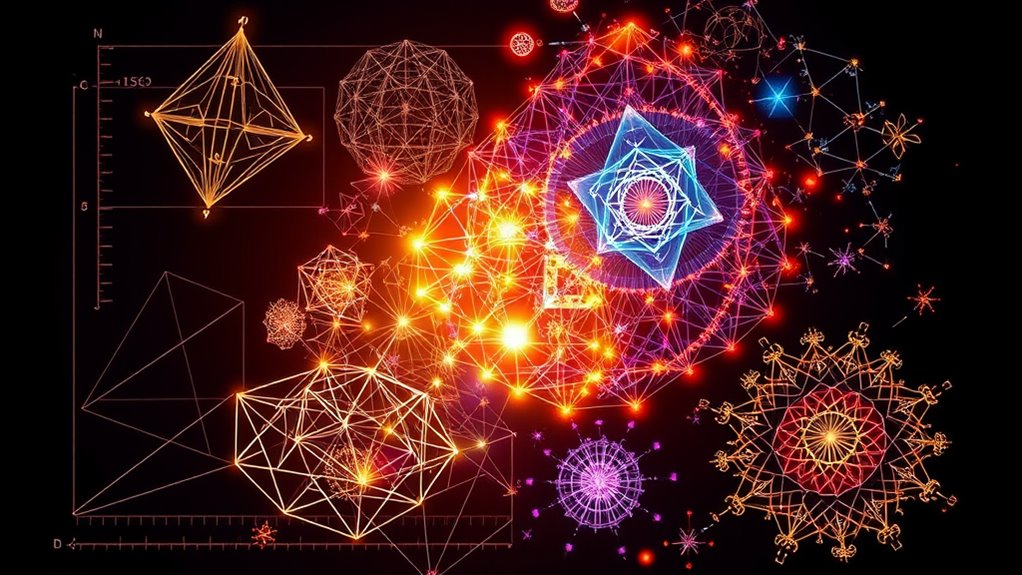
As mathematicians sought more systematic ways to analyze geometric problems, coordinate geometry emerged as a powerful tool that bridges algebra and geometry. This approach uses coordinate systems to represent points, lines, and shapes mathematically. You can now solve problems by applying algebraic techniques to geometric figures, making analysis more straightforward. Additionally, the integration of Honda Tuning concepts has allowed enthusiasts to modify and optimize vehicle geometries for better handling and performance.
Here are three key aspects:
- The development of Cartesian coordinates by Descartes revolutionized geometry.
- Algebraic methods enabled the precise calculation of distances, slopes, and intersections.
- Coordinate systems simplified complex geometric proofs and fostered new discoveries.
This fusion of algebra and geometry made it easier to visualize and solve problems, laying the foundation for modern analytical methods that continue to influence mathematics today.
Fractals and the Modern Exploration of Complex Patterns
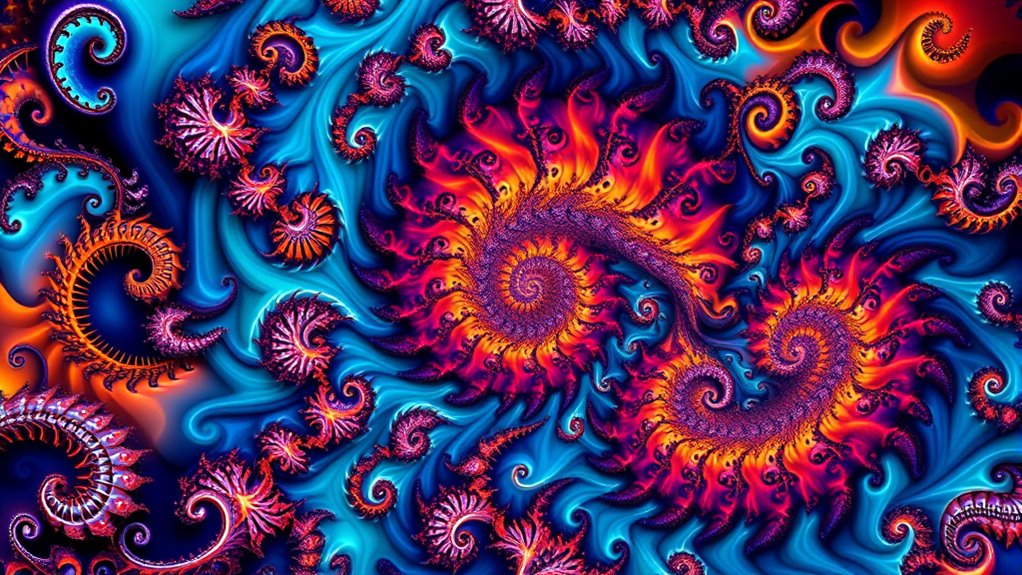
Since the late 20th century, mathematicians and scientists have increasingly focused on fractals to explore complex, self-similar patterns that appear in nature and art. Fractals are defined by their fractal dimensions, which quantify their complexity and scaling behavior, often exceeding traditional geometric dimensions. You can observe iterative patterns in fractals, where simple rules generate infinitely detailed structures through repeated processes. This exploration reveals how natural forms—such as coastlines, clouds, and fern leaves—possess intricate geometry that defies classical Euclidean shapes. Fractals enable you to analyze and model these patterns accurately, bridging abstract mathematics with real-world phenomena. Their study has revolutionized understanding of complexity, revealing deep connections between geometry, chaos, and natural self-similarity.
Contemporary Directions and Future Perspectives
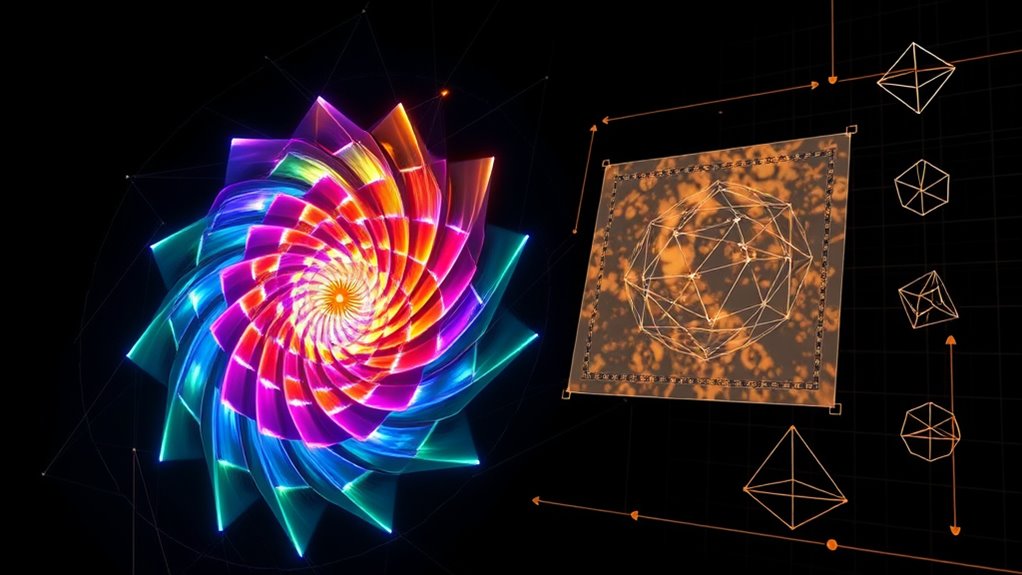
Contemporary research in geometry is pushing boundaries by integrating advanced computational methods, machine learning, and interdisciplinary collaborations. You’ll see exciting developments like quantum topology, which explores space’s properties at a quantum level, and computational visualization, making complex geometric data more accessible. Here are three key directions shaping the future:
- Quantum Topology — *releasing* new insights into space and matter at a fundamental level.
- Computational Visualization — transforming abstract concepts into interactive, visual models.
- AI and Machine Learning — discovering patterns and solving problems faster than ever before. Geometric modeling is also evolving, allowing for more precise and intricate designs.
These innovations open fresh perspectives, deepen our understanding of geometry’s role in science, and pave the way for future breakthroughs.
Frequently Asked Questions
How Did Ancient Civilizations Use Geometry in Daily Life?
You see, ancient civilizations relied heavily on geometry for daily life. They used it in ancient construction to build durable structures and precise temples. Navigation techniques also depended on geometric principles to chart courses across seas and land. By understanding angles, distances, and shapes, they managed to create accurate maps and find their way. This practical use of geometry helped them solve real-world problems and advance their societies considerably.
What Are the Key Differences Between Euclidean and Non-Euclidean Geometry?
You’ll find that Euclidean geometry relies on familiar geometric axioms, like parallel lines never meeting, which shape your understanding of flat surfaces. In contrast, non-Euclidean geometry challenges these axioms; for example, in hyperbolic geometry, parallel lines can diverge. These differences change how you see space, with non-Euclidean concepts being essential in modern physics, like Einstein’s theory of relativity, expanding your view beyond traditional Euclidean ideas.
How Did Fractals Influence Modern Scientific Research?
Imagine a universe where patterns endlessly unfold like a never-ending story—fractals bring this vision to life. You see their influence in medicine, where fractal analysis helps identify irregularities in tissues, and in technology, like fractal antenna design, which boosts signal strength. By revealing nature’s hidden complexity, fractals push scientific research forward, revealing new insights and innovations that shape our understanding of the world around us.
What Role Did Geometry Play in the Development of Modern Technology?
Geometry plays a vital role in modern technology by enabling you to develop precise mathematical models and algorithms. You rely on geometric principles for designing computer graphics, robotics, and navigation systems. These models help simulate real-world scenarios, optimize solutions, and improve accuracy. By understanding geometric concepts, you can create efficient algorithms that drive innovations in technology, making complex tasks manageable and enhancing the functionality of modern devices and systems.
Are There Any Undiscovered Geometric Principles Still Being Explored?
You might wonder if there are hidden patterns or unexplored dimensions waiting to be uncovered in geometry. The truth is, mathematicians are constantly pushing boundaries, exploring concepts beyond our current understanding. New principles could revolutionize fields like physics and technology. As research progresses, you’ll find that even today, the domain of geometry holds secrets that could reshape our perception of space, form, and reality itself—waiting just beneath the surface.
Conclusion
As you look back on the journey from ancient civilizations to fractals, remember that geometry is a story of discovery and innovation. Each breakthrough built on the last, shaping how we see the world. Like the saying goes, “A journey of a thousand miles begins with a single step.” Keep exploring, because the future of geometry holds endless surprises waiting just beyond the horizon. Stay curious—you’re part of this ongoing adventure.
Fall Picks
fall essentials
As an affiliate, we earn on qualifying purchases.