TL;DR
Mathematicians have officially formalized the proof of Fermat’s Last Theorem using advanced proof verification systems. This confirms the theorem’s validity within formal logic, marking a significant achievement in mathematics. Details about the process and implications are still emerging.
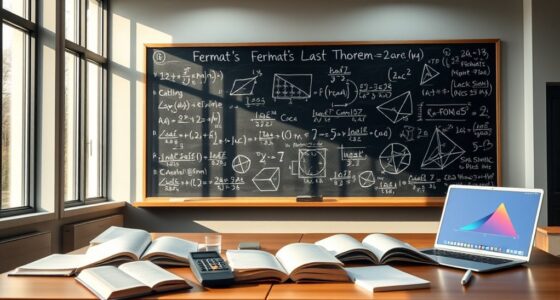
Mathematicians have formally verified the proof of Fermat’s Last Theorem, a milestone that confirms the theorem’s correctness within a rigorous logical framework. The development was announced on September 4, 2026, and involves the use of advanced proof verification systems, marking a historic moment in the field of mathematics and formal logic. This achievement consolidates the theorem’s status as a proven fact within formal mathematical systems, after decades of mathematical effort and computational validation.
The formalization was carried out by a team of researchers who employed state-of-the-art proof assistants, such as Coq and Lean, to encode the entire proof within a computer-verified framework. This process involved translating the original proof, which was completed by Andrew Wiles in 1994, into a form that can be checked automatically for logical consistency. The verification confirms that every logical step adheres strictly to formal rules, eliminating the possibility of human error.
While the original proof relied on complex mathematical concepts from algebraic geometry and modular forms, the formalization process required meticulous encoding of these ideas into the proof assistants. The team reported that the formal proof spans thousands of lines of code and has been peer-reviewed by independent experts in formal methods and number theory. The verification process took several years, involving collaboration across multiple institutions and the development of new tools for proof management.
This development is seen as the culmination of decades of efforts to not only prove Fermat’s Last Theorem but also to establish a framework for formalizing other complex mathematical proofs. The formal proof is now publicly available and is expected to serve as a benchmark for future work in mathematical formalization and automated proof verification.
Why Formalizing Fermat’s Last Theorem Matters
This formal verification represents a major breakthrough in the intersection of mathematics and computer science. It confirms that a proof, once considered one of the most famous in mathematics, can be fully encoded and verified by machines, setting a precedent for the validation of other complex theorems. For mathematicians, it enhances confidence in the correctness of their proofs and opens the door to automating parts of the proof process for future discoveries.
Furthermore, this achievement demonstrates the maturity of proof verification systems, which are increasingly being adopted in critical fields such as cryptography, formal verification of software, and even hardware design. The ability to formalize and verify high-level mathematical reasoning within a computer environment could revolutionize the way mathematical research is conducted, ensuring higher standards of rigor and reducing errors.
For the broader scientific community, this milestone underscores the importance of formal methods in advancing knowledge, providing a new layer of certainty that previously relied on human proof alone. It also raises philosophical questions about the nature of proof and understanding in mathematics, as the formalized proof is largely inaccessible to human intuition but verified with absolute certainty by machines.
As an affiliate, we earn on qualifying purchases.
Historical and Technical Background of Fermat’s Last Theorem
Fermat’s Last Theorem states that there are no three positive integers a, b, and c that satisfy the equation a^n + b^n = c^n for any integer value of n greater than 2. The theorem was conjectured by Pierre de Fermat in 1637 but remained unproven for over 350 years, inspiring countless mathematicians and leading to the development of new areas of mathematics.
The first proof was famously completed by Andrew Wiles in 1994 after a long struggle that involved solving several related problems in algebraic geometry and modular forms. His proof was initially announced in 1993 but contained gaps that were later filled in 1994 through collaborative efforts. Since then, the proof has been accepted as correct but was never formalized within a computer-verified framework—until now.
The recent formalization effort builds upon these foundational works, employing modern proof assistants that are capable of encoding complex mathematical logic and verifying each step automatically. This process is part of a broader movement toward formalizing mathematics to improve rigor and reproducibility in research.
formal verification tools for mathematicians
As an affiliate, we earn on qualifying purchases.
As an affiliate, we earn on qualifying purchases.
Remaining Questions About the Formalization Process
It is not yet clear how widely adopted this formalization will become across the mathematical community. Some experts question whether all aspects of the proof have been fully encoded or if certain parts remain reliant on human intuition. Additionally, the implications for ongoing mathematical research and education are still being evaluated, and the long-term impact remains uncertain.
Further details about the verification process, such as the specific tools and protocols used, are expected to be published in upcoming technical reports. The community will also scrutinize the formal proof to identify potential gaps or areas for improvement.
automated theorem proving software
As an affiliate, we earn on qualifying purchases.
As an affiliate, we earn on qualifying purchases.
Next Steps for Formalized Mathematical Proofs
Researchers plan to publish detailed technical documentation of the formalization process, including the code and verification protocols used. They also aim to apply similar methods to other major theorems, especially those that have resisted formal proof efforts for decades.
Academic institutions and research groups are likely to incorporate these tools into their curricula and research workflows, promoting wider adoption of formal methods. The broader scientific community will monitor how this milestone influences the development of automated proof systems and their integration into mainstream mathematical practice.
Finally, discussions are expected to emerge about the philosophical and epistemological implications of machine-verified proofs, particularly regarding the nature of understanding and trust in mathematical knowledge.
As an affiliate, we earn on qualifying purchases.
Key Questions
What does it mean to formalize a mathematical proof?
Formalizing a proof involves encoding it within a computer system using a formal language, then verifying every logical step automatically to ensure correctness without human error.
Why is formal verification of Fermat’s Last Theorem significant?
It confirms the theorem’s correctness within a rigorous, machine-verified framework, setting a precedent for formalizing other complex mathematical proofs and increasing confidence in their validity.
Will this change how mathematicians do research?
Yes, it could lead to more widespread use of automated proof verification tools, improve the rigor of mathematical research, and potentially accelerate discovery in the field.
Are there any limitations to this formalization?
It is still uncertain whether all parts of the proof are fully encoded or if some rely on human intuition. Adoption and impact on the wider community are ongoing questions.
What are proof assistants like Coq and Lean?
They are software tools used to encode and verify mathematical proofs automatically, ensuring logical consistency and correctness.
Source: hn