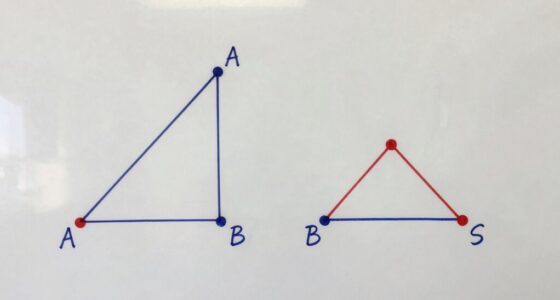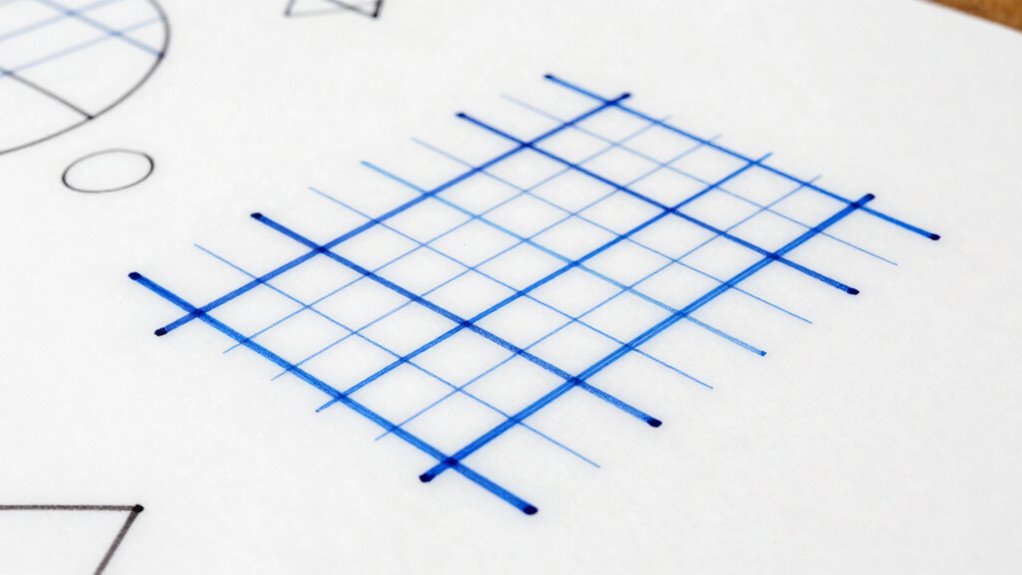
Using coordinate grids makes basic geometry easier because they give you a clear, precise way to plot points and analyze shapes. With grids, you can easily locate points, draw accurate lines, and see how shapes relate to each other. Transformations like shifting or rotating become straightforward since you can work with coordinates algebraically. If you keep exploring, you’ll discover how coordinate systems can simplify many geometric concepts and solve problems more confidently.

Prime made for students and young adults
- Fast, free delivery for dorm and study essentials
- Prime Video and Amazon Music included
- Member-only deals
Key Takeaways
- Coordinate grids provide a clear framework for accurately locating and plotting geometric points and shapes.
- They simplify calculations of distance, slope, and angles using algebraic formulas.
- Grids make it easier to visualize transformations like shifting, rotating, and reflecting shapes.
- Using coordinate systems enhances understanding of geometric properties and relationships.
- Grids streamline problem-solving by offering a structured visual reference for geometric concepts.
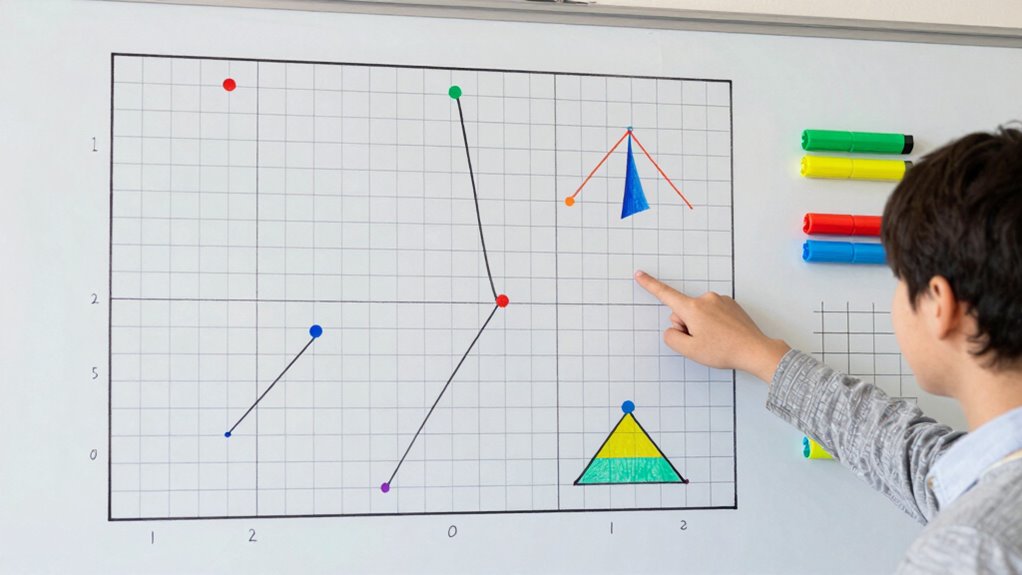
Have you ever wondered how maps and graphs help us understand space? When you look at a map or a graph, you’re fundamentally seeing a visual representation of the world or data. Coordinate grids are the backbone of these visuals, making it easier to understand positions and relationships. They provide a structured way to locate points, simplify calculations, and analyze geometric figures. By transforming coordinates, you can shift, rotate, or reflect shapes without losing their properties, which is extremely useful in problem-solving. This process means you can move points from one place to another on the grid, maintaining their relative positions, all while understanding how these transformations affect the shape’s size or orientation.
Plotting points is a foundational skill in geometry, and coordinate grids make it straightforward. Instead of guessing where a point might be, you can precisely determine its location using an ordered pair—like (3, 5)—that tells you how far to move along the x-axis and y-axis. This clarity removes guesswork and helps you build accurate diagrams. When you plot points, you lay out the basis for drawing lines, triangles, circles, and other figures with exact measurements. The grid acts as a guide, ensuring your shapes are proportionate and correctly positioned relative to one another, which is vital for understanding concepts like distance, slope, and area. Additionally, understanding how to apply transformations helps in visualizing how shapes behave under different conditions, further deepening your geometric understanding. Recognizing these geometric principles can also aid you in solving more complex problems with confidence.
Using a coordinate grid also streamlines the process of solving geometry problems. Instead of visualizing complex shapes in your head, you can use algebraic methods to analyze their properties. For example, calculating the distance between two points becomes a matter of applying the distance formula, which is derived from the Pythagorean theorem. This approach simplifies what might seem complicated at first glance. Additionally, by transforming coordinates—such as shifting a shape to a new location—you can explore symmetry and congruence easily. These transformations allow you to see how a shape behaves under different conditions, which enhances your understanding of geometric principles. Recognizing the importance of coordinate systems can also help you grasp fundamental mathematical concepts, making problem-solving more intuitive.
As an affiliate, we earn on qualifying purchases.
Frequently Asked Questions
How Do Coordinate Grids Help in Real-World Navigation?
Coordinate grids help you in real-world navigation by making map reading and compass navigation more precise. When you use a grid, you can pinpoint exact locations, making it easier to find your way in unfamiliar areas. Whether you’re hiking or exploring a city, the grid system allows you to quickly determine directions and distances, reducing confusion and helping you reach your destination efficiently.
Can Coordinate Grids Be Used in Non-Euclidean Geometries?
Yes, you can use coordinate grids in non-Euclidean geometries like hyperbolic coordinates and non-Euclidean mapping. These systems adapt the traditional grid concept to curved spaces, helping you visualize and analyze complex geometries. By applying hyperbolic coordinates, you can explore shapes and distances that differ from Euclidean expectations. This makes understanding and working within non-Euclidean geometries more manageable and intuitive, especially in advanced mathematical or physical applications.
What Are Common Mistakes When Using Coordinate Grids?
You often make mistakes like grid misalignment or inaccurate plotting when using coordinate grids. To avoid this, double-check your points before plotting and verify your grid is correctly aligned. Be careful with negative coordinates and labeling axes clearly. Mistakes happen when you rush or overlook details, so take your time. Accurate plotting helps you understand geometry better and prevents errors in your work.
How Do Coordinate Grids Relate to Graphing Functions?
Imagine you’re a modern-day explorer charting unknown lands—coordinate grids are your trusty map for graphing functions. They help you visualize and plot function plotting accurately. With grid transformation, you can shift, stretch, or reflect graphs, making complex functions easier to analyze. You simply identify key points, plot them on the grid, and see your function come to life. It’s like having a GPS for math!
Are There Alternative Methods to Coordinate Grids for Geometry?
Yes, there are alternative methods to coordinate grids for geometry. You can use visual aids like diagrams, manipulatives, or sketches to explore geometric concepts. These tools help you understand shapes, angles, and relationships without relying solely on grids. Alternative methods make learning more intuitive, especially for visual learners, and can be useful when coordinate systems are too complex or unnecessary for the problem at hand.
As an affiliate, we earn on qualifying purchases.
Conclusion
Using coordinate grids simplifies basic geometry by providing a clear, visual way to analyze shapes and positions. They make solving problems faster and more accurate, especially for beginners. Did you know that students who use coordinate grids score 20% higher on geometry tests? This statistic shows just how much easier and more effective learning becomes when you incorporate grids. So, next time you face a tricky problem, remember that a coordinate grid might be your best tool for clarity and success.
As an affiliate, we earn on qualifying purchases.
As an affiliate, we earn on qualifying purchases.
Halloween Picks
halloween
As an affiliate, we earn on qualifying purchases.