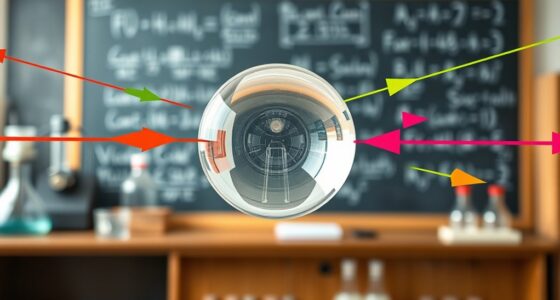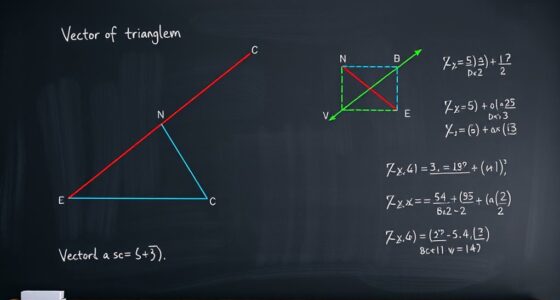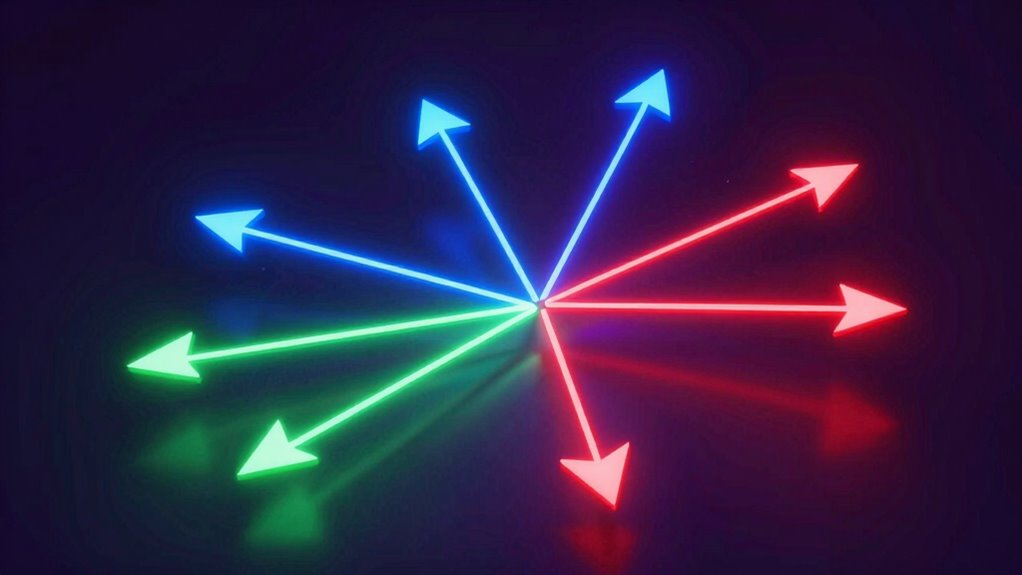
Vectors are more than just arrows because they represent quantities with both magnitude and direction, which are essential for describing physical properties like force, velocity, and position. They serve as fundamental building blocks in mathematics and science, allowing you to perform precise calculations in multiple dimensions. By understanding vectors beyond their visual form, you can better grasp complex concepts and applications. Keep exploring to discover how vectors connect geometry with algebra in powerful ways.

Prime made for students and young adults
- Fast, free delivery for dorm and study essentials
- Prime Video and Amazon Music included
- Member-only deals
Key Takeaways
- Vectors encode both magnitude and direction, representing physical quantities like force and velocity beyond simple arrows.
- They can be mathematically manipulated through operations like addition and scalar multiplication, enabling complex analysis.
- Vectors serve as foundational elements in advanced mathematics and scientific modeling, not just visual arrows.
- They connect geometric intuition with algebraic calculations, aiding in understanding motion, fields, and interactions.
- Vectors facilitate systematic problem-solving across physics, engineering, and mathematics, making them more than just visual representations.

Vectors are often visualized as arrows, but their true significance extends far beyond simple diagrams. In reality, vectors are fundamental objects in mathematics and physics, providing a way to describe quantities that have both magnitude and direction. When you hear about vector notation, it’s not just a fancy symbol; it’s a concise way to represent complex information about these quantities. The mathematical representation of vectors uses symbols like bold lowercase letters (e.g., v) or arrows over letters (e.g., (vec{v})), which helps distinguish them from scalar quantities. This notation isn’t just a stylistic choice—it streamlines calculations and clarifies relationships between different quantities in multi-dimensional spaces.
Vectors are powerful mathematical tools that encode both magnitude and direction, simplifying complex relationships in multi-dimensional spaces.
Understanding vector notation allows you to see how vectors function as building blocks of more advanced concepts. Instead of simply pointing from one place to another, vectors encode data about position, velocity, force, or other physical properties in a way that’s easy to manipulate mathematically. For example, when you write a vector as a combination of its components, such as (vec{v} = (v_x, v_y, v_z)), you’re giving a precise mathematical representation that makes calculations straightforward. This decomposition lets you perform operations like addition, subtraction, and scalar multiplication directly on the components, which is much more efficient than relying solely on visual intuition. Additionally, the algebraic rules** governing vector operations ensure consistency and reliability in calculations across different contexts. Recognizing the algebraic structure** of vectors further emphasizes their role as fundamental elements in mathematical systems.
The power of vectors lies in their ability to connect geometric intuition with algebraic precision. Through their mathematical representation, you can perform calculations that describe how quantities change, combine, or interact in space. This dual nature makes vectors invaluable across fields like engineering, computer graphics, and physics. Recognizing the role of vector notation helps you understand that vectors aren’t just static arrows but dynamic, algebraic entities that obey specific rules. These rules allow you to analyze motion, forces, and fields systematically, translating complex phenomena into manageable math. Understanding the algebraic structure of vectors further enhances your ability to apply them effectively in real-world scenarios.
Additionally, understanding the mathematical representation of vectors helps you see how they serve as the foundation for many advanced scientific and engineering concepts. Appreciating these vector operations deepens your grasp of how physical systems are modeled and analyzed mathematically. Mastering these fundamental principles enables you to approach complex problems with confidence and clarity. This understanding also provides insight into how vectors interact with other mathematical objects, enriching your overall comprehension of mathematical modeling.
In essence, viewing vectors as more than just arrows means appreciating their role as precise, versatile tools. Their mathematical representation provides clarity and efficiency, turning visual concepts into concrete calculations. By mastering vector notation, you unlock a powerful language that bridges geometry and algebra, giving you the ability to describe and analyze the world in a structured, meaningful way.
As an affiliate, we earn on qualifying purchases.
Frequently Asked Questions
How Do Vectors Apply in Computer Graphics Beyond Arrows?
In computer graphics, vectors go beyond arrows by enabling vector transformations, which help you manipulate images, shapes, and animations smoothly. They also play a vital role in color representation, allowing you to define colors precisely through RGB or other models. With vectors, you can scale, rotate, and transform objects efficiently, making your graphics more dynamic and realistic. This versatility helps you create complex visuals with accuracy and flexibility.
Can Vectors Represent Concepts Other Than Physical Quantities?
Yes, vectors can represent abstract concepts beyond physical quantities. You can use vectors to depict emotional states, like happiness or sadness, by assigning values to different emotions. In data analysis, vectors help visualize complex ideas such as preferences or attitudes. This allows you to work with intangible concepts in a mathematical way, making vectors powerful tools for capturing and analyzing both tangible and emotional or conceptual information effectively.
What Are Some Real-World Applications of Vectors in Engineering?
Vectors vividly validate various engineering ventures. You’ll use vector enhancement to maximize material efficiency and minimize costs, ensuring ideal outcomes. Force analysis comes into play when calculating structural stresses, aiding in designing durable bridges and buildings. Whether steering through navigation systems, analyzing aerodynamics, or controlling robotic movements, vectors serve as essential tools for precise problem-solving, empowering engineers to innovate and improve everyday structures and systems with clarity, control, and confidence.
How Do Vectors Differ From Scalar Quantities in Practical Use?
You notice that vectors differ from scalar quantities because they have both magnitude and direction. In practical use, you perform vector addition to combine forces or velocities, which isn’t possible with scalars. Scalar multiplication helps you scale a vector’s magnitude without changing its direction, useful in adjusting forces or velocities. Unlike scalars, vectors give you a complete picture of physical quantities, making them essential in real-world engineering and physics applications.
Are There Limitations to Using Vectors in Complex Systems?
You might find that vectors have limitations in complex systems, especially due to abstract limitations and theoretical challenges. For example, in high-dimensional data, vectors can become difficult to interpret or visualize, with some estimates suggesting that understanding multi-dimensional vectors is over 90% more challenging than simple ones. These challenges make it hard to apply vectors straightforwardly, requiring advanced mathematical tools and careful analysis to guarantee accurate results.
As an affiliate, we earn on qualifying purchases.
Conclusion
So, next time you see a simple arrow, remember—it’s more than just a point and a line. Vectors hold secrets, connections, and powers you’ve yet to reveal. There’s a depth waiting beneath the surface, a world of possibilities that could change how you see everything around you. Are you ready to explore further? Because what you discover might just turn your understanding of vectors—and the universe—upside down. The journey’s only just beginning.
As an affiliate, we earn on qualifying purchases.
As an affiliate, we earn on qualifying purchases.
Fall Picks
fall essentials
As an affiliate, we earn on qualifying purchases.