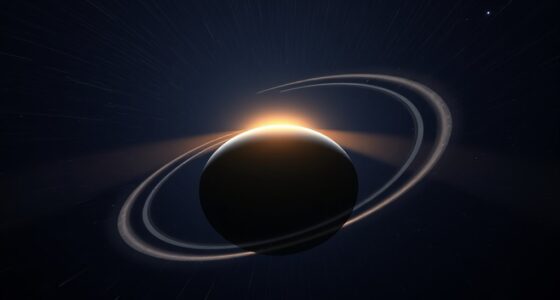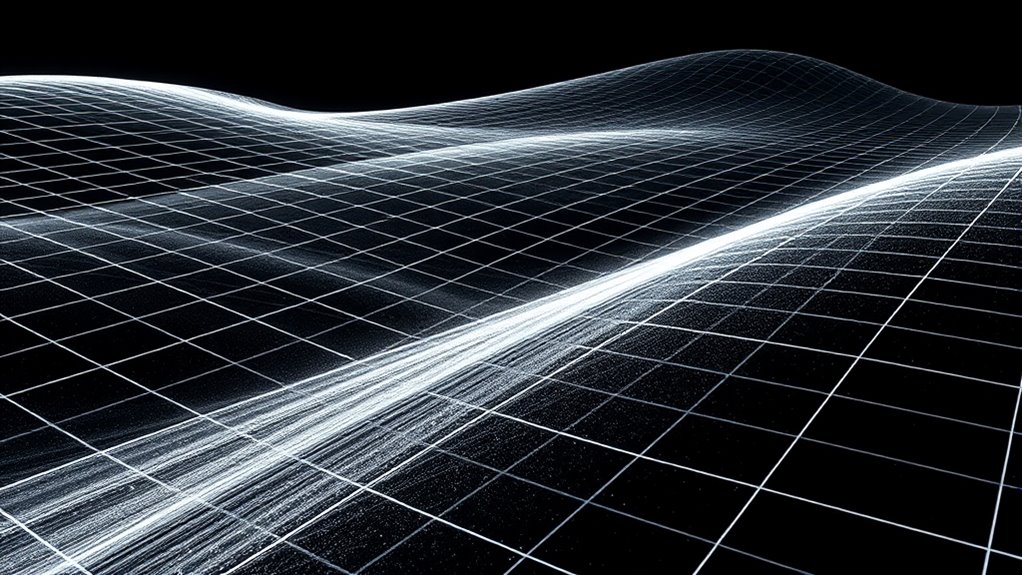

In general relativity, the geometry of spacetime explains gravity as its curvature caused by mass and energy. When a massive object distorts this fabric, it creates curved paths called geodesics, which objects follow naturally. Think of spacetime as a fabric that bends around heavy objects, guiding how objects move without forces. If you keep exploring, you’ll discover how this geometric approach helps us understand everything from planets to black holes more clearly.
Key Takeaways
- Gravity is described as the curvature of spacetime caused by mass and energy.
- The spacetime metric defines how distances and times are measured in this curved geometry.
- Objects move along geodesics, the shortest paths in curved spacetime, explaining gravitational attraction.
- Geodesic equations predict the trajectories of planets, light, and stars in a curved spacetime.
- The geometric approach simplifies gravity as the universe’s fabric shaping the motion of objects.
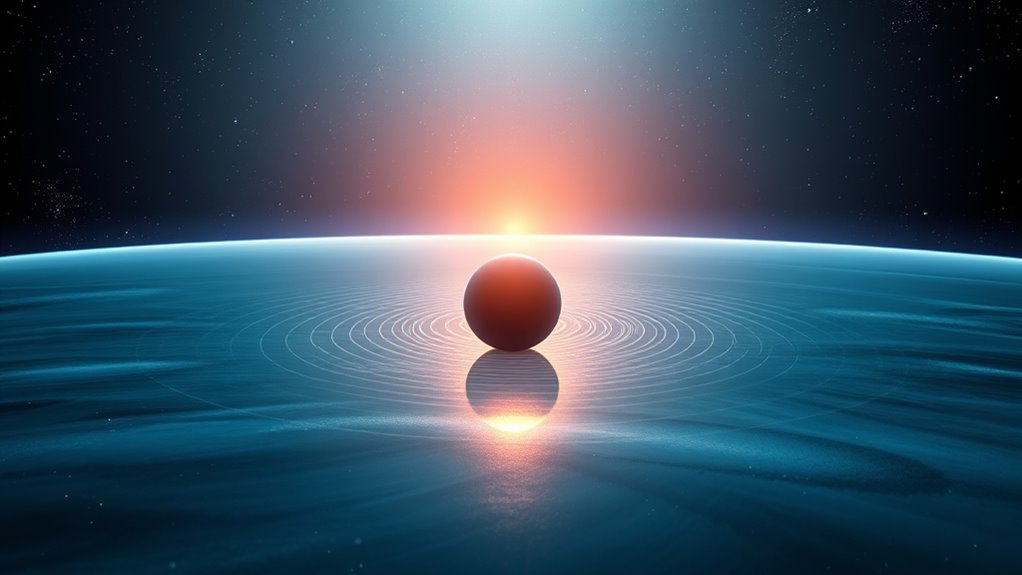
Have you ever wondered how gravity shapes the fabric of space and time? It’s a fascinating question that leads us into the core ideas of Einstein’s general relativity, where gravity isn’t just a force but a curvature of spacetime itself. In this universe, massive objects like stars and planets distort the smooth fabric of spacetime, creating curves that influence the paths objects travel. To understand this, you need to grasp how the geometry of spacetime is described mathematically, primarily through spacetime metrics. These metrics serve as the fundamental tools that tell you how distances and times are measured in a curved universe.
Gravity distorts spacetime, and metrics reveal how distances and times are measured in this curved universe.
When you look at the motion of objects under gravity, they follow what are called geodesics—paths that represent the shortest distance between two points in curved spacetime. Think of geodesic equations as the mathematical equations that describe these paths. They’re derived from the spacetime metric, which encodes how space and time are woven together in the presence of mass and energy. The geodesic equations tell you precisely how an object moves when no other forces act on it, fundamentally following the natural “straight lines” in a curved geometry. These equations are fundamental because they show that what we perceive as gravitational attraction is really just objects moving along these geodesics in a curved spacetime.
The spacetime metric itself is like the blueprint of the universe’s geometry. It contains all the information about how distances and durations are affected by gravity. In regions where mass is concentrated, the metric indicates a significant curvature, causing geodesics to bend. This bending of geodesics explains phenomena like the bending of light around massive objects, known as gravitational lensing, and the orbits of planets and stars. By solving the geodesic equations with specific spacetime metrics, you can predict how objects will move in any gravitational field, whether it’s the orbit of a planet or the path of a photon passing near a black hole.
Furthermore, understanding the spacetime curvature helps in visualizing how gravity operates in the universe, linking the geometric concept directly to observable effects. In fundamentally, the beauty of general relativity lies in describing gravity through the language of geometry. The spacetime metric shapes the universe’s structure, and geodesic equations tell you how objects traverse this structure. Together, they offer a precise, elegant way to understand the dynamic dance of matter, energy, and the very fabric of the cosmos itself. This geometric perspective simplifies what once seemed complex, revealing a universe where space, time, and gravity are seamlessly intertwined.

Relativity: The Special And The General Theory
As an affiliate, we earn on qualifying purchases.
As an affiliate, we earn on qualifying purchases.
Frequently Asked Questions
How Does Curved Spacetime Affect Time Perception?
You experience time dilation when you’re in a region with strong gravitational effects, like near a massive object. Curved spacetime causes time to pass more slowly for you compared to someone farther away from the gravity source. This means your perception of time changes based on your position in the gravitational field, making time seem to move differently depending on how close you are to the mass causing the spacetime curvature.
Can Curved Spacetime Be Visualized in Three Dimensions?
While capturing the true essence of curved spacetime is a delicate dance, visualization challenges and dimensional limitations make it tough to fully represent in three dimensions. You can create models or simulations to hint at its complex structure, but these are simplified versions. Think of it as a way to grasp the concept, knowing that the real fabric of spacetime bends beyond what our three-dimensional world can easily depict.
What Are Practical Applications of Understanding Curved Spacetime?
Understanding curved spacetime helps you improve satellite navigation systems, as it allows for precise adjustments accounting for gravitational effects. It also enables scientists to capture detailed black hole images, revealing how gravity warps light around these massive objects. By grasping these concepts, you can appreciate how Einstein’s theories directly influence technologies you use daily and advance our exploration of the universe’s most extreme phenomena.
How Does Gravity Influence Light in Curved Spacetime?
Imagine you’re in the 19th century, marveling at how light bends around massive objects. Gravity influences light in curved spacetime by causing light bending, which results in gravitational lensing. This effect makes distant stars and galaxies appear distorted or multiplied when viewed through a massive object like a black hole or galaxy cluster. You can see how gravity not only shapes space but also guides light’s path across the universe.
Are There Experimental Ways to Measure Spacetime Curvature Directly?
Yes, you can measure spacetime curvature directly through experiments like gravitational lensing and spacetime tomography. Gravitational lensing allows you to observe how light bends around massive objects, revealing curvature. Spacetime tomography maps the universe’s structure by analyzing signals from multiple sources. These methods help you visualize and quantify spacetime’s shape, providing direct evidence of curvature predicted by general relativity.
The Two Waves: Foundations of the Chord Model: A Unified Geometric Model of Curvature, Energy, and the Structure of the Universe
As an affiliate, we earn on qualifying purchases.
As an affiliate, we earn on qualifying purchases.
Conclusion
You might think that understanding curved spacetime is too complex, but it’s actually about visualizing how gravity shapes the universe around you. Once you see that mass and energy bend spacetime, it all clicks. Don’t let the math intimidate you—focus on the concept. With a little practice, you’ll realize that the geometry of general relativity isn’t just abstract; it’s the key to understanding how the universe truly works.

EUDAX DIY Physics Experiment Model Kit Electromagnetic Materials Electromagnet and Basic Electricity Discovery Circuit for School Lab Creative Educational Science Projects Teaching Equipment
- Easy-to-follow Instructions: Includes detailed battery installation guidance
- Educational Manual Included: Full-color manual explains electromagnet and circuits
- Ideal for Learning and Practice: Helps students understand electromagnetism and circuits
As an affiliate, we earn on qualifying purchases.
As an affiliate, we earn on qualifying purchases.

Numerical Simulation of Viscous Shocked Accretion Flows Around Black Holes (Springer Theses)
As an affiliate, we earn on qualifying purchases.
As an affiliate, we earn on qualifying purchases.